
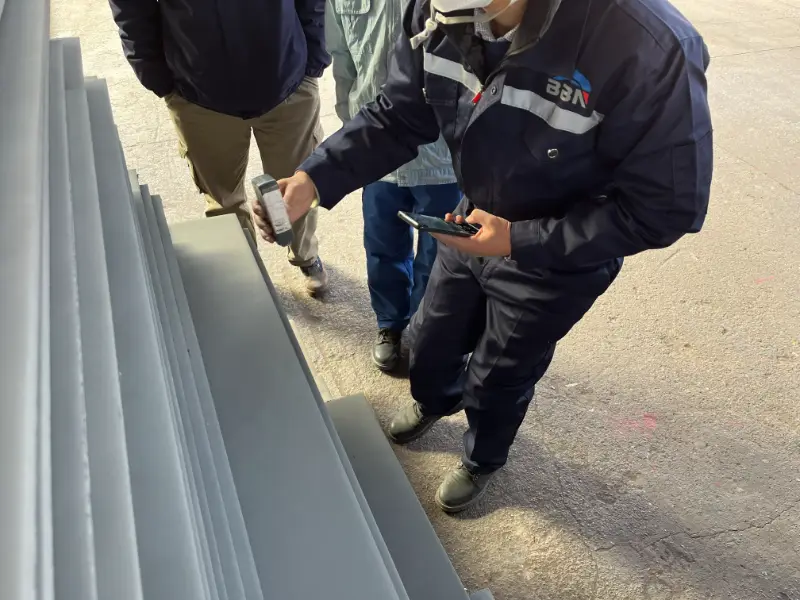
DIN 17102 WStE420 High-Strength Low-Alloy Structural Steel Plate
WStE420 High-Strength Low-Alloy Structural Steel Plate per DIN 17102
Explore the properties, chemical composition, mechanical and physical data of WStE420 carbon and low-alloy high-strength steel plate according to DIN 17102. Includes international equivalents and application guidance.
Hot rolling, normalizing, thermomechanical rolling, welding, cutting, cold forming (limited)
- Phone : +8618037372205
- Email : [email protected]
- WhatsApp: Contact via Whtsapp
- WeChat: +8618037372205
DIN 17102 WStE420 High-Strength Low-Alloy Structural Steel Plate Introduction
WStE420 is a weldable fine-grain structural steel grade defined in the historical German standard DIN 17102. It belongs to the category of carbon and low-alloy high-strength steels with a minimum yield strength of 420 MPa in the as-delivered condition. The 'W' prefix denotes suitability for welding, while 'StE' indicates a structural steel with elevated strength from fine-grain practice. This grade is typically supplied in a normalized or thermomechanically rolled condition and offers a good combination of high strength, toughness, and weldability. It is designed for use in heavily loaded welded structures such as bridges, cranes, offshore platforms, and pressure vessels, where service temperatures down to -20°C are required. Over time, DIN 17102 has been largely superseded by EN 10025-3 and EN 10025-4, but WStE420 remains recognized in legacy specifications and substitution lists.
DIN 17102 WStE420 High-Strength Low-Alloy Structural Steel Plate Chemical Composition
The chemical composition of WStE420 is carefully controlled to ensure a fine-grain microstructure, good weldability, and the specified mechanical properties. The values below are maximum limits unless a range is given, in accordance with DIN 17102 (typical data, since the standard is withdrawn but historically valid).
- Microalloying elements such as niobium, vanadium, and titanium are added for grain refinement and precipitation strengthening.
- Sufficient aluminum is required for full deoxidation and grain size control.
- Low sulfur and phosphorus contents improve toughness and weldability.
| Chemical Element | Standard Value (max or range) | Remarks |
|---|---|---|
| Carbon (C) | ≤ 0.20 | Key strength contributor; kept low for weldability |
| Silicon (Si) | ≤ 0.50 | Deoxidizer; in fully killed steels |
| Manganese (Mn) | 1.00 – 1.70 | Enhances strength and hardenability |
| Phosphorus (P) | ≤ 0.030 | Reduced for improved toughness |
| Sulfur (S) | ≤ 0.025 | Controlled for cleanliness and ductility |
| Aluminum (Al, total) | ≥ 0.020 | Grain refining element; indicates fully killed |
| Niobium (Nb) | ≤ 0.05 | Microalloy for grain refinement |
| Vanadium (V) | ≤ 0.10 | Precipitation strengthening |
| Titanium (Ti) | ≤ 0.05 | Grain refinement and nitrogen fixation |
| Chromium (Cr) | ≤ 0.25 | Residual element |
| Nickel (Ni) | ≤ 0.30 | Residual; improves notch toughness slightly |
| Molybdenum (Mo) | ≤ 0.10 | Residual element |
| Copper (Cu) | ≤ 0.35 | Atmospheric corrosion resistance; limited to avoid hot shortness |
| Nitrogen (N) | ≤ 0.015 | Bound by aluminum, Ti or other nitride formers |
DIN 17102 WStE420 High-Strength Low-Alloy Structural Steel Plate Thermal and Electrical Physical Properties
Physical properties are not fully specified in DIN 17102, but the typical values for low-alloy structural steels similar to WStE420 are provided below. These data are derived from standard reference tables for carbon-manganese steels with 420 MPa yield strength, and are suitable for engineering calculations. Variations may occur depending on exact composition and processing.
- The thermal expansion coefficient and thermal conductivity are temperature dependent; values at 20°C and at elevated temperatures are listed where available.
- Electrical resistivity is given for room temperature.
| Property | Standard Reference Value | Unit | Test Condition |
|---|---|---|---|
| Density (ρ) | 7.85 | g/cm³ | At 20°C |
| Modulus of Elasticity (E) | 210 | GPa | At 20°C, static |
| Shear Modulus (G) | 81 | GPa | At 20°C, calculated from E and Poisson's ratio |
| Poisson's Ratio (ν) | 0.3 | – | At 20°C, typical for steel |
| Thermal Expansion Coefficient (α) | 11.7 | 10⁻⁶/K | Between 20°C and 100°C |
| Thermal Expansion Coefficient (α) | 12.5 | 10⁻⁶/K | Between 20°C and 200°C |
| Thermal Expansion Coefficient (α) | 13.6 | 10⁻⁶/K | Between 20°C and 400°C |
| Thermal Conductivity (λ) | 51 | W/(m·K) | At 20°C |
| Thermal Conductivity (λ) | 47 | W/(m·K) | At 200°C |
| Thermal Conductivity (λ) | 40 | W/(m·K) | At 400°C |
| Specific Heat Capacity (c) | 460 | J/(kg·K) | At 20°C to 100°C |
| Specific Heat Capacity (c) | 500 | J/(kg·K) | At 200°C to 400°C |
| Electrical Resistivity (ρ_e) | 0.20 – 0.25 | μΩ·m | At 20°C, typical range for low-alloy steel |
DIN 17102 WStE420 High-Strength Low-Alloy Structural Steel Plate Mechanical Properties
The tensile and impact properties of WStE420 depend on the product thickness and heat treatment condition. The following data represent minimum requirements for normalized or thermomechanically rolled plates according to DIN 17102. Impact energy values are given for longitudinal Charpy V-notch specimens.
- Yield strength decreases as thickness increases.
- For thicknesses above 100 mm, properties should be agreed upon at the time of ordering.
- Impact test temperature is typically -20°C for the standard grade; lower temperatures may be specified for special applications.
| Property | Standard Requirement | Unit | Test Condition / Remarks |
|---|---|---|---|
| Yield Strength (ReH) | ≥ 420 | MPa | Thickness ≤ 16 mm |
| Yield Strength (ReH) | ≥ 400 | MPa | Thickness 16 < t ≤ 35 mm |
| Yield Strength (ReH) | ≥ 380 | MPa | Thickness 35 < t ≤ 50 mm |
| Yield Strength (ReH) | ≥ 360 | MPa | Thickness 50 < t ≤ 70 mm |
| Yield Strength (ReH) | ≥ 340 | MPa | Thickness 70 < t ≤ 100 mm |
| Tensile Strength (Rm) | 520 – 680 | MPa | Thickness ≤ 100 mm |
| Elongation after fracture (A5) | ≥ 18 | % | Gauge length L0 = 5.65√S0, longitudinal, thickness ≤ 100 mm |
| Charpy Impact Energy (KV) | ≥ 27 | J | At -20°C, longitudinal, thickness ≥ 10 mm |
| Charpy Impact Energy (KV) | ≥ 40 | J | At -20°C (optional increased requirement) |
| Bend test (mandrel diameter) | No cracks | – | Mandrel diameter = 3t (t = specimen thickness), bending angle 180° for plates ≤ 25 mm |
DIN 17102 WStE420 High-Strength Low-Alloy Structural Steel Plate Exact Equivalent Material Standards and Replaceable Grades
| Country/Region | Standard | Grade | Remarks |
|---|---|---|---|
| Europe | EN 10025-3 | S420N | Normalized weldable fine-grain structural steel, minimum yield 420 MPa; directly replaces WStE420 in many specifications. |
| Europe | EN 10025-4 | S420M | Thermomechanically rolled weldable fine-grain steel with identical minimum yield strength; used as a modern alternative. |
| Europe | EN 10025-3 | S420NL | Normalized steel with improved low-temperature toughness (down to -50°C); suitable for more demanding applications. |
| Germany | DIN 17102 (withdrawn) | WStE420 | The original grade, now superseded but still referenced. |
| USA | ASTM A572/A572M | Grade 60 [415] | High-strength low-alloy structural steel with minimum yield 415 MPa (60 ksi); near equivalent, slight difference in yield. |
| USA | ASTM A633/A633M | Grade E [415] | Normalized high-strength low-alloy structural steel, yield 415 MPa, good notch toughness; used in similar applications. |
| Japan | JIS G3106 | SM490A/B/C | Yields 325–365 MPa for SM490; not an exact match but often substituted after re-evaluation of design. |
| UK (historical) | BS 4360 | Grade 50 EE | Yield 355 MPa, but with modified chemistries; predecessor to EN grades. |
| International | ISO 4950-2 | E420 | High yield strength flat products; part of the ISO 4950 series, now superseded by ISO 630-3. |
DIN 17102 WStE420 High-Strength Low-Alloy Structural Steel Plate Application Introduction
WStE420 and its modern counterparts (S420N/M) are extensively employed in welded steel constructions that require a combination of high strength, good low-temperature toughness, and reliable weldability. The steel is typically used in static and dynamically loaded components. The following lists cover typical industries, products and components fabricated from this grade.
Product Applications: Welded plate girders for bridges, Penstocks and spiral cases for hydropower plants, Tubular columns for high-rise buildings, Offshore jacket and topside structures, Crane runway beams and box girders, Pressure vessel shells (operating up to moderate temperatures), Railway wagon frames and bogie components, Container handling spreaders, Foundation piles for wind turbines
Processed into products: Bridge main girders, cross beams, and stiffeners, Crane boom chords and lacing members, Ship hull stringers and stiffeners, Excavator boom and arm plates, Wind turbine tower flanges and door frames, Heavy-duty truss nodes and gusset plates, Rolled and welded beams for tall buildings, Base plates and rib-stiffened panels for heavy machinery, Mining truck bed liners and structural ribs
Application industries: Bridge construction (road, railway, pedestrian), Offshore engineering (platform structures, decks, jacket legs), Shipbuilding (hull structures, decks, superstructures under classification society approval), Crane and lifting equipment manufacturing (booms, lattice structures), Heavy machinery and earthmoving equipment (frames, booms, undercarriage), Pressure vessel and storage tank fabrication (subject to code allowances), Building and civil engineering (high-rise buildings, stadiums, exhibition halls), Wind energy (turbine tower sections, transition pieces), Mining equipment (dump truck bodies, excavator arms)
DIN 17102 WStE420 High-Strength Low-Alloy Structural Steel Plate Similar/Comparable Alternative Materials
| Country/Region | Standard | Grade | Remarks |
|---|---|---|---|
| Europe | EN 10025-2 | S355J2+N | Although yield strength is 355 MPa, S355J2+N is widely available and can be used when design loads permit a lower strength; good weldability and toughness at -20°C. |
| Europe | EN 10025-6 | S460N | Higher yield strength of 460 MPa, normalized; offers enhanced strength at similar thicknesses, but require higher preheat for welding. |
| Europe | EN 10025-3 | S460N | Normalized fine-grain steel, yield 460 MPa; may be considered when upgrading strength or reducing weight. |
| USA | ASTM A572/A572M | Grade 65 [450] | Yield 450 MPa; slightly stronger alternative often used in bridges and buildings. |
| USA | ASTM A514/A514M | Grade B | Quenched and tempered alloy steel plate with yield ≥ 690 MPa; far higher strength but limited weldability. |
| Japan | JIS G3106 | SM520B/C | Yield 365–385 MPa; higher strength than SM490, closer to 420 MPa grade when thickness effects are considered. |
| China | GB/T 1591 | Q420C/D/E | Low-alloy high-strength structural steel with minimum yield 420 MPa; normalizing rolling or TMCP, similar application range. |
Notes:
Historical Note: DIN 17102 has been withdrawn and superseded by the harmonized European standards EN 10025-3 and EN 10025-4. Users are strongly encouraged to specify S420N or S420M for new designs. When substituting WStE420 with an EN grade, the Charpy impact test temperature and energy requirements must be checked carefully. For thicknesses over 100 mm, mechanical properties should be specially agreed upon. Material certification according to EN 10204 Type 3.1 or 3.2 is typical. Consult the relevant material standard for full details on tolerances, testing conditions, and supplementary requirements.
- Share



