
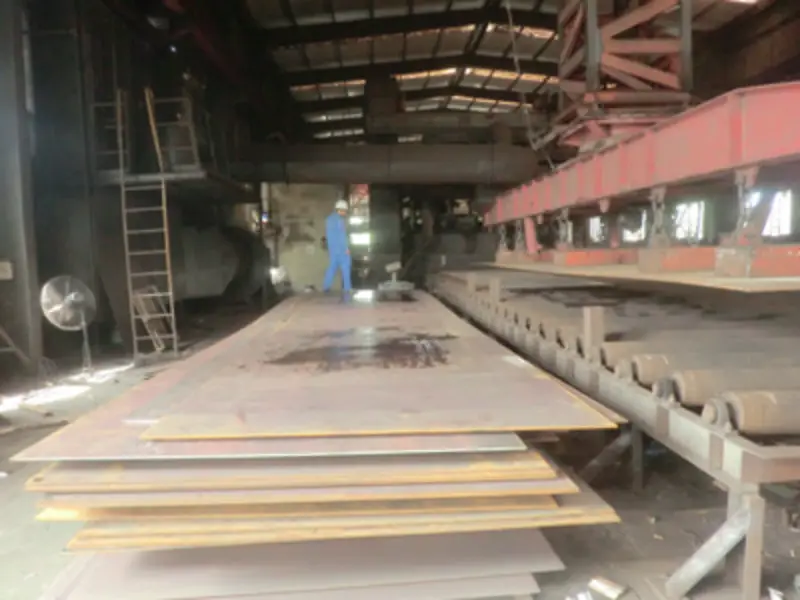
DIN 17102 StE420 High-Strength Normalized Structural Steel Plate
DIN 17102 StE420 High-Strength Normalized Structural Steel Plate
Complete material data for StE420 normalized fine-grain structural steel plate, including chemical composition, mechanical properties, physical properties, equivalent grades, and application guidance.
Welding, thermal cutting, cold forming, hot forming, machining
- Phone : +8618037372205
- Email : [email protected]
- WhatsApp: Contact via Whtsapp
- WeChat: +8618037372205
DIN 17102 StE420 High-Strength Normalized Structural Steel Plate Introduction
DIN 17102 StE420 is a weldable, normalized, fine-grain structural steel with a minimum yield strength of 420 MPa. It belongs to the family of low-alloy high-strength steels designed for heavy-duty welded structures. The steel combines high strength with good toughness, excellent weldability, and reliable through-thickness properties.
- Standard designation: StE420 according to DIN 17102 (withdrawn and replaced by EN 10025-3 S420N).
- Delivery condition: normalized (N), ensuring a uniform fine-grained microstructure.
- Key features: high yield strength, good ductility, adequate impact toughness at low temperatures (optional), and good fabrication properties.
- Typical applications: bridges, crane booms, pressure vessels, offshore structures, heavy machinery, and tall building frameworks.
This datasheet presents official chemistry limits, mechanical properties for various thicknesses, and physical constants relevant for engineering calculations. Equivalent international grades are provided for material substitution.
DIN 17102 StE420 High-Strength Normalized Structural Steel Plate Chemical Composition
The chemical composition of StE420 is carefully controlled to achieve the required mechanical properties after normalizing. Maximum limits for residuals and alloying additions ensure adequate weldability and toughness.
- Carbon equivalent is typically kept low to avoid hardening in the heat-affected zone.
- Grain-refining elements such as aluminium, niobium, vanadium, and titanium are added to maintain a fine austenitic grain size during normalizing.
- Sulphur and phosphorus are restricted for improved cleanliness and through-thickness ductility.
| Chemical Element | Standard Value (wt%) | Remarks |
|---|---|---|
| C | ≤0.22 | Ladle analysis |
| Si | ≤0.55 | |
| Mn | 1.00–1.70 | |
| P | ≤0.035 | |
| S | ≤0.035 | |
| Altot | ≥0.020 | Total aluminium, grain refinement |
| Nb | ≤0.07 | Optional grain-refining element |
| V | ≤0.20 | |
| Ti | ≤0.20 | |
| N | ≤0.025 | |
| Cr | ≤0.30 | |
| Ni | ≤0.30 | |
| Cu | ≤0.30 | |
| Mo | ≤0.10 |
DIN 17102 StE420 High-Strength Normalized Structural Steel Plate Thermal and Electrical Physical Properties
The physical properties provided are typical for normalized low-alloy structural steels at room temperature (20°C) unless otherwise noted. They are suitable for approximate engineering calculations.
- Values may vary slightly depending on exact chemical composition and heat treatment.
- Thermal conductivity and electrical resistivity decrease slightly with increasing temperature.
- The coefficient of thermal expansion is given for a temperature range from 20°C to the indicated endpoint.
| Property | Standard Required Value | Unit | Test Condition / Remarks |
|---|---|---|---|
| Density (ρ) | ≈ 7.85 | g/cm³ | 20°C |
| Elastic modulus (E) | ≈ 210 | GPa | 20°C; tensile loading |
| Shear modulus (G) | ≈ 81 | GPa | 20°C |
| Poisson's ratio (ν) | ≈ 0.30 | – | Elastic range |
| Coefficient of thermal expansion (α, 20–100°C) | ≈ 11.7 × 10⁻⁶ | K-1 | Mean linear expansion |
| Thermal conductivity (λ) | ≈ 50 | W/(m·K) | 20°C |
| Specific heat capacity (cp) | ≈ 460 | J/(kg·K) | 20°C |
| Electrical resistivity (ρe) | ≈ 0.22 × 10⁻⁶ | Ω·m | 20°C |
DIN 17102 StE420 High-Strength Normalized Structural Steel Plate Mechanical Properties
Mechanical properties are determined on test pieces taken in the transverse direction, unless longitudinal is specified. The tensile test piece follows a gauge length L0 = 5.65√S0. Impact toughness is normally agreed upon at the time of order; typical values for the -20°C testing temperature are shown.
- Yield strength decreases with increasing thickness, as shown in the table.
- Bend test is carried out with a 180° bend and a mandrel diameter related to plate thickness.
| Property | Standard Required Value | Unit | Test Condition / Remarks |
|---|---|---|---|
| Upper yield strength ReH (t ≤ 16 mm) | ≥ 420 | MPa | Transverse; normalized; thickness t |
| Tensile strength Rm (t ≤ 16 mm) | 520 – 680 | MPa | Transverse |
| Elongation A (t ≤ 16 mm) | ≥ 19 | % | L0 = 5.65√S0; transverse |
| Upper yield strength ReH (16 < t ≤ 40 mm) | ≥ 400 | MPa | Transverse |
| Tensile strength Rm (16 < t ≤ 40 mm) | 500 – 650 | MPa | Transverse |
| Elongation A (16 < t ≤ 40 mm) | ≥ 18 | % | L0 = 5.65√S0; transverse |
| Upper yield strength ReH (40 < t ≤ 63 mm) | ≥ 390 | MPa | Transverse |
| Tensile strength Rm (40 < t ≤ 63 mm) | 490 – 640 | MPa | Transverse |
| Elongation A (40 < t ≤ 63 mm) | ≥ 18 | % | L0 = 5.65√S0; transverse |
| Charpy impact energy KV (-20°C, longitudinal) | ≥ 27 | J | Longitudinal; average of 3 tests (optional, subject to agreement) |
| Bend test (t ≤ 16 mm) | 180°, mandrel diameter = 3t | – | No cracks; transverse specimen |
| Bend test (16 < t ≤ 63 mm) | 180°, mandrel diameter = 4t | – | No cracks; transverse specimen |
DIN 17102 StE420 High-Strength Normalized Structural Steel Plate Fully Equivalent Material Standards & Substitutable Grades
| Country/Region | Standard | Grade | Remarks |
|---|---|---|---|
| European Union | EN 10025-3:2004 | S420N | Direct replacement for StE420; normalized fine grain steel |
| Germany (previous) | DIN 17102:1984 | StE420 | Original standard, now withdrawn |
| United Kingdom | BS EN 10025-3 | S420N | Identical to EN grade |
| France | NF EN 10025-3 | S420N | Identical to EN grade |
| Italy | UNI EN 10025-3 | S420N | Identical to EN grade |
| International (previous) | ISO 4950-2 | E420 | Withdrawn; formerly equivalent |
DIN 17102 StE420 High-Strength Normalized Structural Steel Plate Application Introduction
StE420 / S420N is engineered for welded constructions requiring a combination of high strength, good toughness, and reliable fabrication behaviour. Typical applications span across civil engineering, heavy machinery, and offshore sectors. The normalized delivery condition ensures homogeneity and ease of welding with standard procedures.
- Welding: Preheating is generally not necessary for moderate thicknesses, but low-hydrogen welding consumables are recommended.
- Cold forming: Excellent formability in the normalized state; radius/thickness ratios follow common structural steel rules.
- Machinability: Good machinability with proper tools, comparable to other low-alloy structural steels.
Product Applications: Steel plates and sheets, Wide flats and strips, Heavy structural sections (when produced), Welded beams and columns, Prefabricated bridge components, Crane booms and lattice structures, Offshore platform nodes and decks
Processed into products: Bridge main girders and crossbeams, Crane base frames and tracks, Supporting structures for heavy rotating equipment, Welded joints in pressure vessel shells, Leg members of jack-up rigs, Structural parts of mining trucks, Reinforcement rings and flanges for towers
Application industries: Civil engineering and construction, Bridge building, Heavy machinery and mining equipment, Offshore and marine engineering, Pressure vessel and boiler construction (when code-approved), Wind energy (towers and foundations), Shipbuilding
DIN 17102 StE420 High-Strength Normalized Structural Steel Plate Similar / Closely Related Material Grades
| Country/Region | Standard | Grade | Remarks |
|---|---|---|---|
| European Union | EN 10025-4 | S420M | Thermomechanical rolled; similar strength, different delivery condition |
| China | GB/T 1591 | Q420 | High-strength low-alloy structural steel; comparable yield strength |
| Japan | JIS G 3106 | SM570 | Welding structural steel; yield ≥420 MPa for t ≤16 mm |
| USA | ASTM A572 | Grade 60 [415] | High-strength low-alloy columbium-vanadium steel; min yield 415 MPa (60 ksi), close match |
| USA | ASTM A913 | Grade 65 [450] | High-strength low-alloy steel; min yield 450 MPa, slightly higher strength |
Notes:
- DIN 17102 has been officially withdrawn and superseded by EN 10025-3. For new designs, order material according to EN 10025-3 S420N or equivalent.
- Impact toughness requirements must be explicitly specified at the time of order (e.g., for -20°C, -40°C, or -50°C testing). The table shows a typical option; other toughness classes exist.
- Through-thickness properties (Z-quality) may be agreed upon for plates used in highly restrained welded connections; refer to EN 10164 or earlier German standards.
- Weathering grades (e.g., WStE420) were also available under DIN 17102; for weathering applications, consider S420W according to EN 10025-5.
- Actual chemical composition and mechanical test certificates are to be provided by the manufacturer according to the relevant delivery condition.
- Share



