
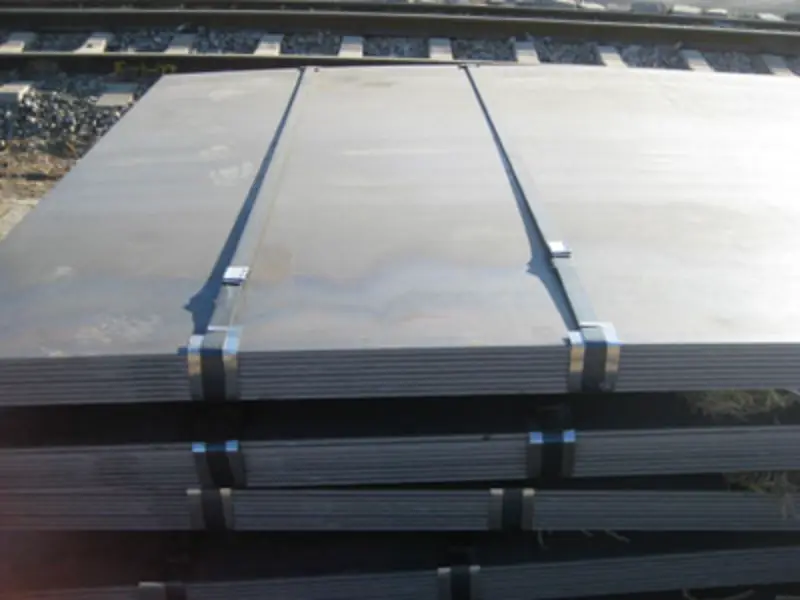
DIN 17102 EStE380 High-Strength Structural Steel Plate
DIN 17102 EStE380 High-Strength Structural Steel Plate - Composition, Properties & Equivalents
Complete material data for DIN 17102 EStE380 carbon and low-alloy high-strength steel plate: chemical composition, mechanical and thermal properties, equivalent grades, and application guide.
Hot rolling followed by normalizing; suitable for welding, bending, cutting, and machining under proper conditions.
- Phone : +8618037372205
- Email : [email protected]
- WhatsApp: Contact via Whtsapp
- WeChat: +8618037372205
DIN 17102 EStE380 High-Strength Structural Steel Plate Introduction
DIN 17102 EStE380 (commonly referred to as StE380) is a weldable fine-grain structural steel supplied in the normalized condition. It belongs to the family of low-carbon, low-alloy high-strength steels specified in the withdrawn German standard DIN 17102, which covered normalized plates, wide flats, sections and bars.
- Minimum yield strength of 380 MPa for thicknesses up to 16 mm, combined with good toughness at low temperatures.
- Fine-grain practice (aluminum-killed or microalloyed with Nb, V, Ti) ensures uniform mechanical properties and excellent weldability.
- Typical applications include heavy welded structures such as bridges, cranes, offshore platforms, pressure vessels and building frames.
- The material is no longer produced under this standard; modern equivalents are found in EN 10025‑3 and EN 10025‑4, though no exact strength-match grade exists.
- Available in various delivery conditions, always normalized (N) to guarantee minimum impact values.
DIN 17102 EStE380 High-Strength Structural Steel Plate Chemical Composition
Ladle analysis according to DIN 17102 for StE380. All values are maximum unless a range or minimum is indicated. The fine-grain treatment requires a minimum aluminum content or sufficient amounts of other grain-refining elements (Nb, V, Ti). The carbon equivalent (CEV) is typically limited to ensure weldability.
| Chemical Element | Standard Value | Remarks |
|---|---|---|
| C | ≤ 0.20 | |
| Si | ≤ 0.50 | |
| Mn | 0.90 – 1.65 | |
| P | ≤ 0.035 | |
| S | ≤ 0.030 | |
| Al (total) | ≥ 0.020 | Minimum for fine-grain practice |
| N | ≤ 0.015 | When nitrogen-binding elements are present |
| Cr | ≤ 0.30 | Residual element |
| Ni | ≤ 0.80 | |
| Mo | ≤ 0.10 | |
| Cu | ≤ 0.50 | |
| Nb | ≤ 0.05 | Microalloying element |
| V | ≤ 0.10 | Microalloying element |
| Ti | ≤ 0.05 | Microalloying element |
| CEV | ≤ 0.45* | Depending on thickness, acc. to standard formula |
DIN 17102 EStE380 High-Strength Structural Steel Plate Thermal & Electrical Physical Properties
Typical ambient-temperature values for low‑alloy structural steel of comparable chemistry and density. Exact figures may vary with actual composition and processing, but these are reliable for engineering calculations.
| Property | Standard Value | Unit | Test Condition |
|---|---|---|---|
| Density (ρ) | 7850 | kg/m³ | At 20°C |
| Elastic modulus (E) | 210 | GPa | At 20°C |
| Shear modulus (G) | 81 | GPa | At 20°C |
| Poisson's ratio (ν) | 0.3 | – | At 20°C |
| Thermal expansion coefficient (α) | 12.0 × 10⁻⁶ (20‑100°C) 12.5 × 10⁻⁶ (20‑200°C) 13.0 × 10⁻⁶ (20‑300°C) | K⁻¹ | Mean linear coefficient |
| Thermal conductivity (λ) | 48 (at 20°C) 45 (at 100°C) 40 (at 200°C) | W/(m·K) | |
| Specific heat capacity (cp) | 460 | J/(kg·K) | At 20°C |
| Electrical resistivity (ρe) | 0.23 × 10⁻⁶ | Ω·m | At 20°C |
DIN 17102 EStE380 High-Strength Structural Steel Plate Mechanical Properties
Test results obtained on normalized specimens taken in the transverse direction (unless otherwise noted). Values comply with DIN 17102. Yield strength and tensile strength depend on product thickness. Impact energy is guaranteed at specified test temperatures for quality classes J0/J2/K2 (here typical J0 values at ‑20°C).
| Property | Standard Requirement | Unit | Test Condition |
|---|---|---|---|
| Upper yield strength (ReH) | ≥ 380 (t ≤ 16 mm) ≥ 360 (16 < t ≤ 40 mm) ≥ 340 (40 < t ≤ 63 mm) | MPa | Transverse specimens |
| Tensile strength (Rm) | 530 – 680 (t ≤ 40 mm) 500 – 650 (40 < t ≤ 63 mm) | MPa | Transverse |
| Elongation after fracture (A) | ≥ 20 (t ≤ 40 mm, L0 = 5.65√S0) ≥ 18 (40 < t ≤ 63 mm) | % | Longitudinal, gauge length 5.65√S0 |
| Bending test | Bend angle 180°, mandrel diameter = 3 × t (t ≤ 40 mm) | – | No cracks, transverse specimens |
| Impact energy (KV) | ≥ 27 J at -20°C (quality J0) ≥ 27 J at -50°C (quality J2) | J | Charpy-V, transverse test pieces, 10×10 mm |
DIN 17102 EStE380 High-Strength Structural Steel Plate Completely Matching Material Standards & Substitute Grades
| Country/Region | Standard | Grade | Remarks |
|---|---|---|---|
| Europe | EN 10025-3:2004 | S355N | Closest modern grade but with lower minimum yield (355 MPa). Often used as a replacement with thickness compensation. |
| Europe | EN 10025-3:2004 | S420N | Higher strength grade (420 MPa) that can replace EStE380 in new designs. |
| United Kingdom | BS 4360:1990 (withdrawn) | 50EE | Obsolete British structural steel with comparable strength and impact properties. |
| USA | ASTM A572/A572M | Grade 60 [415] | Higher yield but similar weldability; widely used for structural applications. |
DIN 17102 EStE380 High-Strength Structural Steel Plate Application Introduction
EStE380 (StE380) is engineered for heavy-loaded, welded structures where reliable toughness and strength are required. The normalized delivery condition guarantees uniform properties through thickness, making it suitable for critical components in civil engineering, shipbuilding and heavy machinery.
- Industries: Bridge construction, building frames, offshore engineering, crane manufacturing, pressure vessel fabrication, shipbuilding, wind energy towers, mining equipment.
- Products: Structural steel plates for box girders, columns, heavy beams, piling sections; formed heads and shells for vessels; boom segments for mobile cranes; welded tubular structures.
- Components: Main girders of road and railway bridges, column base plates, crane outriggers, leg structures of jack‑up rigs, spreader bars, pressure vessel cylindrical courses, and fatigue‑critical nodes in offshore steel.
Product Applications: Box girder bridge sections, Heavy column and beam assemblies, Crane booms and outriggers, Jack-up rig leg chords, Pressure vessel shells and heads, Tubular trusses for offshore structures
Processed into products: Main girder plates and stiffeners, Column base plates and splice plates, Crane jib and luffing frame elements, Node cans for offshore jacket structures, Thick-walled cylindrical pressure parts, Spreader bars and lifting beams, Welded I‑sections and box sections
Application industries: Bridge construction, Heavy building frameworks, Offshore platforms, Crane manufacturing, Shipbuilding, Pressure vessels, Wind energy towers, Mining equipment
DIN 17102 EStE380 High-Strength Structural Steel Plate Comparable / Similar Substitute Materials
| Country/Region | Standard | Grade | Remarks |
|---|---|---|---|
| Germany | DIN 17102 (withdrawn) | StE355 | Lower yield (355 MPa) but otherwise identical; may replace StE380 in less demanding applications. |
| Europe | EN 10025-2:2004 | S355J2+N | Non-fine-grain structural steel; slightly lower yield but widely available. |
| Japan | JIS G 3106 | SM490A | Weldable structural steel with lower yield (325 MPa) and good toughness. |
| China | GB/T 1591-2018 | Q390D | High-strength low-alloy steel with similar strength level and fine-grain practice. |
| International | ISO 630-2 | S385N (obsolete) | ISO fine-grain structural steel with 385 MPa minimum yield, not widely adopted. |
Notes:
- The material is no longer procured to DIN 17102; equivalent properties can be achieved by ordering normalized S420N or S355N with supplementary requirements (e.g., −20°C impact test, restricted chemistry).
- For welding, a carbon equivalent of ≈ 0.40‑0.45 usually requires low‑hydrogen processes and preheat for thick sections (>30 mm). Typical preheat temperature is 100‑150°C.
- When bending or cold forming, a minimum bending radius of 3× thickness is recommended in the as‑normalized condition.
- The steel can be satisfactorily hot‑dip galvanized; however, owing to its silicon content, coating thickness and adhesion should be checked against galvanizer guidelines.
- Share



