
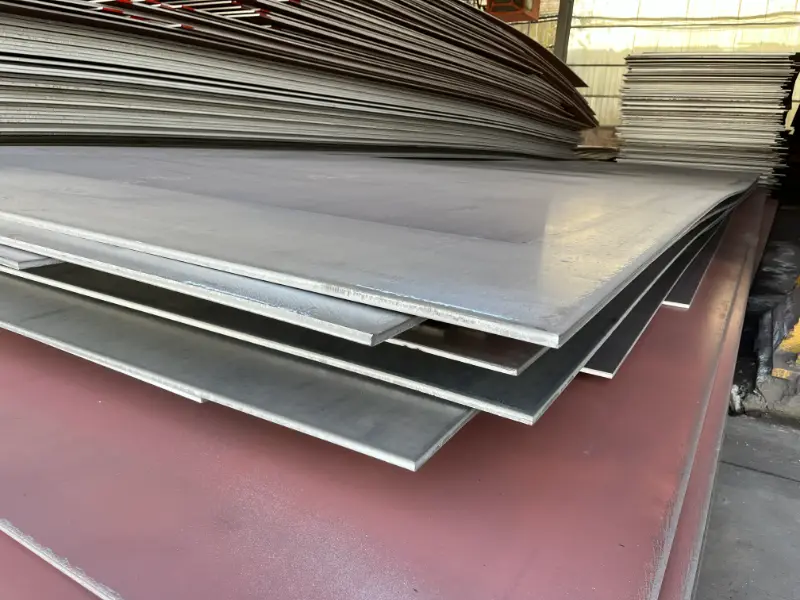
DIN 17102 TStE420 High-Strength Fine-Grain Steel Plate
DIN 17102 TStE420 High-Strength Fine-Grain Steel Plate - Technical Data and Equivalents
Comprehensive material data for TStE420 steel plate according to DIN 17102, including chemical composition, mechanical and thermal properties, international equivalents, and application recommendations for structural engineering.
Welding, bending, cold forming, machining (with proper tooling), hot forming (limited)
- Phone : +8618037372205
- Email : [email protected]
- WhatsApp: Contact via Whtsapp
- WeChat: +8618037372205
DIN 17102 TStE420 High-Strength Fine-Grain Steel Plate Introduction
TStE420 is a weldable, normalized fine‑grain structural steel defined in DIN 17102 (withdrawn, succeeded by EN 10113‑2/EN 10025‑4). This thermomechanically rolled grade offers a minimum yield strength of 420 MPa in the as‑delivered condition. Its fine‑grain microstructure, ensured by a minimum aluminium content and optional microalloying elements (Nb, V, Ti), provides high strength combined with excellent toughness and weldability.
- Excellent strength‑to‑weight ratio
- Good low‑temperature toughness (impact energy ≥27 J at –20 °C)
- Superior formability relative to quenched and tempered steels
- Suitable for welded structures without post‑weld heat treatment
Typical delivery condition is normalized or thermomechanically rolled.
DIN 17102 TStE420 High-Strength Fine-Grain Steel Plate Chemical Composition
Ladle analysis limits according to DIN 17102 for TStE420. Values depend on product thickness (t in mm). Aluminium content ensures fine‑grain practice. Microalloying elements (Nb, V, Ti) may be added singly or in combination for strength and toughness.
| Element | Specified Value (max unless range) | Remarks |
|---|---|---|
| Carbon (C) | t ≤16: ≤0.14% ; 16 < t ≤40: ≤0.14% ; 40 < t ≤63: ≤0.16% | Decreases with thickness for weldability |
| Silicon (Si) | ≤0.50% | Deoxidation |
| Manganese (Mn) | 1.00 – 1.70% | Strength and hardenability |
| Phosphorus (P) | ≤0.030% | Strictly controlled |
| Sulfur (S) | ≤0.025% | Strictly controlled |
| Aluminium (Altotal) | ≥0.020% | Fine‑grain requirement |
| Niobium (Nb) | ≤0.05% | Optional microalloy |
| Vanadium (V) | ≤0.10% | Optional microalloy |
| Titanium (Ti) | ≤0.05% | Optional microalloy |
| Chromium (Cr) | ≤0.30% | Residual element |
| Nickel (Ni) | ≤0.30% | Residual element |
| Molybdenum (Mo) | ≤0.10% | Residual element |
| Copper (Cu) | ≤0.20% | Residual element |
| Nitrogen (N) | ≤0.012% | Bound by Al/Ti |
DIN 17102 TStE420 High-Strength Fine-Grain Steel Plate Thermal and Electrical Physical Properties
Nominal values for TStE420 grade at ambient temperature unless noted. These are typical for low‑alloy fine‑grain steel and are not mandatory specification requirements. Variation of ±5% is possible depending on exact composition and heat treatment.
| Property | Typical Value | Unit | Test Condition |
|---|---|---|---|
| Density (ρ) | 7850 | kg/m³ | 20 °C |
| Elastic modulus (E) | 210 | GPa | 20 °C, tensile |
| Shear modulus (G) | 81 | GPa | Calculated from E and ν |
| Poisson's ratio (ν) | 0.30 | – | Elastic region |
| Thermal expansion coefficient (α) | 12.0 | 10⁻⁶ K⁻¹ | 20 – 100 °C |
| Thermal expansion coefficient (α) | 13.0 | 10⁻⁶ K⁻¹ | 20 – 200 °C |
| Thermal expansion coefficient (α) | 14.0 | 10⁻⁶ K⁻¹ | 20 – 400 °C |
| Thermal conductivity (λ) | 48 | W/(m·K) | 20 °C |
| Thermal conductivity (λ) | 46 | W/(m·K) | 100 °C |
| Specific heat capacity (c) | 460 | J/(kg·K) | 20 – 100 °C |
| Electrical resistivity (ρ_e) | 0.25 | µΩ·m | 20 °C |
DIN 17102 TStE420 High-Strength Fine-Grain Steel Plate Mechanical Properties
Minimum values for transverse test specimens (normalized/thermomechanically rolled condition) at room temperature unless stated otherwise. Thickness 't' in mm.
- Yield strength and tensile strength apply to transverse direction.
- Charpy V‑notch impact energy at –20 °C (longitudinal).
- Bend test with mandrel diameter × thickness.
| Property | Specified Value | Unit | Test Condition |
|---|---|---|---|
| Yield strength (ReH) | ≥420 | MPa | t ≤16 mm |
| Yield strength (ReH) | ≥400 | MPa | 16 < t ≤40 mm |
| Yield strength (ReH) | ≥380 | MPa | 40 < t ≤63 mm |
| Yield strength (ReH) | ≥360 | MPa | 63 < t ≤80 mm |
| Yield strength (ReH) | ≥340 | MPa | 80 < t ≤100 mm |
| Yield strength (ReH) | ≥330 | MPa | 100 < t ≤120 mm |
| Tensile strength (Rm) | 520 – 680 | MPa | t ≤40 mm |
| Tensile strength (Rm) | 500 – 660 | MPa | 40 < t ≤63 mm |
| Tensile strength (Rm) | 480 – 640 | MPa | 63 < t ≤80 mm |
| Tensile strength (Rm) | 470 – 630 | MPa | 80 < t ≤100 mm |
| Tensile strength (Rm) | 460 – 620 | MPa | 100 < t ≤120 mm |
| Elongation after fracture (A) | ≥19 | % | t ≤40 mm (gauge length 5.65√S₀) |
| Elongation after fracture (A) | ≥18 | % | 40 < t ≤63 mm |
| Elongation after fracture (A) | ≥18 | % | 63 < t ≤80 mm |
| Elongation after fracture (A) | ≥17 | % | 80 < t ≤100 mm |
| Elongation after fracture (A) | ≥17 | % | 100 < t ≤120 mm |
| Charpy impact energy (KV₂) | ≥27 | J | At –20 °C, longitudinal, full‑size specimen, t ≥10 mm |
| Bend test (mandrel diameter) | 3t | – | t ≤16 mm, 180° bend, crack‑free |
| Bend test (mandrel diameter) | 4t | – | 16 < t ≤40 mm, 180° bend, crack‑free |
| Bend test (mandrel diameter) | 5t | – | 40 < t ≤63 mm, 180° bend, crack‑free |
DIN 17102 TStE420 High-Strength Fine-Grain Steel Plate Fully Equivalent Material Standards and Replaceable Designations
| Country / Region | Standard | Designation | Remarks |
|---|---|---|---|
| Europe | EN 10113-2:1993 | S420M | Withdrawn, identical concept |
| Europe | EN 10025-4:2004 | S420M | Current EN standard for thermomechanically rolled fine‑grain steels |
| International | ISO 4950‑2:1995 | Fe 420 M | High‑yield‑strength flat products |
| China | GB/T 1591-2008 | Q420D (TMCP delivery) | Similar mechanical properties, but verify‑chemical match |
| Japan | JIS G 3106 | SM490A/B/C | Only approximate; SM490 yield is 325‑365 MPa, not direct substitute |
| USA | ASTM A572 / A633 | Grade 60 / Grade E | ASTM A572‑60 has min yield 415 MPa; A633‑E is normalised with min yield 415 MPa, close performance |
DIN 17102 TStE420 High-Strength Fine-Grain Steel Plate Application Introduction
TStE420 is widely employed in welded heavy‑duty structures where high‑strength, low‑temperature toughness, and good weldability are essential. Its thermomechanical rolling enables reduced carbon equivalent, improving field‑welding performance.
- Preferred for dynamically loaded structures.
- Compatible with all common arc welding processes using low‑hydrogen consumables.
- No pre‑ or post‑weld heat treatment normally required for thicknesses up to 50 mm when proper procedures are followed.
Product Applications: Welded bridge girders and box sections, Prestressed concrete bridge reinforcement plates, Wind turbine tower shells (thick‑gauge segment), Heavy‑duty crane booms and chassis, Penstock liners for hydropower plants, Offshore module frames and flare booms, Mining dump truck bodies (structural parts)
Processed into products: Flanges and webs of welded I‑beams, Box‑shaped columns for high‑rise buildings, Reinforcement ribs and diaphragms in bridges, Welded pipe fittings (when cold‑formed), Base plates and anchor plates for heavy equipment, Load‑bearing plates in hydraulic press frames
Application industries: Civil and structural engineering, Bridge construction, Pressure vessel and storage tank fabrication, Offshore oil & gas platforms, Shipbuilding (limited application), Heavy machinery and crane manufacturing, Hydraulic steel structures (penstocks, gates)
DIN 17102 TStE420 High-Strength Fine-Grain Steel Plate Similar / Approaching Substitute Materials Recommendation
| Country / Region | Standard | Designation | Remarks |
|---|---|---|---|
| Europe | EN 10025‑3:2004 | S420N | Normalized fine‑grain steel, slightly lower toughness specification |
| Europe | EN 10149‑2:2013 | S420MC | Thermomechanically‑rolled cold‑forming steel, suited for thinner gauges |
| Russia | GOST 19281‑89 | 15G2AFDps | High‑strength low‑alloy, may require adjustment of welding procedures |
| USA | ASTM A572 | Grade 65 | Higher strength (450 MPa), lower toughness expectations; evaluate Charpy requirements |
Notes:
The grade TStE420 is the former designation; today's direct successor is S420M according to EN 10025‑4. When substituting, the latest standard's supplementary requirements (e.g., improved toughness classes ML or ML1) should be considered. For critical applications, verify the exact thickness‑dependent properties and the applicable pre‑welding procedures. Plates with thickness >120 mm are not covered by the original DIN 17102 range and may require special agreement.
- Share



