
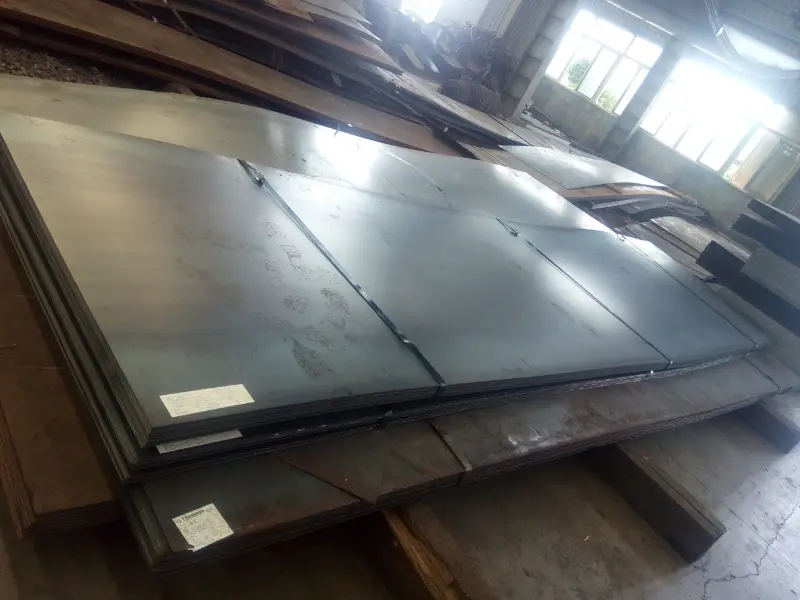
Q550F High-Strength Quenched and Tempered Steel Plate per GB/T 16270
Q550F High-Strength Quenched and Tempered Steel Plate per GB/T 16270 - Reliable -60°C Toughness
Detailed datasheet for Q550F carbon and low-alloy high-strength structural steel plate conforming to GB/T 16270. Covers chemical composition, mechanical & thermal properties, international equivalents, and industrial applications.
Welding, machining, cutting, moderate hot forming (with control), cold forming
- Phone : +8618037372205
- Email : [email protected]
- WhatsApp: Contact via Whtsapp
- WeChat: +8618037372205
Q550F High-Strength Quenched and Tempered Steel Plate per GB/T 16270 Introduction
Q550F is a quenched and tempered high-strength structural steel plate defined in GB/T 16270. It belongs to the carbon and low-alloy steel family, delivering minimum yield strength of 550 MPa and excellent toughness at temperatures as low as -60°C. The material combines high strength, good weldability, and reliable low-temperature impact resistance, making it ideal for heavy-load structures in harsh environments.
- Ultra-fine grain design with micro-alloying elements (Nb, V, Ti, B) ensures a fine microstructure after quenching and tempering.
- Strict control of phosphorus and sulfur guarantees high cleanness and ductility.
- Available in plate form with thicknesses typically up to 100 mm; suitable for welding, cutting, and moderate hot forming.
- Fulfills severe service requirements in construction machinery, bridge engineering, offshore structures, and mining equipment sectors.
Q550F High-Strength Quenched and Tempered Steel Plate per GB/T 16270 Chemical Composition
Elements are controlled to achieve the required strength, toughness, and weldability. Grain refining elements such as Nb, V, Ti, or Alt (≥0.015%) are mandatory. Maximum limits apply unless noted otherwise.
| Element | Content (wt%) | Remarks |
|---|---|---|
| C | ≤ 0.18 | Lower carbon improves weldability |
| Si | ≤ 0.50 | Deoxidizer, contributes to strength |
| Mn | ≤ 1.70 | Enhances hardenability and strength |
| P | ≤ 0.020 | Stringent low temperature toughness requirement |
| S | ≤ 0.010 | Minimum to avoid hot shortness |
| Cr | ≤ 0.80 | Optional element for hardenability |
| Ni | ≤ 0.80 | Optional, improves toughness |
| Mo | ≤ 0.30 | Optional, increases hardenability |
| Cu | ≤ 0.50 | Residual element |
| Nb | ≤ 0.06 | Micro-alloying grain refiner |
| V | ≤ 0.08 | Micro-alloying precipitation strengthening |
| Ti | ≤ 0.03 | Refines grain and fixes nitrogen |
| B | ≤ 0.004 | Optional hardenability enhancer |
| Alt | ≥ 0.015 (if used) | Aluminium total as grain refiner alternative |
Q550F High-Strength Quenched and Tempered Steel Plate per GB/T 16270 Thermal and Electrical Physical Properties
These values are indicative for Q550F grade at room temperature unless otherwise stated. Physical properties are not part of mandatory certification but are useful for design calculations.
| Property | Typical Value | Unit | Test Condition |
|---|---|---|---|
| Density (ρ) | 7.85 | g/cm³ | Room temperature |
| Modulus of Elasticity (E) | 200 – 205 | GPa | Room temperature, static |
| Shear Modulus (G) | ~ 80 | GPa | Calculated from E and ν |
| Poisson's Ratio (ν) | 0.28 – 0.30 | — | Elastic range |
| Thermal Expansion Coef. (α) | 11.5 – 12.5 ×10⁻⁶ | /K | 20°C to 100°C |
| Thermal Conductivity (λ) | 42 – 48 | W/(m·K) | At 100°C |
| Specific Heat Capacity (c) | 460 – 480 | J/(kg·K) | Room temperature |
| Electrical Resistivity (ρ_e) | 0.22 – 0.25 | µΩ·m | At 20°C |
Q550F High-Strength Quenched and Tempered Steel Plate per GB/T 16270 Mechanical Properties
Properties are verified on test pieces taken from the quenched and tempered condition. Impact energy is measured on Charpy-V longitudinal specimens at -60°C. Bending test uses a mandrel diameter of 3 times plate thickness (d=3a) through 180°.
| Property | Specified Value | Unit | Test Condition |
|---|---|---|---|
| Yield Strength (ReH) | ≥ 550 | MPa | Plate thickness ≤ 50 mm |
| Yield Strength (ReH) | ≥ 530 | MPa | Thickness > 50 mm to 100 mm |
| Tensile Strength (Rm) | 640 – 820 | MPa | All thicknesses |
| Elongation (A) | ≥ 16 | % | Gauge length 5.65√S₀, thickness ≤ 50 mm |
| Elongation (A) | ≥ 15 | % | Thickness > 50 mm to 100 mm |
| Impact Energy (KV₂), -60°C, longitudinal | ≥ 27 | J | Average of three specimens; one individual min 70% of average |
| Bend Test (180°) | No cracks | — | d = 3a (mandrel diameter = 3× thickness), all thicknesses |
Q550F High-Strength Quenched and Tempered Steel Plate per GB/T 16270 Exact Equivalent Standards & Substitutable Grades
| Country/Region | Standard | Grade | Remarks |
|---|---|---|---|
| China | GB/T 16270 | Q550F | Base specification, quenched and tempered, -60°C impact |
| Europe | EN 10025-6 | S550QL1 | Same strength class, QL1 suffix guarantees KV₂ ≥ 27 J at -60°C, directly interchangeable |
Q550F High-Strength Quenched and Tempered Steel Plate per GB/T 16270 Application Introduction
Q550F is designed for heavy structural parts demanding high strength and excellent low-temperature toughness. Its combination of weldability and resistance to brittle fracture makes it a first choice for heavy mobile equipment, offshore structures, and bridges in cold climates.
- Low carbon equivalent (typically ≤ 0.45) facilitates shop and field welding with appropriate preheat.
- Uniform through-thickness properties can be achieved with normal mill processing and optional Z-direction testing.
- When forming, avoid sharp radius bends at low temperatures; hot forming should be followed by re-normalizing or re-quenching and tempering depending on severity.
Product Applications: Crane booms and lattice sections, Excavator arms and undercarriage components, Bridge main girders and arch ribs, Offshore module support beams and legs, Mine dump truck frames and dipper handles, High-pressure gas cylinders and accumulator shells
Processed into products: Welded built-up box sections (e.g., crane jib chords), Heavy plate flanges and stiffeners, Stress-concentrated nodes and gusset plates, Welded ring flanges for wind towers, Machined pin plates and lug connections, Structures requiring guaranteed Charpy at -60°C
Application industries: Heavy construction machinery (cranes, excavators, bulldozers), Bridge construction (box girders, truss chords), Offshore and marine engineering (jack-up rigs, platform structures), Mining and mineral processing (truck bodies, crusher frames), Pressure vessels and storage tanks (low temperature service), Renewable energy (wind turbine towers, foundations in arctic conditions)
Q550F High-Strength Quenched and Tempered Steel Plate per GB/T 16270 Near / Alternative Material Recommendations
| Country/Region | Standard | Grade | Remarks |
|---|---|---|---|
| China | GB/T 16270 | Q460F | Lower strength (460 MPa) but same -60°C toughness; suitable for design substitution where lower yield is acceptable |
| China | GB/T 16270 | Q550D | Equivalent strength but lower impact temperature (-20°C); may be used in less severe cold service |
| China | GB/T 16270 | Q690F | Higher strength grade (690 MPa) with same -60°C toughness, can replace Q550F after redesign or weight reduction consideration |
| Europe | EN 10025-6 | S550Q | Same strength level but impact quality at -20°C (Q) or -40°C (QL); not suitable for -60°C applications |
| USA | ASTM A514/A514M | Grade S | 690 MPa minimum yield, high strength quenched and tempered steel, often used in structural applications, but requires careful welding matching |
Notes:
Welding recommendations: Use low-hydrogen welding processes (SMAW, SAW, GMAW). Preheat to 100–150°C depending on thickness and joint restraint. Post-weld heat treatment (PWHT) is generally not required, but if demanded, perform a full re-quenching and tempering cycle to restore properties. Availability: Delivered in as-rolled and quenched & tempered condition with mill test certificate (EN 10204 type 3.1). Plates can be supplied with additional testing such as ultrasonic examination per EN 10160 or GB/T 2970. Cold forming: Minimum bending radius 3t is safe; for sharper radii, test coupons are advised.
- Share



