
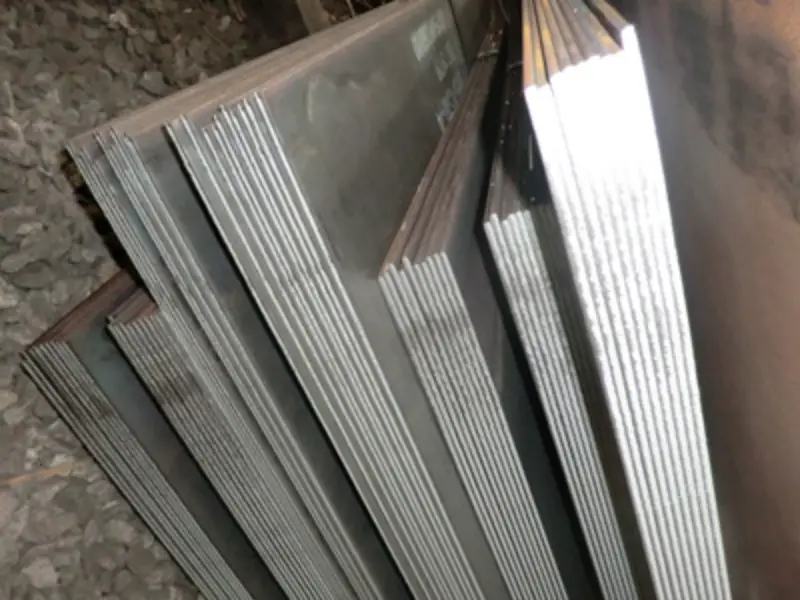
GB/T 16270 Q620C High-Strength Quenched and Tempered Steel Plate
GB/T 16270 Q620C High-Strength Quenched and Tempered Steel Plate for Structural Applications
Q620C is a high-strength low-alloy structural steel plate with minimum yield strength of 620 MPa, supplied in quenched and tempered condition, offering excellent toughness at 0°C.
Hot rolling, quenching, tempering, cutting, cold forming, welding (with preheat control)
- Phone : +8618037372205
- Email : [email protected]
- WhatsApp: Contact via Whtsapp
- WeChat: +8618037372205
GB/T 16270 Q620C High-Strength Quenched and Tempered Steel Plate Introduction
Q620C is a carbon and low-alloy high-strength steel plate specified in China standard GB/T 16270, produced by quenching and tempering (Q&T) process. Key properties: minimum yield strength 620 MPa, tensile strength 700–890 MPa, good elongation and impact toughness at 0°C (quality grade C).
- Excellent weldability with appropriate preheat
- High strength-to-weight ratio for lightweight design
- Good low-temperature impact resistance
- Used in heavy machinery, bridges, offshore structures, and pressure vessels
The material is typically delivered in quenched and tempered condition.
GB/T 16270 Q620C High-Strength Quenched and Tempered Steel Plate Chemical Composition
The chemical composition limits for Q620C steel according to GB/T 16270. The steel is microalloyed with Nb, V, Ti, or other elements to achieve strength and toughness. Maximum values are given unless a range is specified.
- Carbon equivalent (CEV) is often controlled for weldability
- Low sulfur and phosphorus levels ensure good toughness
| Element | Standard Value (max, %) | Remarks |
|---|---|---|
| Carbon (C) | 0.20 | Max |
| Silicon (Si) | 0.80 | Max |
| Manganese (Mn) | 1.80 | Max |
| Phosphorus (P) | 0.025 | Max |
| Sulfur (S) | 0.015 | Max |
| Chromium (Cr) | 1.00 | Max |
| Nickel (Ni) | 1.00 | Max |
| Molybdenum (Mo) | 0.60 | Max |
| Copper (Cu) | 0.50 | Max |
| Niobium (Nb) | 0.06 | Max |
| Vanadium (V) | 0.12 | Max |
| Titanium (Ti) | 0.05 | Max |
| Boron (B) | 0.004 | Max |
| Aluminum (Al) | 0.015–0.06* | Acid-soluble, optional for grain refinement |
GB/T 16270 Q620C High-Strength Quenched and Tempered Steel Plate Thermal and Electrical Physical Properties
Typical physical properties for Q620C steel at room temperature and elevated temperatures. These values are approximate and for engineering reference; they are not specified in the standard but are based on data for similar low-alloy steels. Density, elastic modulus, thermal expansion, conductivity, and resistivity are included.
- Properties may vary slightly with heat treatment and composition
- Poisson's ratio is typical for structural steels
| Property | Typical Value | Unit | Test Condition / Temperature |
|---|---|---|---|
| Density (ρ) | 7.85 | g/cm³ | 20°C |
| Elastic Modulus (E) | 206 | GPa | 20°C |
| Shear Modulus (G) | 79 | GPa | 20°C (estimated) |
| Poisson's Ratio (ν) | 0.30 | — | 20°C |
| Thermal Expansion Coefficient (α) | 12.0 × 10⁻⁶ | 1/K | 20–100°C |
| Thermal Expansion Coefficient (α) | 13.0 × 10⁻⁶ | 1/K | 20–200°C |
| Thermal Expansion Coefficient (α) | 13.8 × 10⁻⁶ | 1/K | 20–300°C |
| Thermal Conductivity (λ) | 40 | W/(m·K) | 20°C |
| Thermal Conductivity (λ) | 38 | W/(m·K) | 200°C |
| Thermal Conductivity (λ) | 35 | W/(m·K) | 400°C |
| Specific Heat Capacity (c) | 460 | J/(kg·K) | 20°C |
| Electrical Resistivity (ρₑ) | 0.25 | µΩ·m | 20°C |
GB/T 16270 Q620C High-Strength Quenched and Tempered Steel Plate Mechanical Properties
Mechanical properties for Q620C plates according to GB/T 16270, dependent on plate thickness. Tensile testing at room temperature, transverse specimens. Yield strength, tensile strength, elongation and impact energy requirements are listed.
- Bend test: d=3a for thickness ≤16 mm, wider bends for thicker plates
- Charpy V-notch impact energy at 0°C: ≥47 J (longitudinal)
| Property | Required Value | Unit | Test Condition / Thickness |
|---|---|---|---|
| Yield Strength (ReH) | 620 | MPa | Thickness ≤ 50 mm |
| Yield Strength (ReH) | 600 | MPa | Thickness > 50 mm to 100 mm |
| Yield Strength (ReH) | 580 | MPa | Thickness > 100 mm to 150 mm |
| Tensile Strength (Rm) | 700–890 | MPa | Thickness ≤ 50 mm |
| Tensile Strength (Rm) | 680–860 | MPa | Thickness > 50 mm to 100 mm |
| Tensile Strength (Rm) | 660–840 | MPa | Thickness > 100 mm to 150 mm |
| Elongation (A, 5.65√So) | ≥ 15 | % | Thickness ≤ 50 mm |
| Elongation (A, 5.65√So) | ≥ 14 | % | Thickness > 50 mm to 100 mm |
| Elongation (A, 5.65√So) | ≥ 13 | % | Thickness > 100 mm to 150 mm |
| Charpy Impact Energy (KV2) | ≥ 47 | J | 0°C, longitudinal |
| Bend Test (d = mandrel diameter, a = thickness) | d = 3a | — | Thickness ≤ 16 mm |
| Bend Test | d = 4a | — | Thickness > 16 mm to 50 mm |
| Bend Test | d = 5a | — | Thickness > 50 mm to 100 mm |
GB/T 16270 Q620C High-Strength Quenched and Tempered Steel Plate Exact Equivalent Material Standards and Substitutable Grades
| Country/Region | Standard | Grade | Remarks |
|---|---|---|---|
| China | GB/T 16270 | Q620C | Base standard, Q&T, 0°C impact |
| Europe | EN 10025-6 | S620Q | Quenched and tempered, 0°C impact (option 1, 2) |
| International | ISO 4951-2 | S620Q | High yield strength steel, Q&T |
| Japan | JIS G 3128 | SHY 620 | Similar strength level, may require comparison of impact temperature |
GB/T 16270 Q620C High-Strength Quenched and Tempered Steel Plate Application Introduction
Q620C steel plate is primarily used in structural applications where weight reduction is critical without sacrificing strength and toughness. It can be welded, cut, and formed via standard methods, but preheating and post-weld heat treatment may be required depending on thickness and service conditions.
- Commonly fabricated into heavy-duty structural parts
- Suitable for service temperatures down to 0°C (for grade C)
- Often supplied with inspection certificates and optional ultrasonic testing
Product Applications: Excavator booms, arms, and buckets, Crane lattice booms and telescopic sections, Bridge girders and load-bearing structural components, Ship hulls and deck plates, Offshore platform legs and deck structures, Heavy mining dump truck bodies, Pneumatic cylinders and hydraulic support components
Processed into products: Welded structural sections and built-up beams, Flanges and webs in fabricated girders, Brackets, stiffeners, and gusset plates, Pinned joints and connecting plates, Wear-prone liner plates (with appropriate hardness treatment), Clevis and lug components for heavy lifting
Application industries: Construction machinery (excavators, cranes, bulldozers), Bridge engineering, Shipbuilding and marine structures, Offshore platforms and wind turbine towers, Mining and earthmoving equipment, Pressure vessels and storage tanks (within design limits), Railway carriages and heavy transport vehicles
GB/T 16270 Q620C High-Strength Quenched and Tempered Steel Plate Similar or Near-Equivalent Alternative Materials
| Country/Region | Standard | Grade | Remarks |
|---|---|---|---|
| China | GB/T 16270 | Q550D | Lower yield strength (550 MPa), better toughness at -20°C |
| China | GB/T 16270 | Q690D | Higher yield strength (690 MPa), good toughness; requires more careful welding |
| Europe | EN 10025-6 | S690Q | Higher strength, similar Q&T process; increased alloy content |
| USA | ASTM A514/A514M | Grade E | Similar strength level but chemistry may differ; 690 MPa min YS, Q&T |
| Japan | JIS G 3128 | SHY 685 | Higher strength grade, comparable weldability under controlled conditions |
Notes:
- Always consult the latest edition of GB/T 16270 for precise requirements, as thickness ranges and properties may be updated.
- For improved weldability, carbon equivalent (CEV) is often limited: typical CEV ≤ 0.45–0.52% depending on thickness and purchaser requirements.
- Supplementary testing such as ultrasonic inspection, Z-direction tensile testing, or simulated post-weld heat treatment can be specified by agreement.
- Share



