
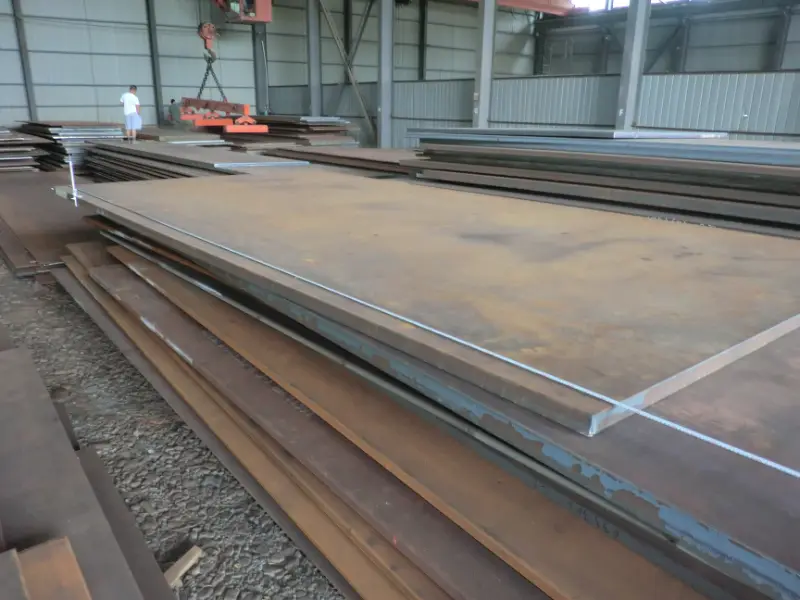
GB/T 16270 Q620D High Strength Quenched & Tempered Steel Plate
GB/T 16270 Q620D High Strength Quenched & Tempered Steel Plate - Properties & Equivalents
Explore the complete data sheet of Q620D steel under GB/T 16270: chemical composition, mechanical properties, thermal & electrical physical properties, international equivalents, and application guidelines.
Cold forming, hot forming (limited), machining, welding, cutting
- Phone : +8618037372205
- Email : [email protected]
- WhatsApp: Contact via Whtsapp
- WeChat: +8618037372205
GB/T 16270 Q620D High Strength Quenched & Tempered Steel Plate Introduction
Q620D is a low-alloy high-strength structural steel plate supplied in quenched and tempered condition according to GB/T 16270. With a minimum yield strength of 620 MPa and excellent low-temperature impact toughness (designated by quality grade D at -20 °C), Q620D offers a balanced combination of high strength, good weldability, and satisfactory formability.
- Typical thickness range covers up to 150 mm with tailored mechanical requirements.
- Chemical composition is carefully controlled to attain strength through a tempered martensite/bainite microstructure, utilizing microalloying elements like Nb, V, Ti, and B.
- The material is widely employed in heavy-duty welded structures such as mobile cranes, bridges, offshore platforms, and pressure vessels where weight reduction and safety are critical.
GB/T 16270 Q620D High Strength Quenched & Tempered Steel Plate Chemical Composition
The following table lists the maximum permissible chemical elements according to GB/T 16270-2009 for Q620D. Microalloying elements such as Nb, V, Ti, and B are added to enhance hardenability and temper resistance.
- All values are given as weight percentage maximum unless otherwise stated.
- Depending on thickness, some element limits may be further tightened to meet mechanical property requirements.
| Element | Specified Value (max, %) | Remarks |
|---|---|---|
| Carbon (C) | 0.18 | - |
| Silicon (Si) | 0.50 | - |
| Manganese (Mn) | 1.70 | - |
| Phosphorus (P) | 0.020 | - |
| Sulfur (S) | 0.010 | - |
| Chromium (Cr) | 0.80 | Optional alloying |
| Nickel (Ni) | 0.80 | Optional alloying |
| Molybdenum (Mo) | 0.30 | Optional alloying |
| Copper (Cu) | 0.50 | Optional alloying |
| Niobium (Nb) | 0.06 | Microalloying |
| Vanadium (V) | 0.08 | Microalloying |
| Titanium (Ti) | 0.05 | Microalloying |
| Boron (B) | 0.005 | Microalloying |
| Aluminium (Al) | ≥0.015 (total Al) | Minimum for fine grain practice |
GB/T 16270 Q620D High Strength Quenched & Tempered Steel Plate Thermal and Electrical Physical Properties
The following physical properties are typical for low-alloy quenched and tempered steel similar to Q620D. They are provided as guidance for design calculations; actual values may vary slightly depending on the exact composition and heat treatment condition.
- Density, elastic modulus, and Poisson's ratio are widely used in finite element analysis.
- Thermal conductivity and expansion coefficient influence heat treatment and welding operations.
| Property | Typical Value | Unit | Test Condition / Comment |
|---|---|---|---|
| Density (ρ) | 7.85 | g/cm³ | Room temperature |
| Modulus of Elasticity (E) | 210 | GPa | Room temperature, static |
| Shear Modulus (G) | ~81 | GPa | Based on E and Poisson |
| Poisson's Ratio (ν) | 0.3 | - | Elastic range |
| Coefficient of Thermal Expansion (α) | 12.0 × 10⁻⁶ | K⁻¹ | 20 – 100 °C |
| Coefficient of Thermal Expansion (α) | 13.5 × 10⁻⁶ | K⁻¹ | 20 – 300 °C |
| Thermal Conductivity (λ) | ~42 | W/(m·K) | At 100 °C |
| Specific Heat Capacity | ~460 | J/(kg·K) | Room temperature to 200 °C |
| Electrical Resistivity (ρ_e) | ~0.25 | µΩ·m | Room temperature |
GB/T 16270 Q620D High Strength Quenched & Tempered Steel Plate Mechanical Properties
Mechanical properties are guaranteed in accordance with GB/T 16270-2009 for quenched and tempered plates. The values depend on nominal thickness. Impact energy is measured on Charpy V-notch specimens at -20 °C (quality D).
- All tensile tests are performed on transverse specimens unless otherwise agreed.
- Bend tests are conducted to verify formability; no cracks or defects are permitted.
| Property | Required Value | Unit | Test Condition / Thickness |
|---|---|---|---|
| Yield Strength (ReH) | ≥ 620 | MPa | t ≤ 50 mm |
| Yield Strength (ReH) | ≥ 590 | MPa | 50 < t ≤ 100 mm |
| Yield Strength (ReH) | ≥ 550 | MPa | 100 < t ≤ 150 mm |
| Tensile Strength (Rm) | 700 – 890 | MPa | t ≤ 50 mm |
| Tensile Strength (Rm) | 700 – 890 | MPa | 50 < t ≤ 100 mm |
| Tensile Strength (Rm) | 700 – 890 | MPa | 100 < t ≤ 150 mm |
| Elongation (A) | ≥ 15 | % | t ≤ 50 mm |
| Elongation (A) | ≥ 14 | % | 50 < t ≤ 100 mm |
| Elongation (A) | ≥ 14 | % | 100 < t ≤ 150 mm |
| Impact Energy (KV2) | ≥ 47 | J | -20 °C, longitudinal specimens |
| Bend Test (180°) | d = 3a | - | t ≤ 50 mm |
| Bend Test (180°) | d = 4a | - | 50 < t ≤ 100 mm |
| Bend Test (180°) | d = 5a | - | 100 < t ≤ 150 mm (as agreed) |
GB/T 16270 Q620D High Strength Quenched & Tempered Steel Plate Fully Equivalent Material Standards & Replaceable Grades
| Country / Region | Standard | Grade | Remarks |
|---|---|---|---|
| Europe | EN 10025-6 | S620Q | Quenched and tempered, -20 °C impact variant; closest match to Q620D. |
| International | ISO 4950-3 | S620DQ | Yield strength 620 MPa, quality D (Q = quenched and tempered). |
| Japan | JIS G 3128 | SHY685N | High yield strength plate, though min. YS 685 MPa; often used as functional substitute with design adjustment. |
GB/T 16270 Q620D High Strength Quenched & Tempered Steel Plate Application Introduction
Q620D is optimal for structures that demand high strength-to-weight ratio, fatigue resistance, and reliable low-temperature toughness. Its good weldability with proper preheating and consumables makes it a standard choice in heavy engineering.
- Typical fabrication methods include plasma/laser cutting, cold bending, and multi-pass welding.
- Avoid prolonged exposure above tempering temperature to preserve mechanical properties.
Product Applications: Welded beams and columns, Crane booms and lattice structures, Heavy-duty chassis and frames, Offshore structural modules, Hydraulic cylinders and supports, Large-size valves and gates
Processed into products: Boom sections and jib arms, Turntable base plates and slewing rings, Load-bearing lugs and pin plates, Stiffeners and gusset plates, Wind tower flanges and shells, Bracket arms and leverage parts
Application industries: Construction and civil engineering (bridges, stadiums), Mobile crane and lifting equipment, Mining and earthmoving machinery, Shipbuilding and offshore platforms, Pressure vessels and penstocks, Wind turbine towers and support structures
GB/T 16270 Q620D High Strength Quenched & Tempered Steel Plate Similar / Alternative Material Recommendations
| Country / Region | Standard | Grade | Remarks |
|---|---|---|---|
| China | GB/T 16270 | Q690D | Higher yield strength (≥690 MPa) but similar processing; can substitute with section redesign. |
| Europe | EN 10025-6 | S690Q | Quenched and tempered, 690 MPa YS; widely available alternative for heavier loads. |
| USA | ASTM A514 / A517 | Grade Q | 690 MPa yield strength, Q&T; mechanical properties above Q620D, may require design check. |
| Germany (withdrawn) | DIN EN 10025-6 | S620Q | Earlier identical to current EN standard. |
| Russia | GOST 19281 | 09G2S (comparable strength) | Not exact match; though similar chemical concepts, YS ~345-390 MPa, only for non-critical substitution. |
Notes:
Important considerations:
- Welding: Preheating (100–150 °C) and low-hydrogen processes are recommended; post-weld heat treatment is not normally required but may be applied below tempering temperature.
- Delivery condition: Plates are ultrasonically tested as per GB/T 2970 if specified.
- Standard also covers similar grades Q550D, Q690D etc., which can be selected based on thickness and design stress.
- For critical applications, supplementary tests (e.g., Z-direction tensile) can be arranged through agreement.
- Share



