
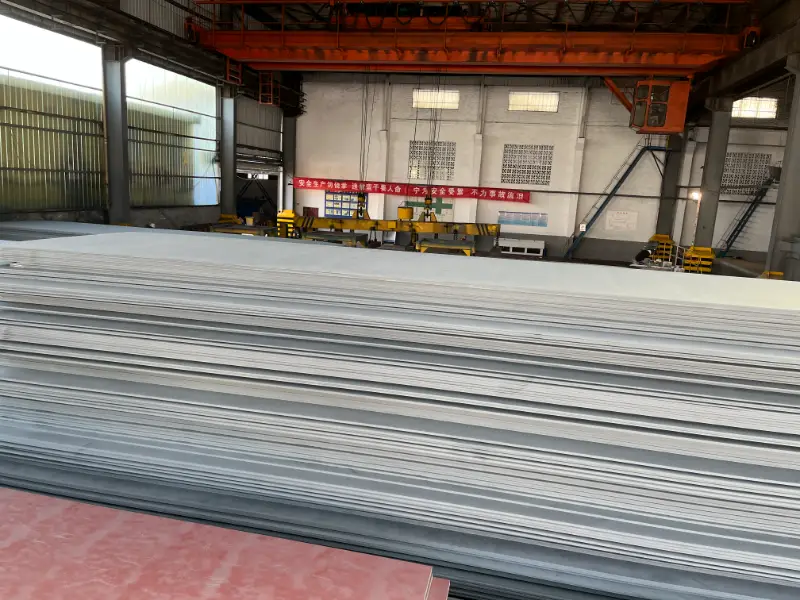
GB/T 16270 Q620E High-Strength Quenched & Tempered Steel Plate
GB/T 16270 Q620E High-Strength Quenched & Tempered Steel Plate | Properties & Equivalents
Explore the chemical composition, mechanical properties, thermal and electrical physical data for GB/T 16270 Q620E high-strength structural steel plate. Find equivalent international standards and typical applications.
Welding, cold forming, bending, machining (after delivery condition)
- Phone : +8618037372205
- Email : [email protected]
- WhatsApp: Contact via Whtsapp
- WeChat: +8618037372205
GB/T 16270 Q620E High-Strength Quenched & Tempered Steel Plate Introduction
Q620E is a high-strength quenched and tempered structural steel plate specified in Chinese standard GB/T 16270-2009 (High strength structural steel plates in the quenched and tempered condition). With a minimum yield strength of 620 MPa, it is designed for welded structures requiring high load-bearing capacity and excellent low-temperature toughness (impact test at -40 °C for grade E). The steel offers good weldability, cold formability, and resistance to brittle fracture, making it suitable for heavy-duty machinery, bridges, pressure vessels, and offshore platforms. Its balanced chemistry incorporates microalloying elements (Nb, V, Ti) to refine grain size and ensure uniform mechanical properties after quenching and tempering treatment.
GB/T 16270 Q620E High-Strength Quenched & Tempered Steel Plate Chemical Composition
The chemical composition specified according to GB/T 16270-2009 for Q620E steel. The values are limits on heat analysis, ensuring a fine balance of strength, toughness, and weldability. Microalloying elements (Nb, V, Ti) are added for grain refinement and precipitation strengthening. Residual elements like P and S are kept low to enhance ductility and impact performance.
| Element | Standard Value (max, %) | Remarks |
|---|---|---|
| C | ≤ 0.18 | |
| Si | ≤ 0.60 | |
| Mn | ≤ 1.80 | |
| P | ≤ 0.020 | |
| S | ≤ 0.010 | |
| Nb | ≤ 0.11 | Microalloying |
| V | ≤ 0.12 | Microalloying |
| Ti | ≤ 0.20 | Microalloying |
| Cr | ≤ 1.00 | Optional |
| Ni | ≤ 2.00 | Optional |
| Mo | ≤ 0.60 | Optional |
| B | ≤ 0.004 | Optional |
| Cu | ≤ 0.50 | Residual (if added) |
| N | ≤ 0.015 | For Al content ratio |
GB/T 16270 Q620E High-Strength Quenched & Tempered Steel Plate Thermal and Electrical Physical Properties
Physical properties for Q620E steel are not specified in GB/T 16270; the following values are typical for low-alloy quenched and tempered steels of this strength class and are provided for engineering reference. They apply at room temperature unless stated otherwise.
| Property | Typical Value | Unit | Test Condition / Remarks |
|---|---|---|---|
| Density (ρ) | 7.85 | g/cm³ | At 20°C |
| Modulus of Elasticity (E) | 210 | GPa | At 20°C |
| Shear Modulus (G) | 80 | GPa | At 20°C |
| Poisson's Ratio (ν) | 0.3 | - | At 20°C |
| Thermal Expansion Coefficient (α) | 12.0 | 10⁻⁶/K | 20°C to 100°C |
| Thermal Conductivity (λ) | 42 – 52 | W/(m·K) | At 20°C; depends on alloy content |
| Specific Heat Capacity (c) | 460 | J/(kg·K) | At 20°C |
| Electrical Resistivity (ρ_e) | 0.20 – 0.25 | µΩ·m | At 20°C |
GB/T 16270 Q620E High-Strength Quenched & Tempered Steel Plate Mechanical Properties
Mechanical properties as per GB/T 16270-2009 for Q620E steel plates. Values depend on the plate thickness. The yield strength, tensile strength, elongation, and impact energy are guaranteed after quenching and tempering. Bending test is performed to evaluate formability.
| Property | Standard Requirement Value | Unit | Test Condition / Thickness Range |
|---|---|---|---|
| Yield Strength (ReH) | ≥ 620 | MPa | Plate thickness ≤ 50 mm |
| Yield Strength (ReH) | ≥ 590 | MPa | 50 < thickness ≤ 100 mm |
| Yield Strength (ReH) | ≥ 560 | MPa | 100 < thickness ≤ 150 mm |
| Tensile Strength (Rm) | 730 – 930 | MPa | Plate thickness ≤ 50 mm |
| Tensile Strength (Rm) | 700 – 900 | MPa | 50 < thickness ≤ 100 mm |
| Tensile Strength (Rm) | 640 – 840 | MPa | 100 < thickness ≤ 150 mm |
| Elongation (A) | ≥ 15 | % | Plate thickness ≤ 50 mm, gauge length 5.65√So |
| Elongation (A) | ≥ 15 | % | 50 < thickness ≤ 100 mm |
| Elongation (A) | ≥ 14 | % | 100 < thickness ≤ 150 mm |
| Bending Test (180°) | d = 3a | Bend diameter d, specimen thickness a; no cracks on outer surface | |
| Impact Energy (KV2), -40°C | ≥ 27 (single min) | J | Charpy V-notch, E-grade requirement; average of 3 specimens |
GB/T 16270 Q620E High-Strength Quenched & Tempered Steel Plate Exact Equivalent Material Standards & Alternative Grades
| Country/Region | Standard | Grade | Remarks |
|---|---|---|---|
| China | GB/T 16270-2009 | Q620E | Original grade |
| Europe | EN 10025-6 | S620Q (+N or +M conditions may differ) | Conceptually similar; EN 10025-6 defines S620Q but mechanical and chemical requirements may vary. Direct substitution should be verified with all specifications. |
| International (ISO) | ISO 4950-2 / ISO 4951 | S620Q (or S620QL) | Not fully identical; check chemical composition and impact temperature. |
GB/T 16270 Q620E High-Strength Quenched & Tempered Steel Plate Application Introduction
Q620E steel plates are engineered for structures that must withstand extreme static and dynamic loads while maintaining high ductility and notch toughness at temperatures as low as -40°C. The quenched and tempered condition ensures a homogeneous tempered martensite/bainite microstructure. The steel is readily weldable using conventional processes with suitable preheating and interpass temperature control, and it exhibits good cold-bending behavior. It is used across heavy engineering sectors where weight reduction and high fatigue life are critical.
Product Applications: Crawler crane booms and lattice structures, Excavator and loader buckets, Mining dump truck bodies, High-load steel bridges (girders, box sections), Offshore platform legs and nodes, Large-diameter pressure vessels, Wind turbine towers (flanges, transition pieces)
Processed into products: Welded structural beams and columns, Boom sections for mobile cranes, Wear-resistant liner plates in chutes and hoppers, Reinforcement ribs and stiffeners, Heavy-duty bolted or welded connections, Hydraulic cylinder supports, Transition rings in wind energy structures
Application industries: Heavy Equipment & Machinery, Mining & Earthmoving, Bridge Construction, Offshore & Marine Engineering, Pressure Vessel Manufacturing, Wind Tower & Renewable Energy
GB/T 16270 Q620E High-Strength Quenched & Tempered Steel Plate Similar / Replaceable Material Recommendations
| Country/Region | Standard | Grade | Remarks |
|---|---|---|---|
| China | GB/T 16270 | Q690E | Higher strength grade (690 MPa min yield); suitable if increased strength is needed with similar toughness. |
| China | GB/T 16270 | Q550E | Lower strength grade (550 MPa min yield); often used for less demanding structures. |
| Europe | EN 10025-6 | S690QL | Common high-strength Q&T steel in Europe; comparable strength to Q690 but with specified low-temperature impact. Higher alloy content may require adjustment in welding. |
| USA | ASTM A514 / A517 | Grade B, H, F, etc. | Quenched and tempered alloy steel plates for structural use; nominal yield strength ~690 MPa. Similar toughness at low temperatures depending on grade; not a direct match for Q620 but often used in heavy equipment. |
| Japan | JIS G 3128 | SHY685 / SHY685N | High yield strength steel for welded structures; yield ≥ 685 MPa, somewhat higher than Q620. |
Notes:
The data provided is based on GB/T 16270-2009. For actual production, supplementary requirements such as ultrasonic testing, improved flatness, or restricted chemical ranges may be agreed upon between purchaser and manufacturer. The physical properties are estimated from similar quenched and tempered alloy steels and should be validated by specific supplier data sheets. Always consult the latest version of the standard and material certificates for critical applications.
- Share



