
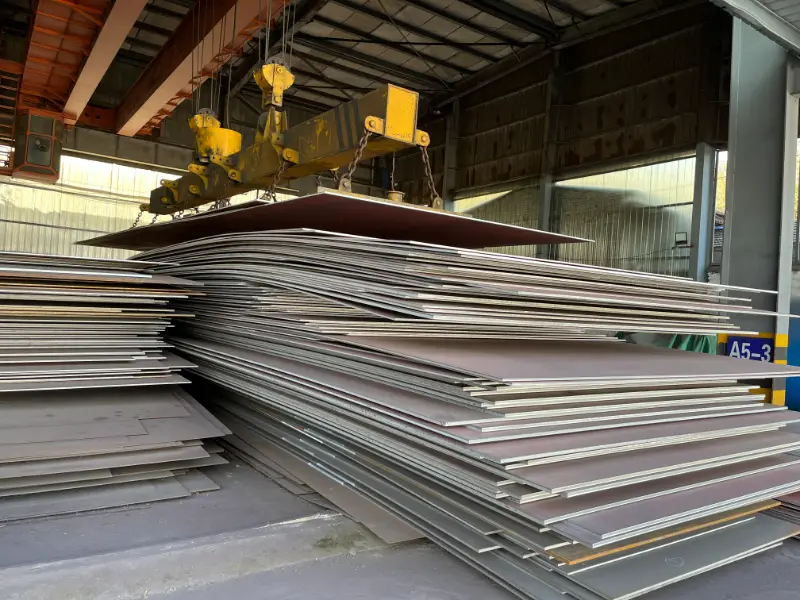
EN10083-3 33MnCrB5-2 Boron Alloy Steel Plate
EN10083-3 33MnCrB5-2 Boron Alloy Steel Plate - Properties & Equivalents
Detailed data on 33MnCrB5-2 according to EN10083-3: chemical composition, mechanical and thermal properties, international equivalents, and applications for high-strength boron steel plate.
Hot rolling, hot forging, machining, induction hardening, flame hardening, quenching & tempering
- Phone : +8618037372205
- Email : [email protected]
- WhatsApp: Contact via Whtsapp
- WeChat: +8618037372205
EN10083-3 33MnCrB5-2 Boron Alloy Steel Plate Introduction
33MnCrB5-2 is a boron-treated alloy steel defined in EN 10083-3, designed for quenching and tempering to achieve high strength and toughness. The boron addition (typically 0.0008–0.0050%) strongly improves hardenability, enabling uniform hardening of larger cross-sections. It is delivered in various conditions (+U, +S, +A, +QT) and finds extensive use in automotive, agricultural, and construction machinery for heavily stressed parts that require a combination of wear resistance and fatigue strength.
EN10083-3 33MnCrB5-2 Boron Alloy Steel Plate Chemical Composition
Ladle analysis according to EN 10083-3. Boron is deliberately added in controlled amounts to enhance hardenability. Sufficient titanium or aluminum is typically present to protect boron from nitrogen. Phosphorus and sulfur are kept low to ensure good toughness.
| Element | Content (%) | Remarks |
|---|---|---|
| Carbon (C) | 0.30 – 0.37 | |
| Silicon (Si) | ≤ 0.40 | |
| Manganese (Mn) | 1.20 – 1.50 | |
| Phosphorus (P) | ≤ 0.025 | |
| Sulfur (S) | ≤ 0.035 | |
| Chromium (Cr) | 0.40 – 0.60 | |
| Boron (B) | 0.0008 – 0.0050 | Key hardenability element |
EN10083-3 33MnCrB5-2 Boron Alloy Steel Plate Thermal and Electrical Physical Properties
Physical properties are representative for quenched and tempered boron alloy steel at room temperature unless otherwise indicated. Thermal expansion and conductivity values are essential for processing and design.
| Property | Typical Value | Unit | Conditions |
|---|---|---|---|
| Density (ρ) | 7.85 | g/cm³ | At 20 °C |
| Modulus of elasticity (E) | 210 | GPa | At 20 °C |
| Shear modulus (G) | 80 | GPa | At 20 °C |
| Poisson's ratio (ν) | 0.30 | – | At 20 °C |
| Coefficient of thermal expansion (α) | 11.5 | 10⁻⁶/K | 20 – 100 °C |
| Thermal conductivity (λ) | 40 | W/(m·K) | At 20 °C |
| Specific heat capacity | 460 | J/(kg·K) | At 20 °C |
| Electrical resistivity (ρₑ) | 0.20 | 10⁻⁶ Ω·m | At 20 °C |
EN10083-3 33MnCrB5-2 Boron Alloy Steel Plate Mechanical Properties
Values refer to the quenched and tempered condition (+QT) with austenitizing at 850–880°C, oil quench, tempering 450–550°C. Data depend on ruling section size. Impact energy is tested with Charpy V-notch specimens.
| Property | Specified Value | Unit | Test Condition |
|---|---|---|---|
| Yield strength (ReH) | ≥ 700 | MPa | QT, diameter ≤ 16 mm, room temperature |
| Tensile strength (Rm) | 1000 – 1200 | MPa | QT, diameter ≤ 16 mm, room temperature |
| Elongation (A) | ≥ 10 | % | QT, proportional test piece |
| Reduction of area (Z) | ≥ 45 | % | QT, diameter ≤ 16 mm |
| Impact energy (KV) | ≥ 27 | J | QT, -20 °C, Charpy V-notch |
| Hardness (delivery +A) | ≤ 229 | HBW | Soft annealed condition |
EN10083-3 33MnCrB5-2 Boron Alloy Steel Plate Identical Standard Equivalents and Replaceable Grades
| Region | Standard | Grade | Remarks |
|---|---|---|---|
| Europe | EN 10083-3 | 33MnCrB5-2 | Original specification |
| International | ISO 683-3 | 33MnCrB5-2 | Identical composition and properties |
EN10083-3 33MnCrB5-2 Boron Alloy Steel Plate Application Introduction
33MnCrB5-2 is mainly employed in the quenched and tempered state for highly stressed components that demand high tensile strength, fatigue resistance, and moderate toughness. The boron alloying guarantees deep hardening, allowing large cross-sections to achieve uniform mechanical properties. Surface hardening (induction or flame) can further improve wear performance.
Product Applications: Hydraulic cylinder rods and tubes, Transmission and drive shafts, Gears and pinions, Axles and spindles, High-strength bolts and studs, Coupling and linkage parts, Forged machine components
Processed into products: Steering knuckles and joints, Piston rods for heavy-duty cylinders, Universal joint crosses, Camshaft and crankshaft gears, Flange shafts, Load-bearing pins and pivots
Application industries: Automotive engineering, Agricultural machinery, Construction equipment, Hydraulic systems, General mechanical engineering
EN10083-3 33MnCrB5-2 Boron Alloy Steel Plate Similar / Alternative Materials Recommendation
| Region | Standard | Grade | Remarks |
|---|---|---|---|
| Europe | EN 10083-3 | 27MnCrB5-2 | Lower carbon, slightly lower strength, better toughness |
| USA | SAE J1268 / ASTM A752 | 15B37 | Boron treated steel, different Mn and Cr levels |
| China | GB/T 3077 | 35MnB | Boron-containing, higher Mn, no Cr; used for quenched & tempered parts |
| Japan | JIS G4052 | SCM435BH | Boron-modified Cr-Mo steel with similar hardenability |
Notes:
For optimum results, quench from 850–880 °C in oil or suitable polymer, then temper at 450–550 °C depending on desired strength. Stress relief at 550–600 °C is recommended after severe machining or welding. Boron protection during steelmaking is achieved by adding titanium or aluminum; therefore, the final product often contains small amounts of these elements. Always refer to the actual material certificate for precise delivery condition properties.
- Share



