
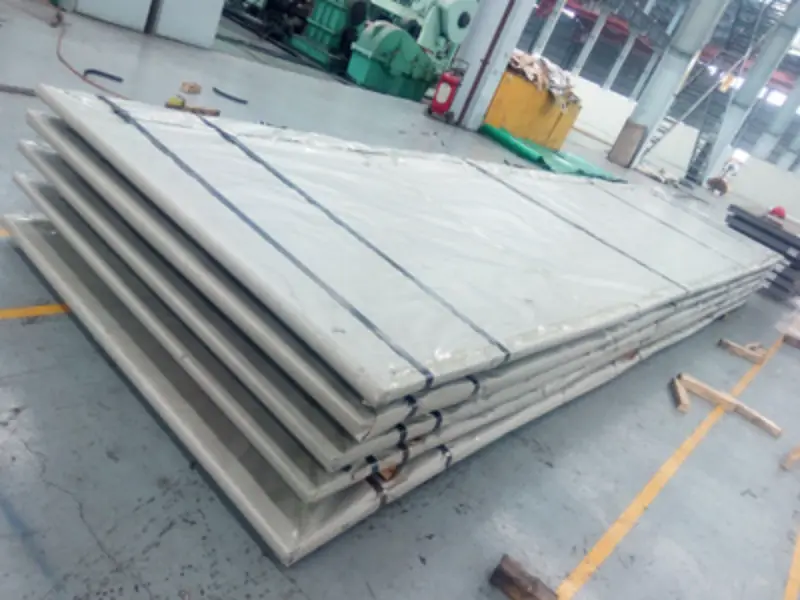
27MnCrB5-2 Boron Alloy Steel Plate
27MnCrB5-2 Boron Alloy Steel Plate - EN 10083-3 Grade Datasheet
Comprehensive material data for 27MnCrB5-2 alloy steel plate per EN 10083-3: chemical composition, mechanical properties, thermal/electrical physical values, international equivalents, and applications.
Hot rolling, forging, quenching and tempering, machining, induction hardening, nitriding
- Phone : +8618037372205
- Email : [email protected]
- WhatsApp: Contact via Whtsapp
- WeChat: +8618037372205
27MnCrB5-2 Boron Alloy Steel Plate Introduction
27MnCrB5-2 is a boron-alloyed quenched and tempered steel defined in EN 10083-3. It combines moderate carbon content with manganese, chromium, and a small boron addition (0.0008–0.005%) to achieve deep hardenability and high strength after heat treatment. In the quenched and tempered (+QT) condition it offers an excellent balance of hardness, tensile strength (typically 900–1100 MPa for small sections), and toughness, with minimum impact energy of 25 J at -20 °C. The steel is intended for medium to high-stress mechanical engineering components such as gears, shafts, bolts, and wear parts, where good fatigue resistance and wear behavior are required. Its hardenability allows through-hardening of sections up to approximately 40 mm in oil or water quenching. Key features:
- High strength and toughness after QT treatment
- Controlled boron content for improved hardenability
- Good machinability in the annealed or quenched and tempered condition
- Suitable for induction hardening or nitriding
27MnCrB5-2 Boron Alloy Steel Plate Chemical Composition
The chemical composition complies with EN 10083-3:2006. Boron effectiveness is ensured by sufficient aluminium (total Al ≥ 0.020%) or titanium. Residual elements (Cu, Ni, Mo, etc.) are limited but not individually specified unless agreed. The values are for the ladle analysis; product analysis tolerances apply per the standard.
| Element | Content (%) | Remarks |
|---|---|---|
| Carbon (C) | 0.24 – 0.30 | |
| Silicon (Si) | ≤ 0.40 | |
| Manganese (Mn) | 1.10 – 1.40 | |
| Phosphorus (P) | ≤ 0.025 | |
| Sulfur (S) | ≤ 0.035 | |
| Chromium (Cr) | 0.30 – 0.60 | |
| Boron (B) | 0.0008 – 0.005 | Boron hardenability element |
27MnCrB5-2 Boron Alloy Steel Plate Thermal and Electrical Physical Properties
The following values are typical for 27MnCrB5-2 in the quenched and tempered condition. They are not specified in EN 10083-3 but are commonly used for engineering calculations. Actual values may vary with heat treatment and temperature.
| Property | Value | Unit | Test condition |
|---|---|---|---|
| Density (ρ) | 7.8 | g/cm³ | 20 °C |
| Modulus of elasticity (E) | 210 | GPa | 20 °C |
| Shear modulus (G) | 81 | GPa | Calculated, 20 °C |
| Poisson's ratio (ν) | 0.3 | — | 20 °C |
| Thermal expansion coefficient (α) | 12.0 | 10⁻⁶/K | 20 – 100 °C |
| Thermal expansion coefficient (α) | 12.5 | 10⁻⁶/K | 20 – 200 °C |
| Thermal expansion coefficient (α) | 13.5 | 10⁻⁶/K | 20 – 400 °C |
| Thermal conductivity (λ) | 42 | W/(m·K) | 20 °C |
| Thermal conductivity (λ) | 40 | W/(m·K) | 300 °C |
| Specific heat capacity (cₚ) | 460 | J/(kg·K) | 20 °C |
| Electrical resistivity (ρₑ) | 0.25 | 10⁻⁶ Ω·m | 20 °C |
27MnCrB5-2 Boron Alloy Steel Plate Mechanical Properties
Mechanical properties apply to the quenched and tempered condition as specified in EN 10083-3 Table 5. Typical heat treatment: austenitize at 850–890 °C, quench in water or oil, temper at 450–650 °C. The values are minimum unless a range is given. Impact energy is determined on Charpy V-notch specimens at -20 °C.
| Property | Value | Unit | Test condition / section size |
|---|---|---|---|
| Yield strength (ReH) | ≥ 700 | MPa | Thickness d ≤ 16 mm |
| Tensile strength (Rm) | 900 – 1100 | MPa | Thickness d ≤ 16 mm |
| Elongation (A) | ≥ 10 | % | Proportional test piece, L₀=5d₀; d ≤ 16 mm |
| Reduction of area (Z) | ≥ 40 | % | d ≤ 16 mm |
| Impact energy (KV₂, -20°C) | ≥ 25 | J | d ≤ 16 mm |
| Yield strength (ReH) | ≥ 600 | MPa | 16 < d ≤ 40 mm |
| Tensile strength (Rm) | 800 – 950 | MPa | 16 < d ≤ 40 mm |
| Elongation (A) | ≥ 12 | % | 16 < d ≤ 40 mm |
| Reduction of area (Z) | ≥ 45 | % | 16 < d ≤ 40 mm |
| Impact energy (KV₂, -20°C) | ≥ 25 | J | 16 < d ≤ 40 mm |
| Yield strength (ReH) | ≥ 500 | MPa | 40 < d ≤ 100 mm |
| Tensile strength (Rm) | 750 – 900 | MPa | 40 < d ≤ 100 mm |
| Elongation (A) | ≥ 14 | % | 40 < d ≤ 100 mm |
| Reduction of area (Z) | ≥ 50 | % | 40 < d ≤ 100 mm |
| Impact energy (KV₂, -20°C) | ≥ 25 | J | 40 < d ≤ 100 mm |
27MnCrB5-2 Boron Alloy Steel Plate Exactly Equivalent Material Standards and Substitutional Grades
| Country/Region | Standard | Grade | Remarks |
|---|---|---|---|
| International (ISO) | ISO 683-2 | 27MnCrB5-2 | Chemically identical |
| European Union | EN 10083-3 | 27MnCrB5-2 | Original standard |
| Germany | DIN EN 10083-3 | 27MnCrB5-2 | Adopted from EN |
| United Kingdom | BS EN 10083-3 | 27MnCrB5-2 | Adopted from EN |
| France | NF EN 10083-3 | 27MnCrB5-2 | Adopted from EN |
| Italy | UNI EN 10083-3 | 27MnCrB5-2 | Adopted from EN |
| Spain | UNE EN 10083-3 | 27MnCrB5-2 | Adopted from EN |
| Sweden | SS-EN 10083-3 | 27MnCrB5-2 | Adopted from EN |
27MnCrB5-2 Boron Alloy Steel Plate Application Introduction
27MnCrB5-2 is optimized for medium- to high-stress components in the automotive and general engineering sectors. In the quenched and tempered condition, it provides an attractive combination of high tensile strength, fatigue resistance, and adequate toughness, making it suitable for dynamically loaded parts. The boron treatment ensures consistent hardening response even in large sections, reducing the need for expensive alloying elements. Typical working hardness after QT is 270–330 HBW. Components can be further surface-hardened by induction or nitriding to improve wear resistance without sacrificing core toughness.
Product Applications: Gears and pinions, Shafts and axles, High-strength bolts and studs, Steering knuckles and suspension arms, Wear plates, sprockets, and track links
Processed into products: Transmission gears and differential gears, Camshafts and crankshafts, Axle shafts and steering shafts, Hydraulic piston rods and cylinder parts, Fasteners and tension bars, Chain links and excavator bucket teeth
Application industries: Automotive and commercial vehicle manufacturing, Agricultural and construction machinery, General mechanical engineering, Mining and material handling equipment, Hydraulic and power transmission systems
27MnCrB5-2 Boron Alloy Steel Plate Similar and Alternative Materials with Comparable Properties
| Country/Region | Standard | Grade | Remarks |
|---|---|---|---|
| Europe | EN 10083-3 | 30MnB5 | Higher Mn (1.15-1.45), no Cr; slightly lower hardenability but similar applications |
| Europe | EN 10083-3 | 38MnB5 | Higher C (0.36-0.42), higher strength, lower toughness; for larger cross-sections |
| Europe | EN 10083-3 | 20MnB5 | Lower C (0.18-0.23), case-hardening grade; comparable core properties after carburizing |
| USA | ASTM A322 | 51B30 | Similar C and Cr, with boron; often used for gears and shafts |
| USA | SAE J404 | 50B30 | Similar chemistry, slight variation in Mn range |
| China | GB/T 3077 | 20MnVB | V replaces part of Cr, lower hardening capacity but suitable replacement in some cases |
| Japan | JIS G4105 | SCM420H | Cr-Mo case-hardening steel; similar core strength after carburizing but no boron |
Notes:
Heat treatment guidance: Austenitize at 850–890 °C, quench in oil or water (depending on section size). Temper at 450–650 °C to achieve the desired strength/toughness balance. Stress-relief annealing at 30–50 °C below tempering temperature is recommended after welding or machining.
Welding: Due to the boron content and medium carbon level, welding should be performed with care. Preheating to 200–300 °C and post-weld heat treatment are advised. Suitable filler materials include electrodes with low hydrogen content and matching strength level (e.g., E 50 6 MnNi or similar).
Availability: Plates, bars, and forgings are produced in the +QT, +A (soft annealed), or +U (untreated) conditions. Contact the mill for specific dimensions and delivery condition.
- Share



