
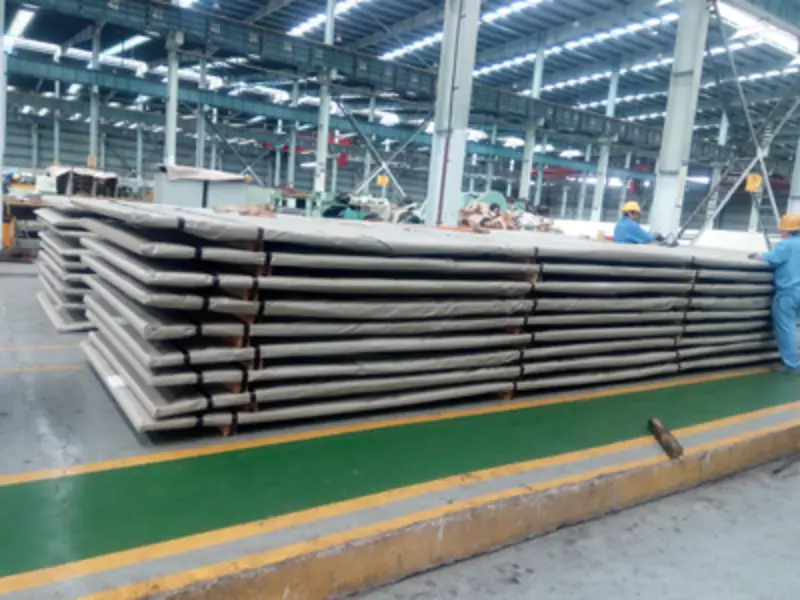
GB/T 1591 Q460C Low-Alloy High-Strength Structural Steel
GB/T 1591 Q460C Low-Alloy High-Strength Structural Steel - Properties, Equivalents, and Applications
Comprehensive technical data for Q460C structural steel plate according to Chinese standard GB/T 1591, including chemical composition, mechanical and thermal properties, international equivalents, and application guidance.
Hot rolling, controlled rolling, normalizing, thermomechanical rolling (TMCP), cold forming, welding, machining
- Phone : +8618037372205
- Email : [email protected]
- WhatsApp: Contact via Whtsapp
- WeChat: +8618037372205
GB/T 1591 Q460C Low-Alloy High-Strength Structural Steel Introduction
Q460C is a low-alloy high-strength structural steel grade specified in the Chinese standard GB/T 1591. It offers a minimum yield strength of 460 MPa for thicknesses up to 16 mm and demonstrates good weldability, toughness at 0°C, and excellent plasticity.
- High Strength: Provides superior load-bearing capacity, enabling lighter structures.
- Excellent Weldability: Low carbon equivalent and controlled composition reduce the risk of cold cracking.
- Good Low-Temperature Toughness: Guaranteed Charpy impact energy at 0°C ensures reliability in cold environments.
- Versatile Processing: Suitable for cold forming, bending, and cutting operations.
It is widely used in heavy machinery, bridges, offshore structures, and pressure vessels where high strength and durability are critical.
GB/T 1591 Q460C Low-Alloy High-Strength Structural Steel Chemical Composition
The chemical composition of Q460C steel is designed to achieve high strength and good weldability. Maximum limits for impurities like sulfur and phosphorus are low to ensure toughness. Microalloying elements such as niobium, vanadium, and titanium are added for grain refinement and precipitation strengthening. The carbon equivalent (CEV) is typically controlled to ensure excellent weldability. Note: The values shown below are the maximum limits unless a range is given; the steel may also contain other elements for special purposes as agreed between the manufacturer and the purchaser.
| Element | Standard Value (max or range) | Remarks |
|---|---|---|
| C | ≤0.20% | Carbon content influences strength and hardenability. |
| Si | ≤0.60% | Silicon acts as a deoxidizer and strengthens ferrite. |
| Mn | ≤1.80% | Manganese enhances hardenability and strength. |
| P | ≤0.030% | Low phosphorus content ensures toughness and avoids embrittlement. |
| S | ≤0.030% | Low sulfur improves formability and weldability. |
| Nb | ≤0.11% | Niobium forms fine carbides for grain refinement. |
| V | ≤0.20% | Vanadium provides precipitation strengthening. |
| Ti | ≤0.20% | Titanium fixes nitrogen and refines grain structure. |
| Cr | ≤0.30% | Chromium increases hardenability (if present). |
| Ni | ≤0.80% | Nickel improves low-temperature toughness. |
| Cu | ≤0.55% | Copper enhances atmospheric corrosion resistance. |
| Mo | ≤0.20% | Molybdenum increases strength and temper resistance. |
| N | ≤0.015% | Nitrogen is limited to avoid strain aging. |
| Al (total) | ≥0.015% | Aluminum is used for fully killed steel and grain refinement. |
GB/T 1591 Q460C Low-Alloy High-Strength Structural Steel Thermal and Electrical Physical Properties
The following physical properties are typical for low-alloy structural steels similar to Q460C and may vary slightly depending on the exact chemical composition and heat treatment condition. These values are provided for design calculations and general engineering reference. Note: These are not mandatory standard values but are based on published data for comparable steels.
| Property | Typical Value | Unit | Test Condition / Remarks |
|---|---|---|---|
| Density (ρ) | 7.85 | g/cm³ | Ambient temperature |
| Modulus of elasticity (E) | 206 | GPa | Room temperature |
| Shear modulus (G) | 79.3 | GPa | Room temperature |
| Poisson's ratio (ν) | 0.30 | - | Room temperature |
| Thermal expansion coefficient (α) | 12.5 | 10⁻⁶/K | 20 – 100°C |
| Thermal expansion coefficient (α) | 12.8 | 10⁻⁶/K | 20 – 200°C |
| Thermal expansion coefficient (α) | 13.5 | 10⁻⁶/K | 20 – 300°C |
| Thermal expansion coefficient (α) | 13.9 | 10⁻⁶/K | 20 – 400°C |
| Thermal conductivity (λ) | 42 | W/(m·K) | at 100°C |
| Specific heat capacity (c) | 460 | J/(kg·K) | at 20°C |
| Electrical resistivity (ρₑ) | 0.23 | 10⁻⁶ Ω·m | at 20°C |
GB/T 1591 Q460C Low-Alloy High-Strength Structural Steel Mechanical Properties
Mechanical properties of Q460C vary with product thickness. The steel is often supplied in normalized or controlled rolled condition; values below represent the minimum requirements unless otherwise indicated. Tensile testing is performed in the transverse direction for plates and in the longitudinal direction for sections. Charpy V-notch impact tests are conducted at 0°C on longitudinal specimens. Note: For thicknesses >150 mm, mechanical properties shall be agreed upon between the manufacturer and the purchaser.
| Property | Standard Required Value | Unit | Test Condition / Thickness Range |
|---|---|---|---|
| Yield strength (ReH) | ≥460 | MPa | t ≤ 16 mm |
| Yield strength (ReH) | ≥440 | MPa | 16 mm < t ≤ 40 mm |
| Yield strength (ReH) | ≥420 | MPa | 40 mm < t ≤ 63 mm |
| Yield strength (ReH) | ≥400 | MPa | 63 mm < t ≤ 80 mm |
| Yield strength (ReH) | ≥400 | MPa | 80 mm < t ≤ 100 mm |
| Yield strength (ReH) | ≥380 | MPa | 100 mm < t ≤ 150 mm |
| Tensile strength (Rm) | 550 – 720 | MPa | t ≤ 100 mm |
| Tensile strength (Rm) | 530 – 700 | MPa | 100 mm < t ≤ 150 mm |
| Elongation (A) (L₀=5.65√S₀) | ≥17 | % | t ≤ 100 mm (transverse) |
| Elongation (A) (L₀=5.65√S₀) | ≥17 | % | 100 mm < t ≤ 150 mm (transverse) |
| Charpy impact energy (KV₂) at 0°C | ≥34 | J | Longitudinal, full-size specimen |
| Bend test (180°) – bend diameter d | d = 3a | - | t ≤ 16 mm |
| Bend test (180°) – bend diameter d | d = 4a | - | 16 mm < t ≤ 100 mm |
| Bend test (180°) – bend diameter d | d = 5a | - | 100 mm < t ≤ 150 mm |
GB/T 1591 Q460C Low-Alloy High-Strength Structural Steel International Equivalent Standards and Grades
The following table lists internationally recognized standards and grades that can be considered fully equivalent or closely comparable to Q460C in terms of chemical composition and mechanical properties. However, minor differences in impact test temperature or yield strength may exist; careful verification is recommended when substituting. Note: Equivalent grades should be confirmed by the specific standard and any supplementary requirements.
| Country/Region | Standard | Grade | Remarks |
|---|---|---|---|
| Europe | EN 10025-3 | S460N | Normalized, impact energy at -20°C ≥40 J; minor toughness advantage over Q460C |
| Europe | EN 10025-4 | S460M | Thermomechanical rolled, impact at -20°C; similar strength |
| International | ISO 4950/1 | E460 | General structural use, comparable yield strength |
| Japan | JIS G 3106 | SM570 | Tensile strength 570-720 MPa, yield ≥460 MPa, impact test optional; may require supplementary requirements |
| USA | ASTM A572/A572M | Grade 65 [450] | Nominal yield 450 MPa (65 ksi), slightly lower strength; more similar to Q460D/E variants if toughness conditions are added |
GB/T 1591 Q460C Low-Alloy High-Strength Structural Steel Application Introduction
Q460C is designed for welded and bolted structures that require high strength, good fatigue resistance, and reliable performance at mild low temperatures. Its balanced composition enables efficient fabrication through cutting, cold forming, and welding with standard procedures. Key considerations:
- Preheating may be required for thick sections above 30 mm to avoid cold cracking.
- Post-weld heat treatment is generally unnecessary but may be applied for stress relief.
- The steel is compatible with most conventional welding processes (SMAW, GMAW, SAW).
Product Applications: Welded bridge girders and trusses, Offshore platform legs and decks, Excavator booms and arms, Crane main chords and outriggers, Pressure vessel shells and heads, Ship hulls and deck plates, Wind tower tubular sections, Heavy-duty trailer frames, Hydropower penstocks
Processed into products: Longitudinal and transverse stiffeners, Bolted or welded joints, Flanges and web plates, Structural nodes and connectors, Cladding plates (when corrosion resistance is not primary), Skewbacks and base plates, Diaphragms of box girders, Stiffened panels
Application industries: Bridge engineering, Ship and marine construction, Offshore oil and gas platforms, Wind turbine towers, Heavy machinery manufacturing, Pressure vessels and storage tanks, Building and infrastructure (high-rise frames), Railway vehicle bodies, Mining and earth-moving equipment
GB/T 1591 Q460C Low-Alloy High-Strength Structural Steel Similar or Alternative Steel Grades for Reference
The following grades share a similar strength level and application field, but they may differ in chemical composition, delivery condition, or toughness class. They can serve as practical alternatives with appropriate adjustment of design or welding procedures.
| Country/Region | Standard | Grade | Remarks |
|---|---|---|---|
| China | GB/T 1591 | Q460D | Impact test at -20°C; improved toughness compared to Q460C |
| China | GB/T 1591 | Q460E | Impact test at -40°C; higher toughness for severe cold applications |
| China | GB/T 16270 | Q500C | Higher strength (500 MPa min) with similar low-temperature properties |
| Europe | EN 10025-6 | S500Q | Quenched and tempered, higher strength but lower elongation; requires different welding procedures |
| USA | ASTM A913/A913M | Grade 65 [450] | Structural shapes, fine-grain practice, yield ≥450 MPa, impact test optional |
Notes:
- Welding: Low carbon equivalent (maximum specified composition yields CEV typically below 0.45) allows good weldability. Welding consumables matching the base metal strength should be selected (e.g., ER70S-6 or E7018 type). Preheat range 75–125°C for thicknesses >20 mm is recommended.
- Forming: Cold bending radii should comply with the bend test recommendations (e.g., minimum 3t bending radius for thin plates). Hot forming can be performed between 900–1100°C followed by air cooling; subsequent normalizing may be required to restore properties.
- Corrosion resistance: As a low-alloy steel, Q460C has similar atmospheric corrosion resistance to plain carbon steel. For aggressive environments, protective coatings or weathering grades (e.g., Q460NH under GB/T 4171) should be considered.
- Ultrasonic testing: May be specified according to GB/T 2970 or EN 10160 for quality verification, especially for critical applications.
- Dimensional tolerances: Unless otherwise agreed, the tolerances for plates comply with GB/T 709, and for wide flats or bars with relevant product standards.
- Share



