
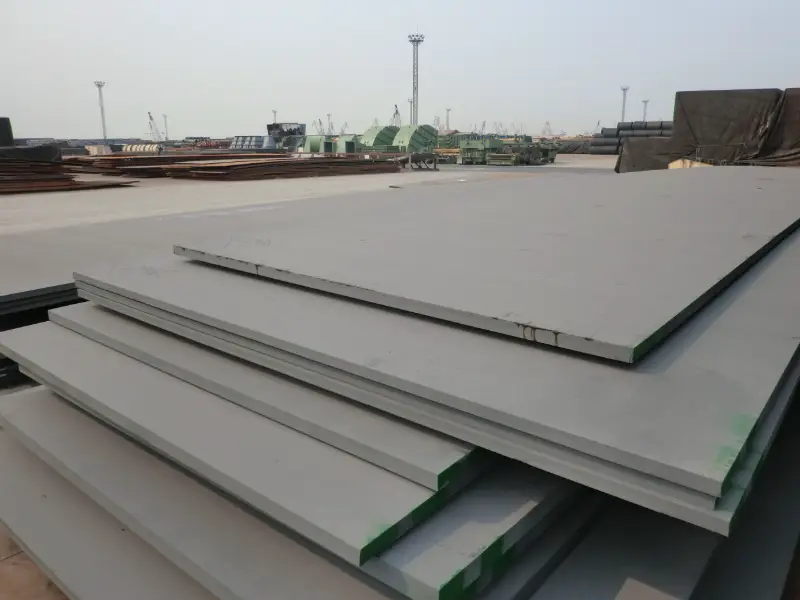
GB/T 1591 Q460D Carbon
Q460D High-Strength Low-Alloy Steel: Properties and Global Equivalents for Structural Engineering
Explore Q460D carbon and low-alloy high-strength steel plate according to GB/T 1591. Detailed data on chemical composition, mechanical and thermal properties, international equivalents, and industrial applications for reliable structural design.
Hot rolling, controlled rolling, normalizing, welding, cold bending, machining
- Phone : +8618037372205
- Email : [email protected]
- WhatsApp: Contact via Whtsapp
- WeChat: +8618037372205
GB/T 1591 Q460D Carbon Introduction
Q460D is a high-strength low-alloy structural steel grade defined in Chinese standard GB/T 1591. It offers a minimum yield strength of 460 MPa in the as-delivered condition, typically in normalized or thermo-mechanically rolled state. Key features:
- Excellent strength-to-weight ratio for lightweight structural design
- Good weldability with controlled carbon equivalent
- Guaranteed impact toughness at -20°C (D quality class)
- Suitable for cold forming and moderate bending
This grade is widely employed in heavy-duty constructions such as bridges, high-rise buildings, offshore platforms, and heavy machinery.
GB/T 1591 Q460D Carbon Chemical Composition as per GB/T 1591-2018
The chemical composition of Q460D is controlled to balance strength, toughness and weldability. Key restrictions:
- Low carbon and phosphorus/sulfur to ensure low-temperature toughness
- Microalloying elements (Nb, V, Ti) provide grain refinement and precipitation strengthening
- Aluminum acts as a deoxidizer and grain refiner
All values are ladle analysis and comply with the limits specified.
| Element | Standard Value (max, %) | Remarks |
|---|---|---|
| Carbon (C) | ≤0.20 | Ladle analysis; lower for improved weldability |
| Silicon (Si) | ≤0.60 | Deoxidizing element |
| Manganese (Mn) | ≤1.80 | Primary strengthening element |
| Phosphorus (P) | ≤0.030 | Controlled for toughness |
| Sulfur (S) | ≤0.025 | Improves machinability but limited |
| Niobium (Nb) | ≤0.11 | Grain refiner and precipitation hardener |
| Vanadium (V) | ≤0.20 | Strengthening via carbonitride formation |
| Titanium (Ti) | ≤0.20 | Grain refiner and nitride former |
| Chromium (Cr) | ≤0.30 | Residual element, may enhance hardenability |
| Nickel (Ni) | ≤0.80 | Improves toughness, residual |
| Copper (Cu) | ≤0.55 | Residual; may improve atmospheric corrosion resistance |
| Molybdenum (Mo) | ≤0.20 | May be present as residual |
| Nitrogen (N) | ≤0.015 | Controlled to avoid aging effects |
| Aluminum (Altotal) | ≥0.015 | Minimum total aluminum for grain refinement |
GB/T 1591 Q460D Carbon Thermal and Electrical Physical Properties
The following values are typical for Q460D and similar low-alloy structural steels at room temperature unless otherwise stated. They are not mandatory in the material standard but are useful for design calculations. Actual values may vary slightly with processing and temperature.
| Property | Standard Requirement | Unit | Test Condition |
|---|---|---|---|
| Density (ρ) | 7.85 | g/cm³ | Room temperature |
| Modulus of Elasticity (E) | 200 | GPa | Room temperature |
| Shear Modulus (G) | 80 | GPa | Room temperature |
| Poisson's Ratio (ν) | 0.3 | - | Room temperature |
| Coefficient of Thermal Expansion (α) | 12.0 | 10⁻⁶/K | 20 – 100°C |
| Coefficient of Thermal Expansion (α) | 12.8 | 10⁻⁶/K | 20 – 200°C |
| Coefficient of Thermal Expansion (α) | 13.5 | 10⁻⁶/K | 20 – 300°C |
| Thermal Conductivity (λ) | 45 | W/(m·K) | Room temperature |
| Specific Heat Capacity (cp) | 470 | J/(kg·K) | Room temperature |
| Electrical Resistivity (ρe) | 0.25 | μΩ·m | Room temperature |
GB/T 1591 Q460D Carbon Mechanical Properties per GB/T 1591-2018
Mechanical properties depend on product thickness. Test conditions:
- Tensile testing at room temperature on longitudinal specimens
- Impact testing (Charpy V-notch) at -20°C for D quality
- Bend test: 180° cold bend with specified mandrel diameter
Data below reflect the minimum required values for plates and wide flats up to 150 mm thickness.
| Property | Standard Requirement | Unit | Test Condition / Thickness Range |
|---|---|---|---|
| Yield Strength (ReH) | ≥460 | MPa | t ≤16 mm |
| Yield Strength (ReH) | ≥440 | MPa | 16 < t ≤ 40 mm |
| Yield Strength (ReH) | ≥420 | MPa | 40 < t ≤ 63 mm |
| Yield Strength (ReH) | ≥400 | MPa | 63 < t ≤ 80 mm |
| Yield Strength (ReH) | ≥380 | MPa | 80 < t ≤ 100 mm |
| Yield Strength (ReH) | ≥360 | MPa | 100 < t ≤ 150 mm |
| Tensile Strength (Rm) | 540 – 720 | MPa | t ≤ 16 mm |
| Tensile Strength (Rm) | 540 – 720 | MPa | 16 < t ≤ 40 mm |
| Tensile Strength (Rm) | 540 – 720 | MPa | 40 < t ≤ 63 mm |
| Tensile Strength (Rm) | 540 – 720 | MPa | 63 < t ≤ 100 mm |
| Tensile Strength (Rm) | 500 – 660 | MPa | 100 < t ≤ 150 mm |
| Elongation after fracture (A) | ≥17 | % | t ≤ 16 mm, gauge length 5.65√S0 |
| Elongation after fracture (A) | ≥17 | % | 16 < t ≤ 40 mm |
| Elongation after fracture (A) | ≥17 | % | 40 < t ≤ 63 mm |
| Elongation after fracture (A) | ≥17 | % | 63 < t ≤ 100 mm |
| Elongation after fracture (A) | ≥16 | % | 100 < t ≤ 150 mm |
| Charpy Impact Energy (KV2) | ≥47 | J | Longitudinal, -20°C, D quality |
| Bend Test (180°) | d = 3a | - | t ≤ 16 mm |
| Bend Test (180°) | d = 4a | - | 16 < t ≤ 100 mm |
| Bend Test (180°) | d = 5a | - | 100 < t ≤ 150 mm |
GB/T 1591 Q460D Carbon Direct Equivalent Material Standards and Substitute Grades
| Country/Region | Standard | Grade | Remarks |
|---|---|---|---|
| Europe | EN 10025-3 | S460N | Normalized fine-grain structural steel, similar strength and toughness; S460N is for N quality, S460NL for low temperature |
| Europe | EN 10025-3 | S460NL | Normalized with guaranteed impact at -50°C, equivalent to higher toughness requirement; can replace Q460D |
| China | GB/T 1591 | Q460D | Original grade; alternative designation for the same material |
| International (ISO) | ISO 4950-2/3 | S460N/NL | ISO standard for high yield strength steel, comparable property profile |
GB/T 1591 Q460D Carbon Application Introduction
Q460D is engineered for demanding structural applications where high strength and reliable low-temperature toughness are essential. Processing recommendations:
- Preheating before welding is usually not required for plates up to 30 mm when using low-hydrogen processes, but may be needed for thicker sections to avoid hydrogen cracking.
- Hot forming should be followed by a normalizing heat treatment to restore mechanical properties.
- Galvanizing and painting can be applied without special preparation beyond standard surface cleaning.
Typical industries and products are listed below.
Product Applications: Steel girders and bridge deck plates, High-rise building columns and beams, Offshore platform decks and nodes, Crane booms and heavy lifting equipment, Wind turbine towers and foundations, Pressure vessels and storage tanks, Truck frames and railcar components
Processed into products: Welded structural assemblies, Load-carrying beams and box girders, Tubular trusses and lattice structures, Base plates and stiffeners for heavy machinery, Excavator arms and bulldozer blades, Ship hull reinforcements
Application industries: Bridge engineering, Construction and civil infrastructure, Offshore and marine structures, Heavy machinery and cranes, Energy and power (turbines, pressure vessels), Mining and earth-moving equipment, Automotive chassis and trailers
GB/T 1591 Q460D Carbon Similar or Closely Matching Alternative Materials
| Country/Region | Standard | Grade | Remarks |
|---|---|---|---|
| Japan | JIS G3106 | SM570 | Weldable structural steel, yield ≥ 450 MPa (thickness ≤ 16 mm), tensile 570-720 MPa; similar strength level but no guaranteed -20°C impact (JIS specifies 0°C for SM570) |
| USA | ASTM A572/A572M | Grade 65 | HSLA steel, yield 450 MPa (65 ksi), tensile 550 MPa; slightly lower strength, toughness not mandatory unless supplementary requirement |
| USA | ASTM A709/A709M | Grade 65 | Structural steel for bridges, similar to A572 Gr 65; may be ordered with Charpy test requirements |
| Europe | EN 10025-4 | S460M/ML | Thermomechanically rolled fine-grain structural steel, yield 460 MPa, Charpy at -20°C (ML) or -50°C; alternative when normalized condition not mandatory |
| India | IS 2062 | E460 | High-strength structural steel, yield 460 MPa, comparable chemistry |
Notes:
- Q460D is supplied in normalized condition by default when the standard requires it, but may also be delivered in TMCP (thermo-mechanical controlled process) with mutual agreement.
- Ultrasonic testing and through-thickness properties (Z-direction) can be ordered as supplementary requirements according to GB/T 2970 or EN 10160.
- For outdoor exposure, Q460D does not have inherent atmospheric corrosion resistance (like weathering steel), so protective coatings are recommended.
- When substituting with EN S460N/NL, the carbon equivalent values (CEV) are similar, ensuring consistent weldability.
- Share



