
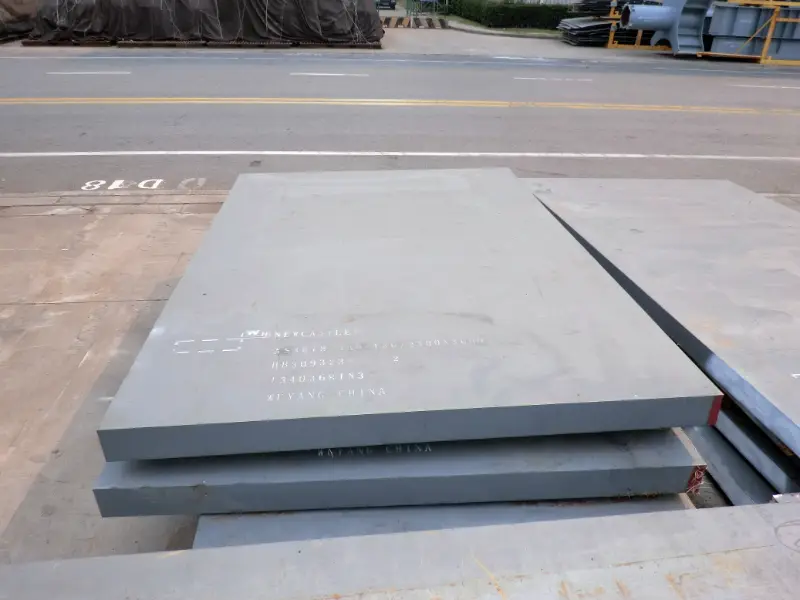
Q460E Low-Alloy High-Strength Structural Steel Plate
GB/T1591 Q460E High-Strength Low-Alloy Structural Steel Plate – Datasheet & Equivalent Grades
Q460E is a Chinese standard low-alloy high-strength structural steel with minimum yield strength of 460 MPa, excellent low-temperature toughness down to -40°C, and good weldability. Widely used in bridges, buildings, and heavy machinery.
Hot rolling, normalizing, normalizing rolling, thermomechanical rolling, welding, bending, cold forming
- Phone : +8618037372205
- Email : [email protected]
- WhatsApp: Contact via Whtsapp
- WeChat: +8618037372205
Q460E Low-Alloy High-Strength Structural Steel Plate Introduction
Q460E is a low-alloy high-strength structural steel defined in GB/T 1591-2018. It belongs to the Q460 strength class, with 'E' denoting impact testing at -40°C to guarantee excellent low-temperature toughness. The material is typically supplied in normalized or thermomechanically rolled condition, featuring fine grain structure and microalloying elements such as Nb, V, and Ti.
The steel offers a minimum yield strength of 460 MPa and tensile strength in the range of 550–720 MPa, combined with good ductility and weldability. It is suitable for welded, bolted, and riveted structures in bridge construction, high-rise buildings, offshore platforms, pressure vessels, and heavy-duty vehicles. Delivery condition is usually normalized, normalized rolled, or thermomechanical rolled, as agreed.
Q460E Low-Alloy High-Strength Structural Steel Plate Chemical Composition
The chemical composition of Q460E according to GB/T 1591-2018 is shown below. Maximum limits are given unless a range is specified. Microalloying elements Nb, V, and Ti may be added individually or in combination. The carbon equivalent (CEV) is usually controlled to ensure good weldability.
| Chemical Element | Standard Value (max %) | Remarks |
|---|---|---|
| C | ≤ 0.20 | Carbon content |
| Si | ≤ 0.60 | Silicon content |
| Mn | 1.00 – 1.70 | Manganese range |
| P | ≤ 0.020 | Phosphorus max |
| S | ≤ 0.010 | Sulfur max |
| Nb | 0.015 – 0.060 | Niobium range |
| V | 0.02 – 0.20 | Vanadium range |
| Ti | 0.02 – 0.20 | Titanium range |
| Cr | ≤ 0.70 | Chromium max |
| Ni | ≤ 0.80 | Nickel max |
| Cu | ≤ 0.55 | Copper max |
| Mo | ≤ 0.30 | Molybdenum max |
| N | ≤ 0.015 | Nitrogen max |
| Als | ≥ 0.015 (min) | Total aluminum if added |
| B | ≤ 0.0040 | Boron max (if added) |
Q460E Low-Alloy High-Strength Structural Steel Plate Thermal and Electrical Physical Properties
Physical properties are typical for low-alloy structural steels and are provided as reference data. Slight variations may occur depending on exact composition and heat treatment. Values are valid at room temperature unless otherwise stated.
| Property | Typical Value | Unit | Test Condition / Remarks |
|---|---|---|---|
| Density (ρ) | 7850 | kg/m³ | at 20°C |
| Modulus of elasticity (E) | 206 | GPa | at 20°C |
| Shear modulus (G) | 80 | GPa | at 20°C |
| Poisson's ratio (ν) | 0.30 | – | elastic range |
| Thermal expansion coefficient (α) | 12.0 × 10⁻⁶ | 1/K | between 20°C and 100°C |
| Thermal expansion coefficient (α) | 12.8 × 10⁻⁶ | 1/K | between 20°C and 200°C |
| Thermal expansion coefficient (α) | 13.5 × 10⁻⁶ | 1/K | between 20°C and 400°C |
| Thermal conductivity (λ) | 46 | W/(m·K) | at 20°C |
| Specific heat capacity (cp) | 470 | J/(kg·K) | at 20°C |
| Electrical resistivity (ρe) | 0.22 × 10⁻⁶ | Ω·m | at 20°C |
Q460E Low-Alloy High-Strength Structural Steel Plate Mechanical Properties
Mechanical properties at room temperature as specified in GB/T 1591-2018. Values are valid for the delivery condition (normalized or thermomechanically rolled) and apply for flat products. Impact energy is tested on longitudinal Charpy V-notch specimens at -40°C. The bend test requires 180° bending around a mandrel diameter related to plate thickness.
| Property | Standard Requirement | Unit | Test Condition / Thickness Range |
|---|---|---|---|
| Yield strength (ReH) | ≥ 460 | MPa | t ≤ 16 mm |
| Yield strength (ReH) | ≥ 450 | MPa | 16 < t ≤ 40 mm |
| Yield strength (ReH) | ≥ 440 | MPa | 40 < t ≤ 63 mm |
| Yield strength (ReH) | ≥ 420 | MPa | 63 < t ≤ 80 mm |
| Yield strength (ReH) | ≥ 400 | MPa | 80 < t ≤ 100 mm |
| Tensile strength (Rm) | 550 – 720 | MPa | t ≤ 100 mm |
| Elongation after fracture A | ≥ 17 | % | t ≤ 16 mm, L0=5.65√S0 |
| Elongation after fracture A | ≥ 17 | % | 16 < t ≤ 40 mm |
| Elongation after fracture A | ≥ 17 | % | 40 < t ≤ 63 mm |
| Elongation after fracture A | ≥ 17 | % | 63 < t ≤ 80 mm |
| Elongation after fracture A | ≥ 17 | % | 80 < t ≤ 100 mm |
| Impact energy (KV2) | ≥ 34 | J | -40°C, longitudinal, average of 3 specimens |
| Bend test (180°) | Crack-free | – | Mandrel dia. = 3t for t ≤ 16 mm; 4t for t > 16 mm |
Q460E Low-Alloy High-Strength Structural Steel Plate Complete Equivalent Material Standards and Recommended Substitute Grades
| Country/Region | Standard | Grade | Remarks |
|---|---|---|---|
| China | GB/T 1591-2018 | Q460E | Original grade |
| International | ISO 4950-2 | E460DD | Similar strength, normalized delivery, but may differ in impact temperature |
| European Union | EN 10025-4 | S460M / S460N / S460Q | Thermomechanical, normalized, or quenched & tempered; S460N/E460N comparable |
| United States | ASTM A913/A913M | Grade 65 [450] | High-strength low-alloy structural shapes; QST process; can match properties |
| United States | ASTM A572/A572M | Grade 65 [450] | HSLA plate; minimum yield 450 MPa; impact requirements must be specified separately |
| Japan | JIS G3106 | SM570 | High-strength structural steel; yield ≥ 460 MPa for t≤40 mm; impact test optional |
Q460E Low-Alloy High-Strength Structural Steel Plate Application Introduction
Q460E is designed for heavy welded structures requiring high strength and low-temperature toughness. It can be formed into various shapes using hot rolling, cold bending, and welding processes. Typical applications include:
Product Applications: Welded bridge girders and box sections, Built-up columns and trusses for skyscrapers, Offshore platform legs and decks, Heavy-duty truck frames and crane booms, Excavator arms and mining dump bodies, Pressure vessel shells (subject to code approval), Wind tower tubular sections
Processed into products: Flanges and webs of plate girders, Chord and web members of trusses, Boom sections and pivot pins of excavators, Reinforcement ribs and stiffeners, Lifting lugs and heavy shackles, Transverse beams in ship structures, Tower adapter flanges
Application industries: Bridge engineering, High-rise and heavy-lift building structures, Offshore and marine engineering, Mining and earthmoving machinery, Pressure vessels and storage tanks (where design codes allow), Railway and automotive heavy components, Wind turbine towers and support structures
Q460E Low-Alloy High-Strength Structural Steel Plate Similar / Approximate Substitute Material Recommendations
| Country/Region | Standard | Grade | Remarks |
|---|---|---|---|
| China | GB/T 1591-2018 | Q460C / Q460D | Lower impact test temperature (0°C and -20°C respectively); same strength |
| European Union | EN 10025-3 | S460NL | Normalized fine-grain steel; guaranteed -50°C impact, close to Q460E requirements |
| European Union | EN 10025-4 | S460ML | Thermomechanical rolled; guaranteed -50°C impact, excellent toughness |
| United States | ASTM A709/A709M | Grade 50W | Weathering structural steel; can be produced to meet Q460E strength if modified |
| South Korea | KS D 3515 | SM570 | Korean standard equivalent to JIS SM570, similar strength level |
Notes:
- For improved atmospheric corrosion resistance, a weathering version (Q460EW or similar) may be specified by agreement.
- The steel is suitable for galvanizing.
- Preheating before welding may be required depending on plate thickness and CEV; typical preheat temperature for CEV ~0.45% is 100–150°C.
- Dimensional and shape tolerances shall comply with GB/T 709 or other relevant standards.
- Inclusions and internal soundness can be verified by ultrasonic testing per GB/T 2970 if specified.
- Share



