
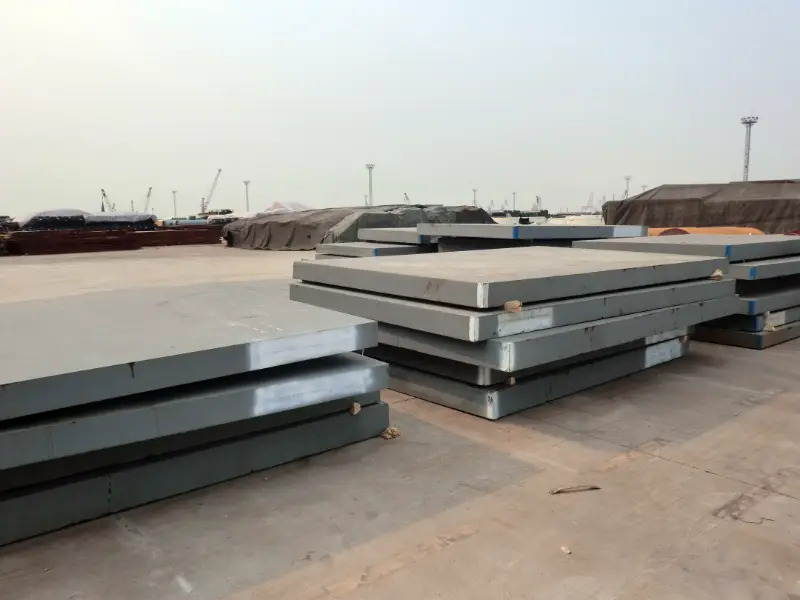
Q460C High-Strength Carbon & Low-Alloy Steel Plate
Q460C High-Strength Carbon & Low-Alloy Steel Plate - GB/T 16270 Quenched & Tempered Grade
Q460C is a Chinese standard high-strength low-alloy structural steel plate delivered in quenched and tempered condition, offering excellent strength, weldability, and impact toughness at 0°C. Widely used in heavy steel structures, bridges, and machinery.
Hot rolling, cold forming, welding, machining, thermal cutting
- Phone : +8618037372205
- Email : [email protected]
- WhatsApp: Contact via Whtsapp
- WeChat: +8618037372205
Q460C High-Strength Carbon & Low-Alloy Steel Plate Introduction
GB/T 16270 Q460C is a high-strength carbon and low-alloy structural steel plate intended for quenched and tempered delivery condition. It belongs to the Q460 series under the Chinese standard GB/T 16270-2009 (High strength structural steel plates in the quenched and tempered condition). This grade provides a minimum yield strength of 460 MPa (for thickness ≤50 mm), good ductility (minimum elongation 17%), and guaranteed Charpy impact energy of at least 47 J at 0°C (QL quality). Its controlled chemical composition ensures adequate weldability and toughness for demanding heavy-duty applications. The steel is commonly supplied in thicknesses up to 150 mm, with rolled, normalized, or quenched and tempered delivery options as agreed. It is extensively utilized in construction machinery, bridges, offshore platforms, pressure vessels, and welded structural components subjected to static and dynamic loads.
Q460C High-Strength Carbon & Low-Alloy Steel Plate Chemical Composition
The chemical composition of Q460C steel is defined in GB/T 16270-2009. The limits are designed to ensure high strength, good weldability, and low-temperature toughness. Note: Micro-alloying elements like Nb, V, Ti may be added individually or in combination, satisfying Nb+V+Ti ≤ 0.22%. Carbon equivalent (CEV) shall not exceed 0.47% for Q460C.
| Element | Standard Value (max %) | Remarks |
|---|---|---|
| C | 0.20 | |
| Si | 0.60 | |
| Mn | 1.70 | |
| P | 0.020 | |
| S | 0.010 | |
| Cr | 0.70 | |
| Ni | 0.70 | |
| Mo | 0.35 | |
| Cu | 0.50 | |
| Nb | 0.06 | If added; Nb+V+Ti ≤ 0.22% |
| V | 0.08 | If added; Nb+V+Ti ≤ 0.22% |
| Ti | 0.05 | If added; Nb+V+Ti ≤ 0.22% |
| B | 0.005 |
Q460C High-Strength Carbon & Low-Alloy Steel Plate Thermal and Electrical Physical Properties
Physical properties are typical for low-alloy high-strength structural steels and are not mandatory in GB/T 16270. The values provided are reference data for room temperature unless otherwise noted. Variations may occur depending on exact composition and heat treatment condition.
| Property | Typical Value | Unit | Test Condition |
|---|---|---|---|
| Density (ρ) | 7.85 | g/cm³ | 20°C |
| Modulus of Elasticity (E) | 210 | GPa | 20°C |
| Shear Modulus (G) | 80 | GPa | 20°C |
| Poisson's Ratio (ν) | 0.3 | — | 20°C |
| Thermal Expansion Coefficient (α) | 12.0 | 10⁻⁶/K | 20-100°C |
| Thermal Conductivity (λ) | 45 | W/(m·K) | 20°C |
| Specific Heat Capacity | 460 | J/(kg·K) | 20°C |
| Electrical Resistivity (ρ_e) | 0.20 | μΩ·m | 20°C |
Q460C High-Strength Carbon & Low-Alloy Steel Plate Mechanical Properties
The mechanical properties of Q460C steel plates are specified according to GB/T 16270-2009, measured on transverse test pieces in quenched and tempered condition. Note: Yield strength (ReH) and elongation (A) vary with plate thickness. Impact test is performed on Charpy V-notch specimens at 0°C. Bending test uses a mandrel diameter of 3×thickness (t≤50mm) or 4×thickness (50
Property Required Value Unit Testing Condition Yield Strength (ReH) ≥460 MPa Plate thickness ≤50 mm Yield Strength (ReH) ≥440 MPa 50 mm < thickness ≤100 mm Tensile Strength (Rm) 550 - 720 MPa thickness ≤100 mm Elongation (A) ≥17 % Gauge length 5.65√S₀, thickness ≤50 mm Elongation (A) ≥16 % Gauge length 5.65√S₀, 50 mm < thickness ≤100 mm Impact Energy (KV₂) ≥47 J 0°C, Charpy V-notch, transverse Bend Test (Mandrel diameter d) d=3a — 180° bending, a = plate thickness ≤50 mm Bend Test (Mandrel diameter d) d=4a — 180° bending, 50 mm < a ≤100 mm
Q460C High-Strength Carbon & Low-Alloy Steel Plate Fully Equivalent Material Standards and Substitute Grades
| Country/Region | Standard | Grade | Remarks |
|---|---|---|---|
| China | GB/T 16270-2009 | Q460C | Original standard and grade, impact test at 0°C |
| — | — | — | No other international standard provides an exact chemical and property match with the same impact temperature. |
Q460C High-Strength Carbon & Low-Alloy Steel Plate Application Introduction
Due to its high strength, good weldability, and guaranteed 0°C toughness, Q460C steel is suitable for a wide range of heavy-duty structural applications. It can be processed by cutting, bending, and welding using standard procedures for quenched and tempered steels. Preheating and post-weld heat treatment may be required for thick sections to avoid cold cracking.
Product Applications: Welded H-beams and box columns, Bridge deck plates and girders, Pressure vessel shells and heads, Excavator booms and arms, Offshore platform legs and nodes, Heavy-duty vehicle chassis, Storage tanks for low-temperature service
Processed into products: Crane main chords and lattice members, Bulldozer blades and ripper shanks, Hydraulic cylinder bodies, Structural nodes and gusset plates, Crawler crane crawler frames, Wind turbine tower flanges and stiffeners, Ship stiffeners and marine hatch covers
Application industries: Construction and infrastructure, Bridge engineering, Shipbuilding and marine structures, Offshore oil and gas platforms, Mining and heavy machinery, Transportation equipment (truck frames, crane booms), Power generation (wind turbine towers, hydraulic structures)
Q460C High-Strength Carbon & Low-Alloy Steel Plate Similar / Comparable Alternative Material Recommendations
| Country/Region | Standard | Grade | Remarks |
|---|---|---|---|
| European Union | EN 10025-6:2004 | S460Q | Quenched and tempered; minimum yield 460 MPa; impact test at -20°C (better than Q460C). Chemical composition differs slightly. |
| European Union | EN 10025-6:2004 | S460QL | Quenched and tempered; minimum yield 460 MPa; impact test at -40°C. Not identical. |
| International | ISO 4950-2:1995 | E460DD | High yield strength steel plates; minimum yield 460 MPa; impact test at -20°C. |
| USA | ASTM A514/A514M | Grade B, H, Q | Quenched and tempered alloy steel; minimum yield 690 MPa; significantly higher strength level, different chemistry. |
| Japan | JIS G 3128 | SHY685 | High yield strength steel for welded structures; yield ≥685 MPa, higher strength class. |
Notes:
Welding considerations: Q460C is readily weldable using common processes (SMAW, GMAW, SAW) with low-hydrogen electrodes and proper preheat/interpass temperatures. CEV requirement: The carbon equivalent (CEV) shall not exceed 0.47% to ensure weldability. Ultrasonic testing: Plates can be ordered with ultrasonic inspection according to GB/T 2970 or other standards upon agreement. Through-thickness properties: Z-grade (Z15, Z25, Z35) are available as per GB/T 5313 if lamellar tearing resistance is required. Dimensional tolerances: Conform to GB/T 709 for plates.
- Share



