
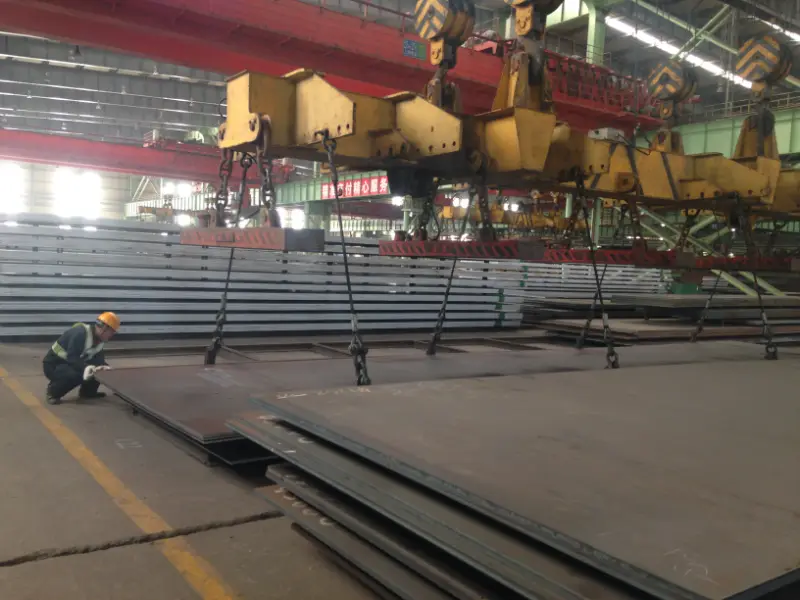
GB/T 16270 Q460D High-Strength Quenched and Tempered Steel Plate
Q460D High-Strength Quenched and Tempered Steel Plate Under GB/T 16270
Detailed material data for Q460D steel plate according to GB/T 16270, including chemical composition, mechanical properties, thermal and electrical physical properties, and international equivalents.
Welding, cutting, cold forming, machining, hot forging (after re-heating to appropriate temperatures)
- Phone : +8618037372205
- Email : [email protected]
- WhatsApp: Contact via Whtsapp
- WeChat: +8618037372205
GB/T 16270 Q460D High-Strength Quenched and Tempered Steel Plate Introduction
Q460D is a high-strength low-alloy (HSLA) quenched and tempered structural steel plate specified in GB/T 16270. It offers a minimum yield strength of 460 MPa and is supplied in the heat-treated condition (quenched and tempered). The 'D' quality level guarantees a minimum Charpy V-notch impact energy of 47 J at -20°C. This grade combines high strength with good weldability and toughness, making it suitable for demanding structural applications in heavy machinery, bridges, pressure vessels, and offshore engineering. Its carefully controlled chemical composition and carbon equivalent ensure reliable performance even in thick sections.
GB/T 16270 Q460D High-Strength Quenched and Tempered Steel Plate Chemical Composition
The chemical composition is in accordance with GB/T 16270 for grade Q460D. Elements such as Nb, V, Ti, Cr, Ni, Mo may be added singly or in combination to achieve the required mechanical properties. Aluminium is added as a grain refiner. Maximum limits are given for residual elements. The carbon equivalent (CEV) is normally controlled to guarantee weldability.
| Element | Standard Value (max, unless range) | Remarks |
|---|---|---|
| Carbon (C) | ≤ 0.20 | |
| Silicon (Si) | ≤ 0.80 | |
| Manganese (Mn) | ≤ 1.70 | |
| Phosphorus (P) | ≤ 0.025 | |
| Sulfur (S) | ≤ 0.015 | |
| Aluminium (Altotal) | ≥ 0.015 | Total aluminium |
| Niobium (Nb) | ≤ 0.06 | If added |
| Vanadium (V) | ≤ 0.20 | If added |
| Titanium (Ti) | ≤ 0.20 | If added |
| Chromium (Cr) | ≤ 0.70 | If added |
| Nickel (Ni) | ≤ 0.80 | If added |
| Molybdenum (Mo) | ≤ 0.30 | If added |
| Copper (Cu) | ≤ 0.50 | If added |
| Boron (B) | ≤ 0.004 | If added |
GB/T 16270 Q460D High-Strength Quenched and Tempered Steel Plate Thermal and Electrical Physical Properties
The physical properties are typical for quenched and tempered low-alloy steel at room temperature unless otherwise stated. Actual values may vary depending on the exact chemical composition and heat treatment condition.
| Property | Typical Value | Unit | Test Condition |
|---|---|---|---|
| Density (ρ) | 7.85 | g/cm³ | 20°C |
| Modulus of elasticity (E) | 206 | GPa | 20°C |
| Shear modulus (G) | 80 | GPa | 20°C |
| Poisson's ratio (ν) | 0.30 | - | 20°C |
| Thermal expansion coefficient (α) | 12.5 × 10&supminus;&sup6; | K&supminus;¹ | 20 to 100°C |
| Thermal conductivity (λ) | 42 | W/(m·K) | 20°C |
| Specific heat capacity (c) | 460 | J/(kg·K) | 20°C |
| Electrical resistivity (ρe) | 0.23 × 10&supminus;&sup6; | Ω·m | 20°C |
GB/T 16270 Q460D High-Strength Quenched and Tempered Steel Plate Mechanical Properties
Mechanical properties are based on GB/T 16270 for quenched and tempered plates. The yield strength, tensile strength, elongation, and impact energy vary with plate thickness. Transverse V-notch Charpy impact tests are performed at -20°C for grade D. Bend test shall be carried out with the specified mandrel diameter for a 180° bend without cracking.
| Property | Required Value | Unit | Test Condition / Thickness |
|---|---|---|---|
| Yield strength (ReH) | ≥ 460 | MPa | Thickness ≤ 50 mm |
| Yield strength (ReH) | ≥ 440 | MPa | 50 mm < thickness ≤ 100 mm |
| Yield strength (ReH) | ≥ 420 | MPa | 100 mm < thickness ≤ 150 mm |
| Tensile strength (Rm) | 550 to 720 | MPa | All thicknesses |
| Elongation after fracture (A) | ≥ 17 | % | Thickness ≤ 50 mm, gauge length 5.65√So |
| Elongation after fracture (A) | ≥ 16 | % | 50 mm < thickness ≤ 100 mm |
| Elongation after fracture (A) | ≥ 15 | % | 100 mm < thickness ≤ 150 mm |
| Bend test (d = mandrel diameter, a = specimen thickness) | d = 2a | - | Thickness ≤ 16 mm |
| Bend test | d = 3a | - | 16 mm < thickness ≤ 50 mm |
| Bend test | d = 3a | - | 50 mm < thickness ≤ 100 mm |
| Bend test | d = 4a | - | 100 mm < thickness ≤ 150 mm |
| Charpy V-notch impact energy (KV2) | ≥ 47 | J | -20°C, longitudinal specimen |
GB/T 16270 Q460D High-Strength Quenched and Tempered Steel Plate Fully Equivalent Material Standards and Replaceable Grades
| Country / Region | Standard | Grade | Remarks |
|---|---|---|---|
| Europe | EN 10025-6 | S460Q | Quenched and tempered, -20°C impact, similar strength and chemical composition. |
| International | ISO 630-3 | S460Q | High-strength plate, quenched and tempered, quality Q (-20°C). |
GB/T 16270 Q460D High-Strength Quenched and Tempered Steel Plate Application Introduction
Q460D is ideally suited for welded heavy-duty structures where high strength, good toughness at low temperatures, and excellent weldability are required. Its quenched and tempered condition ensures uniform mechanical properties through the thickness. Typical manufacturing processes include plasma/laser/flame cutting, bending, welding, and machining. Preheating for welding is recommended for thick sections to avoid cold cracking.
Product Applications: Heavy steel bridges and structural frames, Offshore wind turbine foundations, Lifting and mobile crane booms, Hydraulic press components, Large diameter penstocks and pipes, Armour and blast-resistant structures
Processed into products: Flanges and webs in plate girders, Boom sections and outriggers for mobile cranes, Hydro-electric turbine stay rings, Pressure vessel shell courses, Excavator bucket bodies and arms, Transition pieces for offshore wind towers
Application industries: Construction and infrastructure (bridges, high-rise buildings, stadiums), Offshore and marine engineering (platforms, decks, jack-up rigs), Pressure vessel and boiler manufacturing, Mining and earth-moving equipment, Power generation (turbine casings, generator frames), Transportation (heavy-duty trailers, rail components)
GB/T 16270 Q460D High-Strength Quenched and Tempered Steel Plate Similar / Substitute Material Recommendations
| Country / Region | Standard | Grade | Remarks |
|---|---|---|---|
| China | GB/T 16270 | Q460C | Lower toughness (0°C impact), otherwise similar properties. |
| China | GB/T 16270 | Q460E | Higher toughness (-40°C impact), otherwise similar. |
| Europe | EN 10025-6 | S460QL | -40°C impact, similar strength, suitable for colder conditions. |
| Japan | JIS G 3106 | SM570 | Similar strength level but different delivery condition (as-rolled / normalized). |
| USA | ASTM A514 / A517 | Grade E / Q | Quenched and tempered alloy steel plates with comparable strength but different chemistry. |
Notes:
Delivery condition: The plates are supplied in the quenched and tempered (Q+T) condition. Carbon equivalent (CEV): Usually limited to CEV ≤ 0.47–0.50% to ensure good field weldability. Ultrasonic testing: Can be supplied according to EN 10160 or ISO 16809 upon agreement. Surface quality: According to GB/T 14977 or agreed options.
- Share



