
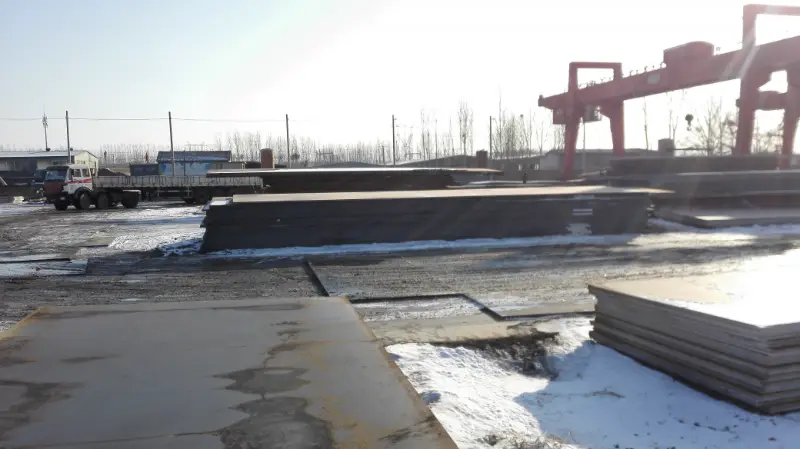
Q420E Low-Alloy High-Strength Structural Steel Plate
Q420E Low-Alloy High-Strength Structural Steel Plate | GB/T 1591 Standard
Comprehensive technical data for Q420E carbon and low-alloy high-strength steel plate according to GB/T 1591, including chemistry, mechanical properties, thermal properties, and international equivalents.
Hot rolling, controlled rolling, normalizing, thermo-mechanical controlled processing (TMCP), welding, cutting, cold forming
- Phone : +8618037372205
- Email : [email protected]
- WhatsApp: Contact via Whtsapp
- WeChat: +8618037372205
Q420E Low-Alloy High-Strength Structural Steel Plate Introduction
Q420E is a low-alloy high-strength structural steel grade specified in GB/T 1591, with a minimum yield strength of 420 MPa and excellent low-temperature impact toughness (guaranteed at -40 °C). It belongs to the Q420 strength class and quality grade E, offering a good combination of strength, weldability, and notch toughness. The steel is typically supplied in the as-rolled, normalized, or thermo-mechanically controlled processed (TMCP) condition. Key applications include welded structures, bridges, offshore platforms, and heavy machinery where both high load-bearing capacity and reliable performance in cold environments are required.
Q420E Low-Alloy High-Strength Structural Steel Plate Chemical Composition
The chemical composition of Q420E as specified in GB/T 1591-2018 is shown below. Microalloying elements such as Nb, V, Ti may be added singly or in combination to achieve grain refinement and precipitation strengthening. The total aluminum content (Alt) or acid-soluble aluminum (Als) is specified to ensure sufficient deoxidation. All values are maximum unless a range is indicated.
| Element | Standard Value (max, %) | Remarks |
|---|---|---|
| C | 0.20 | |
| Si | 0.50 | |
| Mn | 1.70 | |
| P | 0.020 | Quality grade E requires lower P |
| S | 0.010 | Quality grade E requires lower S |
| Nb | 0.07 | May be added singly or in combination |
| V | 0.20 | May be added singly or in combination |
| Ti | 0.20 | May be added singly or in combination |
| Cr | 0.30 | |
| Ni | 0.80 | |
| Cu | 0.50 | |
| Mo | 0.20 | |
| N | 0.015 | |
| Als | ≥ 0.015 | Acid-soluble aluminum, minimum value |
Q420E Low-Alloy High-Strength Structural Steel Plate Thermal and Electrical Physical Properties
Typical physical properties for low-alloy carbon-manganese steels similar to Q420E. These values are not specified in the product standard and are provided for general engineering reference. They may vary slightly depending on the exact chemical composition and heat treatment condition.
| Property | Typical Value | Unit | Test Condition / Remarks |
|---|---|---|---|
| Density (ρ) | 7.85 | g/cm³ | at 20 °C |
| Modulus of Elasticity (E) | 200 – 210 | GPa | at 20 °C |
| Shear Modulus (G) | ≈ 80 | GPa | estimated |
| Poisson's Ratio (ν) | 0.3 | — | typical for steel |
| Thermal Expansion Coeff. (α) | 12.0 | 10⁻⁶ /K | 20 – 100 °C |
| Thermal Expansion Coeff. (α) | 12.5 | 10⁻⁶ /K | 20 – 200 °C |
| Thermal Expansion Coeff. (α) | 13.0 | 10⁻⁶ /K | 20 – 300 °C |
| Thermal Conductivity (λ) | 45 | W/(m·K) | at 100 °C |
| Thermal Conductivity (λ) | 42 | W/(m·K) | at 200 °C |
| Thermal Conductivity (λ) | 39 | W/(m·K) | at 300 °C |
| Specific Heat Capacity | 470 | J/(kg·K) | 20 – 100 °C (approx.) |
| Electrical Resistivity (ρₑ) | 0.25 | μΩ·m | at 20 °C |
Q420E Low-Alloy High-Strength Structural Steel Plate Mechanical Properties
Minimum mechanical properties for Q420E according to GB/T 1591-2018. The values apply to longitudinal test pieces. Charpy V-notch impact energy is guaranteed at -40 °C. Bending test specimens have width b = 35 mm; bending angle 180°.
| Property | Standard Requirement | Unit | Test Condition / Thickness Range |
|---|---|---|---|
| Yield Strength (ReH) | ≥ 420 | MPa | t ≤ 16 mm |
| Yield Strength (ReH) | ≥ 400 | MPa | 16 mm < t ≤ 40 mm |
| Yield Strength (ReH) | ≥ 380 | MPa | 40 mm < t ≤ 63 mm |
| Yield Strength (ReH) | ≥ 360 | MPa | 63 mm < t ≤ 80 mm |
| Yield Strength (ReH) | ≥ 360 | MPa | 80 mm < t ≤ 100 mm |
| Yield Strength (ReH) | ≥ 340 | MPa | 100 mm < t ≤ 150 mm |
| Yield Strength (ReH) | ≥ 330 | MPa | 150 mm < t ≤ 200 mm |
| Yield Strength (ReH) | ≥ 320 | MPa | 200 mm < t ≤ 250 mm |
| Tensile Strength (Rm) | 520 – 680 | MPa | all thicknesses |
| Elongation after fracture (A) | ≥ 19 | % | t ≤ 40 mm |
| Elongation after fracture (A) | ≥ 18 | % | 40 mm < t ≤ 63 mm |
| Elongation after fracture (A) | ≥ 18 | % | 63 mm < t ≤ 100 mm |
| Elongation after fracture (A) | ≥ 18 | % | 100 mm < t ≤ 150 mm |
| Elongation after fracture (A) | ≥ 17 | % | 150 mm < t ≤ 200 mm |
| Elongation after fracture (A) | ≥ 17 | % | 200 mm < t ≤ 250 mm |
| Charpy Impact Energy (KV₂) | ≥ 34 | J | Longitudinal, -40 °C |
| Bend Test (mandrel diameter) | d = 2a | — | t ≤ 16 mm, 180° bend |
| Bend Test (mandrel diameter) | d = 3a | — | 16 mm < t ≤ 100 mm, 180° bend |
Q420E Low-Alloy High-Strength Structural Steel Plate Fully Equivalent Material Standards and Replaceable Grades
| Country/Region | Standard | Grade | Remarks |
|---|---|---|---|
| Europe | EN 10025-4 | S420ML | TMCP delivery; minimum yield 420 MPa; impact at -50 °C (27J), equivalent to Q420E when agreed with -40 °C and 34J. |
| International | ISO 4950-2 | E420 (with appropriate suffix) | High yield strength flat products; normalized or controlled rolled; should specify quality level equivalent to E420E for -40 °C impact. |
| Japan | JIS G3106 | SM490 (requiring supplementary low-temperature impact) | SM490 has higher tensile range (490-610 MPa); yield 325-365 MPa; not direct equivalent but may be modified with extra requirements. |
Q420E Low-Alloy High-Strength Structural Steel Plate Application Introduction
Q420E combines high strength, good weldability, and excellent low-temperature toughness, making it suitable for heavy-duty welded structures operating in cold climates. Typical uses include:
- Bridges (road, railway, pedestrian) and bridge components
- High-rise building frames and structural columns
- Offshore platforms, ship hulls, and marine structures
- Pressure vessels and storage tanks (with appropriate design codes)
- Lifting and transport equipment (cranes, aerial platforms, heavy vehicle chassis)
- Mining and earth-moving machinery
- Power transmission poles and wind turbine towers
Product Applications: Welded structural frameworks, Bridge girders and box sections, Ship plates and stiffeners, Offshore platform modules, Crane booms and chassis, Heavy vehicle frames, Tower masts and poles, Industrial storage tanks
Processed into products: Flanges and webs of welded beams, Connecting plates and gussets, Column base plates, End plates and stiffeners, Chords and braces in lattice structures, Boom sections for crawler cranes, Ring frames for wind tower sections, Welded pipe piles
Application industries: Civil engineering and construction, Bridge building, Shipbuilding and offshore engineering, Pressure vessel manufacturing, Heavy machinery, Railway and transportation, Energy (wind power, power transmission)
Q420E Low-Alloy High-Strength Structural Steel Plate Similar or Substitute Materials
| Country/Region | Standard | Grade | Remarks |
|---|---|---|---|
| China | GB/T 1591 | Q420D | Same strength class, but impact guaranteed only at -20 °C; suitable for less severe cold conditions. |
| China | GB/T 1591 | Q460E | Next higher strength class (460 MPa min yield) with -40 °C impact; good alternative for higher load requirements. |
| Europe | EN 10025-3 | S420N / S420NL | Normalized delivery; S420NL guarantees -50 °C impact; yield 420 MPa; very close match when TMCP is not required. |
| USA | ASTM A572 / A709 | Grade 60 (415) / Grade 50W | Min yield 415 MPa (Grade 60) or 345 MPa (Grade 50W); no mandatory low-temperature impact; requires supplementary requirements for -40 °C. |
Notes:
Q420E is typically supplied with a minimum impact energy requirement of 34 J at -40 °C in the longitudinal direction. When used for critical welded connections, preheating may be required depending on thickness and hydrogen control. Carbon equivalent (CEV) values are usually controlled to ensure good weldability; the standard CEV maximum is normally 0.45–0.47% for this grade. Delivery condition should be clearly specified (e.g., TMCP) to guarantee the required toughness. This data is based on GB/T 1591-2018; for earlier editions check for possible differences in S and P limits.
- Share



