
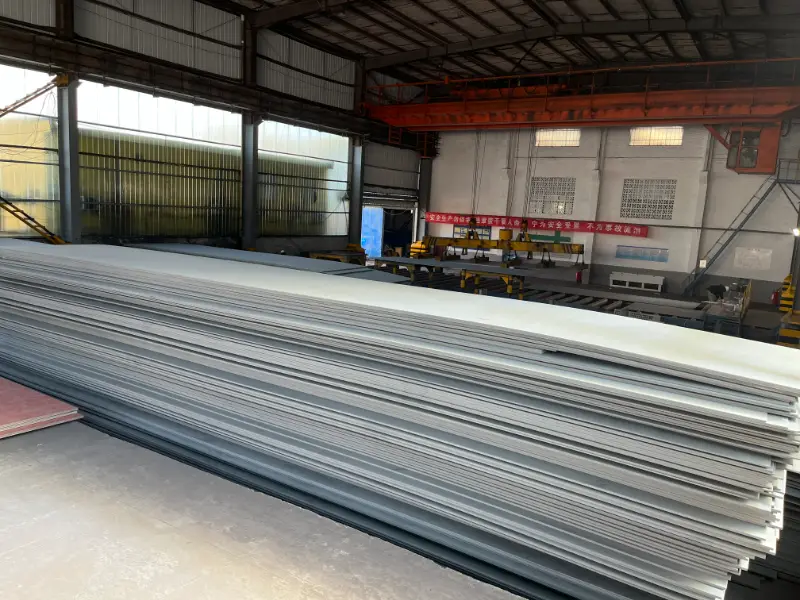
Q420D High-Strength Low-Alloy Steel Plate
Q420D High-Strength Low-Alloy Steel Plate: Properties, Equivalents, and Applications per GB/T 1591
Explore the chemical composition, mechanical and physical properties, international equivalents, and typical applications of Q420D carbon and low-alloy high-strength structural steel plate according to Chinese standard GB/T 1591.
Hot rolling, controlled rolling, normalizing, normalizing rolling, thermo-mechanical control process (TMCP), welding, cold forming
- Phone : +8618037372205
- Email : [email protected]
- WhatsApp: Contact via Whtsapp
- WeChat: +8618037372205
Q420D High-Strength Low-Alloy Steel Plate Introduction
Q420D is a Chinese standard (GB/T 1591) low-alloy high-strength structural steel offering a minimum yield strength of 420 MPa for thicknesses up to 16 mm. As a quality grade D steel, it delivers guaranteed impact toughness at -20 °C, making it suitable for demanding welded structures subjected to low-temperature service. It features good weldability, cold formability, and high strength, enabling weight reduction and robust design. Typical delivery conditions include hot rolling, controlled rolling, normalizing, or thermo-mechanical control process (TMCP), providing flexibility for structural, bridge, shipbuilding, and heavy machinery applications.
Q420D High-Strength Low-Alloy Steel Plate Chemical Composition
Chemical composition limits for Q420D according to GB/T 1591-2018. The steel is microalloyed with niobium, vanadium, and/or titanium to achieve grain refinement and precipitation strengthening. At least one of these elements shall be present with a minimum content of 0.015% when added in combination. Aluminium is used for deoxidation and grain refinement (acid-soluble or total aluminium).
| Element | Specified Value (wt.%) | Remarks |
|---|---|---|
| Carbon (C) | ≤ 0.20 | Max |
| Silicon (Si) | ≤ 0.50 | Max |
| Manganese (Mn) | ≤ 1.70 | Max |
| Phosphorus (P) | ≤ 0.030 | Max |
| Sulfur (S) | ≤ 0.025 | Max |
| Niobium (Nb) | ≤ 0.07 | Max |
| Vanadium (V) | ≤ 0.20 | Max |
| Titanium (Ti) | ≤ 0.20 | Max |
| Chromium (Cr) | ≤ 0.30 | Max |
| Nickel (Ni) | ≤ 0.80 | Max |
| Copper (Cu) | ≤ 0.30 | Max |
| Molybdenum (Mo) | ≤ 0.20 | Max |
| Nitrogen (N) | ≤ 0.015 | Max |
| Aluminium (Als or Alt) | Als ≥ 0.015 or Alt ≥ 0.020 | Min (acid-soluble or total) |
Q420D High-Strength Low-Alloy Steel Plate Thermal and Electrical Physical Properties
The following physical properties are typical reference values for low-alloy structural steels and are not specified in GB/T 1591. They can be used for design calculations, thermal analysis, and welding simulations. Actual values may vary slightly with composition and heat treatment.
| Property | Typical Value | Unit | Test Condition |
|---|---|---|---|
| Density (ρ) | 7.85 | g/cm³ | At 20 °C |
| Elastic modulus (E) | 200 | GPa | Room temperature |
| Shear modulus (G) | 80 | GPa | Room temperature |
| Poisson's ratio (ν) | 0.3 | — | Room temperature |
| Thermal expansion coefficient (α) | 12 × 10⁻⁶ | K⁻¹ | 20 – 100 °C |
| Thermal conductivity (λ) | ~50 | W/(m·K) | At 20 °C |
| Specific heat capacity | ~460 | J/(kg·K) | At 20 °C |
| Electrical resistivity (ρₑ) | ~0.2 | µΩ·m | At 20 °C |
Q420D High-Strength Low-Alloy Steel Plate Mechanical Properties
Tensile and impact properties depend on the product thickness. The steel must meet the specified values in the as-delivered condition. Impact test temperature for grade D is -20 °C, with a minimum absorbed energy of 47 J on longitudinal Charpy V-notch specimens (applies to thicknesses ≥6 mm). Bending test (180°) is mandatory; for thickness >100 mm the bend diameter is subject to agreement.
| Property | Required Value | Unit | Test Condition |
|---|---|---|---|
| Yield Strength (ReH) | ≥ 420 | MPa | Thickness ≤ 16 mm |
| Yield Strength (ReH) | ≥ 400 | MPa | Thickness > 16 – 40 mm |
| Yield Strength (ReH) | ≥ 380 | MPa | Thickness > 40 – 63 mm |
| Yield Strength (ReH) | ≥ 360 | MPa | Thickness > 63 – 80 mm |
| Yield Strength (ReH) | ≥ 360 | MPa | Thickness > 80 – 100 mm |
| Yield Strength (ReH) | ≥ 340 | MPa | Thickness > 100 – 150 mm |
| Tensile Strength (Rm) | 520 – 680 | MPa | All thicknesses |
| Elongation (A) | ≥ 19 | % | Thickness ≤ 40 mm (gauge length 5.65√S₀) |
| Elongation (A) | ≥ 18 | % | Thickness > 40 – 63 mm |
| Elongation (A) | ≥ 18 | % | Thickness > 63 – 100 mm |
| Elongation (A) | ≥ 18 | % | Thickness > 100 – 150 mm |
| Impact Energy (KV₂) | ≥ 47 | J | -20 °C, longitudinal, thickness ≥ 6 mm |
| Bend Test (180°) | d = a | Thickness ≤ 16 mm | |
| Bend Test (180°) | d = 3a | Thickness > 16 – 100 mm | |
| Bend Test (180°) | By agreement | Thickness > 100 – 150 mm |
Q420D High-Strength Low-Alloy Steel Plate Fully Equivalent International Standards and Grades
| Country/Region | Standard | Grade | Remarks |
|---|---|---|---|
| China | GB/T 1591-2018 | Q420D | Original specification; no exact international counterpart exists. |
Q420D High-Strength Low-Alloy Steel Plate Application Introduction
Q420D steel is engineered for structures that demand high strength-to-weight ratios and reliable toughness at sub-zero temperatures. Its balanced composition permits efficient welding and forming, reducing fabrication costs. Typical uses include:
Product Applications: High-strength welded structural frameworks, Offshore platform modules, Heavy machinery chassis and frames, Long-span bridge girders, Multi-story building steel structures, Liquefied gas storage tanks and pressure vessels
Processed into products: Welded H-beams and box columns, Crane boom and outrigger sections, Ship hull plates and stiffeners, Pressure vessel shells and heads, Bridge box girders and arches, Vehicle chassis and subframes
Application industries: Construction and civil engineering, Bridge engineering, Shipbuilding and offshore engineering, Automotive and transportation, Lifting and hoisting equipment, Pressure vessel and storage tank manufacturing
Q420D High-Strength Low-Alloy Steel Plate Similar or Alternative Grades for Comparison
| Country/Region | Standard | Grade | Remarks |
|---|---|---|---|
| European Union | EN 10025-3 | S420N | Normalized/normalized rolled; min yield 420 MPa (t≤16 mm), impact -20 °C ≥40 J. Different delivery condition and sulfur/phosphorus limits. |
| European Union | EN 10025-3 | S420NL | Normalized/normalized rolled; impact -50 °C ≥27 J. Higher toughness level. |
| USA | ASTM A572/A572M | Grade 65 [450] | Yield ≥450 MPa, but no mandatory impact test; closer in strength but not toughness. |
| Japan | JIS G3106 | SM490YA | Yield ≥365 MPa, impact at 0 °C; lower strength but often used in similar welded structures. |
| International | ISO 4950-2:1995 (withdrawn) | E420DD | High yield strength structural steel, delivery condition normalizing or TMCP; now obsolete. |
| China | GB/T 1591 | Q390D | Yield ≥390 MPa, same -20 °C impact; lower strength alternative within same standard family. |
Notes:
Q420D can be supplied with additional requirements such as through-thickness tensile testing (Z25/Z35) for lamellar tearing resistance, ultrasonic testing per GB/T 2970, or specific carbon equivalent limits to improve weldability. The grade is covered under GB/T 1591-2018, which harmonizes with the latest Chinese steel standards. Always refer to the applicable edition of the standard for current requirements, especially for thicknesses above 100 mm where some properties are agreed upon.
- Share



