
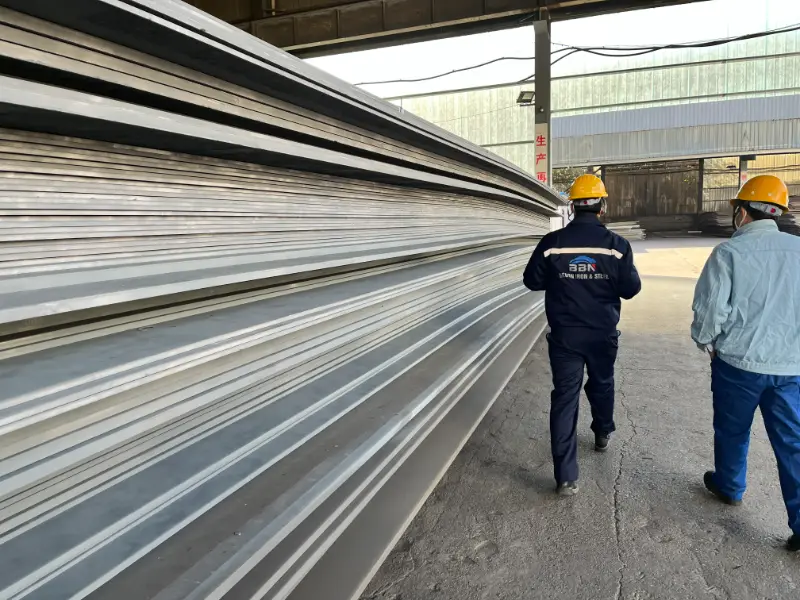
Q420C High-Strength Low-Alloy Structural Steel Plate per GB/T 1591
Q420C High-Strength Low-Alloy Structural Steel Plate per GB/T 1591 - Composition, Properties & Equivalent Grades
Comprehensive data sheet for Q420C carbon and low-alloy high-strength steel plate according to GB/T 1591, including chemical composition, mechanical properties, thermal and electrical physical properties, international equivalents, and typical applications.
Hot rolling, normalizing rolling, thermomechanical rolling (TMCP), normalizing, or quenching and tempering (optional for heavy sections)
- Phone : +8618037372205
- Email : [email protected]
- WhatsApp: Contact via Whtsapp
- WeChat: +8618037372205
Q420C High-Strength Low-Alloy Structural Steel Plate per GB/T 1591 Introduction
Q420C is a low-alloy high-strength structural steel grade specified in the Chinese standard GB/T 1591-2018. It is classified as a high-strength steel with a minimum yield strength of 420 MPa in thicknesses up to 16 mm. The steel offers good weldability, excellent toughness at 0°C, and moderate atmospheric corrosion resistance. Typical delivery conditions include hot-rolled, normalized rolled, thermomechanically controlled processed (TMCP), or normalized.
- Grade designator 'Q' stands for yield strength, '420' for minimum yield strength in MPa, and 'C' for impact test temperature at 0°C with minimum impact energy of 47 J.
- It is widely used in welded structural components requiring high strength and good cold-forming characteristics, such as bridges, building structures, and heavy machinery.
- The steel is microalloyed with elements like Nb, V, Ti to achieve fine grain strengthening and precipitation hardening.
Q420C High-Strength Low-Alloy Structural Steel Plate per GB/T 1591 Chemical Composition
Chemical composition requirements according to GB/T 1591-2018 for Q420C. The steel must contain at least one grain-refining element (Nb, V, Ti, or Al). For Al-killed steels, total Al ≥ 0.020% or acid-soluble Al ≥ 0.015%. Ceq ≤ 0.45% for thicknesses ≤ 100 mm. Other residual elements are limited as indicated.
| Chemical Element | Standard Value (%) | Remarks |
|---|---|---|
| Carbon (C) | ≤ 0.20 | Maximum |
| Silicon (Si) | ≤ 0.55 | Maximum |
| Manganese (Mn) | ≤ 1.70 | Maximum |
| Phosphorus (P) | ≤ 0.025 | Maximum |
| Sulfur (S) | ≤ 0.020 | Maximum |
| Niobium (Nb) | ≤ 0.07 | Grain refiner; if used alone or in combination |
| Vanadium (V) | ≤ 0.20 | Grain refiner; if used |
| Titanium (Ti) | ≤ 0.20 | Grain refiner; if used |
| Chromium (Cr) | ≤ 0.30 | Maximum |
| Nickel (Ni) | ≤ 0.80 | Maximum |
| Copper (Cu) | ≤ 0.30 | Maximum |
| Molybdenum (Mo) | ≤ 0.20 | Maximum |
| Nitrogen (N) | ≤ 0.015 | Maximum; if not fixed by Ti or Al |
| Aluminum (Altotal) | ≥ 0.020 | If Al is used as grain refiner; or Als ≥ 0.015 |
Q420C High-Strength Low-Alloy Structural Steel Plate per GB/T 1591 Thermal and Electrical Physical Properties
Physical properties are typical for low-alloy structural steels and are not directly specified in GB/T 1591. Values are provided for engineering reference at ambient temperature unless otherwise noted. Actual properties may vary slightly with processing and microalloying.
| Property | Typical Value | Unit | Test Condition |
|---|---|---|---|
| Density (ρ) | 7.85 | g/cm³ | 20°C |
| Modulus of Elasticity (E) | 206 | GPa | 20°C, tension |
| Shear Modulus (G) | 79 | GPa | 20°C, typical |
| Poisson's Ratio (ν) | 0.30 | - | Elastic range |
| Thermal Expansion Coefficient (α) | 12.0 | 10⁻⁶/K | 20°C – 100°C |
| Thermal Expansion Coefficient (α) | 13.0 | 10⁻⁶/K | 20°C – 200°C |
| Thermal Expansion Coefficient (α) | 13.5 | 10⁻⁶/K | 20°C – 300°C |
| Thermal Conductivity (λ) | 53 | W/(m·K) | 20°C |
| Specific Heat Capacity (cp) | 460 | J/(kg·K) | 20°C – 100°C |
| Electrical Resistivity (ρe) | 0.18 | 10⁻⁶ Ω·m | 20°C, typical |
Q420C High-Strength Low-Alloy Structural Steel Plate per GB/T 1591 Mechanical Properties
Mechanical properties determined on longitudinal test pieces in accordance with GB/T 1591-2018. Impact test temperature is 0°C for grade C, with minimum absorbed energy of 47 J. Yield strength decreases with increasing thickness. Values below are for thermomechanically rolled or normalized condition.
| Property | Requirement / Typical Value | Unit | Test Condition |
|---|---|---|---|
| Yield Strength (ReH) | ≥ 420 | MPa | Thickness ≤ 16 mm |
| Yield Strength (ReH) | ≥ 400 | MPa | Thickness > 16 mm to 40 mm |
| Yield Strength (ReH) | ≥ 380 | MPa | Thickness > 40 mm to 63 mm |
| Yield Strength (ReH) | ≥ 360 | MPa | Thickness > 63 mm to 80 mm |
| Yield Strength (ReH) | ≥ 340 | MPa | Thickness > 80 mm to 100 mm |
| Tensile Strength (Rm) | 520 – 680 | MPa | All thicknesses ≤ 100 mm |
| Elongation after fracture (A) | ≥ 19 | % | Thickness ≤ 16 mm, Lo = 5.65√So |
| Elongation after fracture (A) | ≥ 18 | % | Thickness > 16 mm to 40 mm |
| Elongation after fracture (A) | ≥ 17 | % | Thickness > 40 mm to 63 mm |
| Elongation after fracture (A) | ≥ 16 | % | Thickness > 63 mm to 100 mm |
| Bend Test | No cracks | - | 180° bend, d=3a (thk ≤16mm), d=4a (thk >16-100mm) |
| Impact absorbed energy (KV2) | ≥ 47 | J | Longitudinal, 0°C |
Q420C High-Strength Low-Alloy Structural Steel Plate per GB/T 1591 Fully Equivalent or Matching Standards and Substitutable Grades
| Country/Region | Standard & Grade | Notes |
|---|---|---|
| International (ISO) | ISO 4950-2:1995 E420DD | Delivery in normalized or thermomechanical rolled condition; comparable toughness level. |
| European Union | EN 10025-3:2019 S420N | Normalized fine grain steel; impact at -20°C, min 27J. Chemical and mechanical match closely; commonly used as cross-reference. |
| European Union | EN 10025-4:2019 S420M | Thermomechanical rolled; impact at -20°C min 40J. Consider equivalent in many structural applications. |
| Japan | JIS G 3106 SM490 (yield 325-365 MPa) | Not direct equivalent; strength lower but weldability similar. Limited replacement for non-critical thicknesses. JIS G 3128 SHY685 (quenched and tempered) is stronger but different production route. |
| USA | ASTM A572/A572M Grade 60 [415] | Yield strength 415 MPa, chemical composition allows different microalloying. Approximate substitution, require technical review. |
Q420C High-Strength Low-Alloy Structural Steel Plate per GB/T 1591 Application Introduction
Q420C steel is primarily used in welded structures where high strength and 0°C toughness are required. It is suitable for heavy fabrication, bridge construction, and high-rise buildings.
- Excellent weldability with low carbon equivalent allows efficient fabrication without preheat in moderate thicknesses.
- Good cold bending and forming performance for making structural shapes and beams.
- Typical industries include civil engineering, heavy transport, offshore engineering, and power generation.
Product Applications: Welded beams and girders, Bridge decks and structural frames, Pressure vessel shells (where recognized by design code), Heavy-duty vehicle chassis and crane booms, High-rise building columns and floor plates, Offshore platform topsides and jack-up legs
Processed into products: Flanges and webs for welded I/H-beams, Bent plates and gussets, Bolted and welded joints in truss structures, Machine frames and base plates, Cold-formed hollow sections, Wind turbine towers (rolled and welded sections)
Application industries: Civil engineering and construction, Bridge and infrastructure, Heavy machinery and equipment manufacturing, Offshore and marine engineering, Railway vehicles and automotive structural parts, Energy and power generation (wind turbine towers, support structures)
Q420C High-Strength Low-Alloy Structural Steel Plate per GB/T 1591 Close / Similar Alternative Material Recommendations
| Country/Region | Standard & Grade | Remarks |
|---|---|---|
| China | GB/T 1591 Q390C / Q420B | Slightly lower yield (Q390C) or same strength but 20°C impact (Q420B). Good alternative when design allows. |
| EU | EN 10025-2:2019 S355J2 / S420J0 | S355J2 has lower yield but good toughness; S420J0 yield matches but impact 0°C min 27J. Common structural steel. |
| Russia | GOST 19281:2014 09G2S or 10G2FBY (similar class) | 09G2S yield ~325 MPa, not strength equivalent; 10G2FBY with microalloying may reach 420 MPa. Requires verification. |
| India | IS 2062:2011 E420 Grade BR / C | Not directly equivalent; E420 BR (20°C impact). Can be used in non-critical structural elements. |
| Australia/New Zealand | AS/NZS 3678:2011 400L0 / 400L15 | 400L15 offers yield 400 MPa with 0°C impact; close but 20 MPa lower strength. |
Notes:
For Q420C, carbon equivalent (CEV) shall not exceed 0.45% when the product thickness is ≤ 100 mm, computed as CEV = C + Mn/6 + (Cr+Mo+V)/5 + (Ni+Cu)/15.
- Ultrasonic testing or other non-destructive evaluation may be specified upon agreement.
- The steel can be supplied with improved through-thickness properties (Z-quality, e.g., Z25 or Z35) per GB/T 5313.
- Welding consumables should be selected to match the base metal strength and low-temperature toughness.
- Post-weld heat treatment is not typically required for thin to medium sections but may be specified for thick plates to relieve stress.
- Share



