
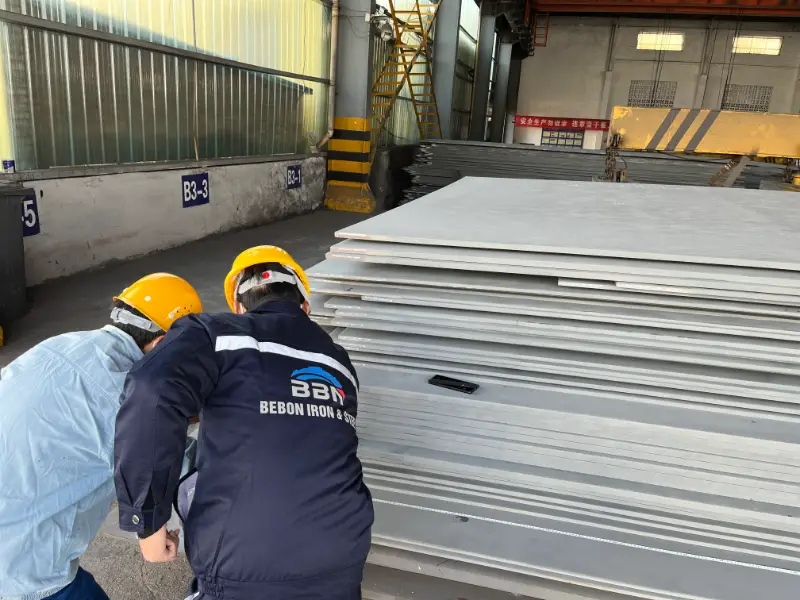
Q420B High-Strength Low-Alloy Structural Steel Plate
Q420B Low-Alloy High-Strength Steel: Properties, Equivalents & Applications Per GB/T 1591
In-depth data sheet for Q420B carbon and low-alloy high-strength steel to GB/T 1591. Includes chemical composition, mechanical properties, physical constants, international equivalents, and typical structural applications.
Hot rolling, controlled rolling, normalizing, thermo-mechanical rolling, welding, bending, punching, cutting
- Phone : +8618037372205
- Email : [email protected]
- WhatsApp: Contact via Whtsapp
- WeChat: +8618037372205
Q420B High-Strength Low-Alloy Structural Steel Plate Introduction
Q420B is a Chinese low-alloy high-strength structural steel grade defined by GB/T 1591-2018. It delivers a minimum yield strength of 420 MPa for thicknesses ≤16 mm and belongs to quality level B, requiring impact energy of at least 34 J at +20 °C. The steel is microalloyed with elements such as Nb, V, Ti, and Al to refine grain size, which notably improves both strength and toughness. It offers good weldability and formability, making it suitable for welded heavy-duty structures. Typical delivery conditions include hot-rolled, normalized, or thermo-mechanically rolled states. Widely used in bridges, buildings, pressure vessels, and machinery, Q420B balances excellent mechanical performance with reliable low-temperature impact resistance.
Q420B High-Strength Low-Alloy Structural Steel Plate Chemical Composition
Chemical composition according to GB/T 1591-2018 for Q420B grade. Maximum limits are given unless a range is indicated. Grain-refining elements (Nb, V, Ti, Al) are added to achieve fine ferrite-pearlite microstructure and meet strength-toughness balance. Carbon equivalent (CEV) is typically controlled for weldability.
| Element | Specified Value (max, %) | Remarks |
|---|---|---|
| Carbon (C) | 0.20 | Max |
| Silicon (Si) | 0.50 | Max |
| Manganese (Mn) | 1.70 | Max |
| Phosphorus (P) | 0.035 | Max; quality level B |
| Sulfur (S) | 0.035 | Max; quality level B |
| Niobium (Nb) | 0.07 | Max |
| Vanadium (V) | 0.20 | Max |
| Titanium (Ti) | 0.20 | Max |
| Chromium (Cr) | 0.30 | Max |
| Nickel (Ni) | 0.80 | Max |
| Copper (Cu) | 0.30 | Max |
| Molybdenum (Mo) | 0.20 | Max |
| Nitrogen (N) | 0.015 | Max |
| Aluminum (Als or Alt) | Als ≥0.015 or Alt ≥0.020 | Min. acid-soluble/total Al; for grain refinement |
Q420B High-Strength Low-Alloy Structural Steel Plate Physical, Thermal & Electrical Properties
These values are representative for low-alloy structural steels and are not specified in GB/T 1591. They are provided for design calculations and thermal analysis. Actual values may vary slightly with composition and heat treatment.
| Property | Typical Value | Unit | Measuring Condition / Remarks |
|---|---|---|---|
| Density (ρ) | 7.85 | g/cm³ | Room temperature |
| Young's modulus (E) | 210 | GPa | Room temperature, tensile test |
| Shear modulus (G) | 80 | GPa | Calculated from E and ν (G=E/[2(1+ν)]) |
| Poisson's ratio (ν) | 0.3 | – | Elastic range, room temperature |
| Coefficient of thermal expansion (α) | ~11.5 | ×10⁻⁶/K | 20–100°C |
| Coefficient of thermal expansion (α) | ~12.0 | ×10⁻⁶/K | 20–200°C |
| Coefficient of thermal expansion (α) | ~12.8 | ×10⁻⁶/K | 20–400°C |
| Thermal conductivity (λ) | ~48 | W/(m·K) | At 25°C |
| Thermal conductivity (λ) | ~44 | W/(m·K) | At 100°C |
| Specific heat capacity (c) | ~460–480 | J/(kg·K) | Room temperature |
| Electrical resistivity (ρe) | ~0.20 | ×10⁻⁶ Ω·m (µΩ·m) | At 20°C |
Q420B High-Strength Low-Alloy Structural Steel Plate Mechanical Properties
Room-temperature tensile properties and impact toughness for Q420B per GB/T 1591-2018. Upper yield strength (ReH), tensile strength (Rm), elongation (A, 5.65√S0 gauge), and Charpy V-notch impact energy (KV2, longitudinal) are listed for the commonly supplied thickness range. Bending test performed on flat specimens.
| Property | Specified Value | Unit | Test Condition / Remarks |
|---|---|---|---|
| Upper yield strength (ReH) | ≥420 | MPa | Thickness ≤16 mm |
| Upper yield strength (ReH) | ≥400 | MPa | Thickness >16–40 mm |
| Upper yield strength (ReH) | ≥380 | MPa | Thickness >40–63 mm |
| Upper yield strength (ReH) | ≥360 | MPa | Thickness >63–80 mm |
| Upper yield strength (ReH) | ≥360 | MPa | Thickness >80–100 mm |
| Upper yield strength (ReH) | ≥340 | MPa | Thickness >100–150 mm |
| Upper yield strength (ReH) | ≥330 | MPa | Thickness >150–200 mm |
| Tensile strength (Rm) | 470–630 | MPa | Thickness ≤100 mm |
| Tensile strength (Rm) | 450–600 | MPa | Thickness >100–150 mm |
| Tensile strength (Rm) | 450–600 | MPa | Thickness >150–200 mm |
| Elongation after fracture (A) | ≥19 | % | Thickness ≤40 mm, gauge A5.65 |
| Elongation after fracture (A) | ≥18 | % | Thickness >40–63 mm |
| Elongation after fracture (A) | ≥18 | % | Thickness >63–100 mm |
| Elongation after fracture (A) | ≥17 | % | Thickness >100–150 mm |
| Elongation after fracture (A) | ≥17 | % | Thickness >150–200 mm |
| Charpy impact energy (KV2) | ≥34 | J | Longitudinal, +20°C, thickness ≤100 mm |
| Charpy impact energy (KV2) | ≥27 | J | Longitudinal, +20°C, thickness >100–200 mm |
| Bend test (180°), d = mandrel diameter | d = 2a | – | a = sample thickness; t ≤16 mm, specimen width ≥60 mm |
| Bend test (180°) | d = 3a | – | a = sample thickness; 16 < t ≤100 mm, specimen width ≥60 mm |
Q420B High-Strength Low-Alloy Structural Steel Plate Fully Equivalent / Directly Substitutable Material Standards & Grades
| Country/Region | Standard | Grade | Remarks |
|---|---|---|---|
| China | GB/T 1591-2018 | Q420B | Original grade; impact temperature +20°C |
| European Union | EN 10025-2: 2019 | S420JR | Equivalent for general structural use; JR = 27J at +20°C; verify tensile strength range 520–680 MPa for thickness ≤40 mm |
| International (ISO) | ISO 630-2: 2021 | Fe420C | C = 27J at 0°C; for +20°C, select Fe420B (27J at +20°C); check exact chemical and delivery requirements |
| Japan | JIS G3106: 2015 | SM520B | Minimum yield 365 MPa; not equal to 420 MPa but commonly adjusted; use SM570 for 420 MPa yield; direct substitute limited |
| United States | ASTM A572/A572M-21 | Grade 60 [415] | Yield 415 MPa (60 ksi); impact not mandatory unless supplementary; equivalent for strength, but toughness agreement required |
| India | IS 2062: 2011 | E420 B | Fe 420 B when qualified to +20°C impact; comparable composition and strength |
Q420B High-Strength Low-Alloy Structural Steel Plate Application Introduction
Q420B is engineered for welded heavy constructions that need high strength-to-weight ratios. Thanks to its combination of strength, toughness, and good fabrication behavior, it is employed in a vast range of load-bearing structures. The steel can be cut, welded, drilled, and formed with standard workshop practices. Surface protection by painting or galvanizing is recommended for outdoor exposure unless a weathering grade is specifically selected. Typical industries and products are outlined below.
Product Applications: Multi-story building columns and beams, Highway and railway bridge girders, Offshore platform legs and decks, LPG and LNG storage tanks, Heavy-duty crane booms and jibs, Truck frames and trailer structures, Hydraulic press frames, Piling pipes and structural hollow sections
Processed into products: Welded H-beams and box girders, Bridge expansion joints and bearings, Turret rings for excavators, Pressure vessel shells and dished heads, Shear studs and connecting plates, Telescopic crane sections, Dump truck bodies and bucket edges, Wind turbine tower flanges and shells
Application industries: Civil engineering and construction, Bridge engineering, Offshore and marine structures, Pressure vessel and tank manufacturing, Mining and earth-moving machinery, Railway rolling stock and automotive chassis, Power transmission towers and wind turbine towers, Industrial piping and penstocks
Q420B High-Strength Low-Alloy Structural Steel Plate Similar / Comparable Material Recommendations
| Country/Region | Standard | Grade | Remarks |
|---|---|---|---|
| China | GB/T 1591-2018 | Q390B | Lower yield (390 MPa); similar weldability and toughness; downgrade option if strength requirements allow |
| China | GB/T 1591-2018 | Q420C | Same strength, but improved impact at 0°C (34J); use where higher toughness is needed |
| China | GB/T 1591-2018 | Q460B | Higher yield (460 MPa); structural upgrade for weight reduction; formability slightly lower |
| European Union | EN 10025-3: 2019 | S420N | Normalized fine-grain steel; impact at -20°C possible; higher purity; suitable for demanding applications |
| European Union | EN 10025-4: 2019 | S420M | Thermo-mechanically rolled; good weldability; close match when delivery is TMCP |
| United States | ASTM A572/A572M-21 | Grade 65 [450] | Higher strength (450 MPa); can be overmatch if 420 MPa is minimum, requires careful design |
| United States | ASTM A633/A633M-18 | Grade E | Normalized high-strength low-alloy steel with good notch toughness; yield ~420–460 MPa; suitable for low-temperature service |
| International (ISO) | ISO 630-3: 2021 | S420E | Weathering steel grade; similar strength but with atmospheric corrosion resistance; for exposed structures |
Notes:
Welding recommendations: Low-hydrogen processes are preferred. Preheating is usually not required for thicknesses below 30 mm, but a preheat of 50–100°C may be applied for thicker sections. Carbon equivalent (CEV) is typically ≤0.45% for good weldability, as agreed between supplier and purchaser. Tolerances and surface quality follow GB/T 709 or the corresponding product standard. For specific impact requirements at lower temperatures, higher quality levels (Q420C/D/E) should be specified. Material certification to EN 10204 type 3.1 is common.
Disclaimer: The data provided are for general reference based on standard requirements; for critical applications, always refer to the official standard and mill test certificates.
- Share



