
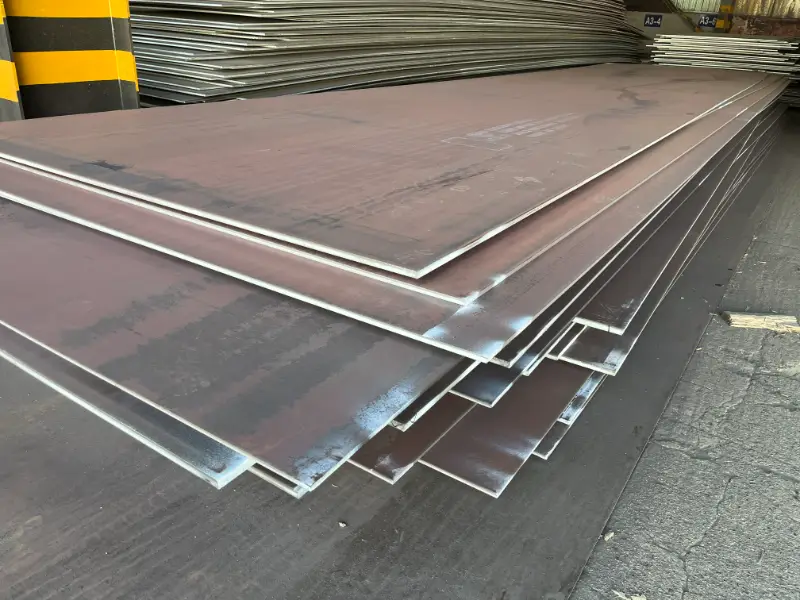
Q420A Carbon and Low-alloy High-strength Steel Plate - GB/T 1591
GB/T1591 Q420A Low-Alloy High-Strength Steel Plate – Data Sheet & Equivalents
Detailed material data for Q420A carbon and low-alloy high-strength steel plate per GB/T 1591. Includes chemical composition, mechanical and thermal properties, international equivalents, similar substitutes, and typical applications in structural engineering.
Hot rolling, normalizing, thermomechanical rolling, welding, cutting, bending, forming
- Phone : +8618037372205
- Email : [email protected]
- WhatsApp: Contact via Whtsapp
- WeChat: +8618037372205
Q420A Carbon and Low-alloy High-strength Steel Plate - GB/T 1591 Introduction
Q420A is a Chinese standard low-alloy high-strength structural steel defined in GB/T 1591. It offers a minimum yield strength of 420 MPa and is widely used in welded bridges, high-rise buildings, pressure vessels, and heavy machinery due to its excellent strength-to-weight ratio and good weldability.
- Designation 'Q' stands for yield point, '420' for minimum yield strength in MPa, and 'A' for room-temperature impact test requirements (no low-temperature impact guarantee).
- Supplied in hot-rolled, normalized, or thermomechanical rolled condition, with plate thickness typically up to 150 mm.
- Microalloyed with elements such as Nb, V, Ti to refine grain size and improve mechanical properties.
Q420A Carbon and Low-alloy High-strength Steel Plate - GB/T 1591 Chemical Composition
Chemical composition per GB/T 1591 for Q420A. The steel is microalloyed with niobium, vanadium, and/or titanium to achieve the specified strength. Residual elements are tightly controlled to ensure weldability. The carbon equivalent (CEV) is typically ≤0.45% for guaranteed weldability.
- Values are maximum unless a range is given.
- For thickness >200 mm, composition may be slightly modified by agreement.
| Element | Standard Value (wt%) | Remarks |
|---|---|---|
| Carbon (C) | ≤0.20 | Max |
| Silicon (Si) | ≤0.50 | Max |
| Manganese (Mn) | ≤1.70 | Max |
| Phosphorus (P) | ≤0.030 | Max |
| Sulfur (S) | ≤0.030 | Max |
| Niobium (Nb) | ≤0.07 | Optional grain-refining element; may be present alone or in combination |
| Vanadium (V) | ≤0.15 | Optional; total V+Nb+Ti ≤0.22% when used together |
| Titanium (Ti) | ≤0.20 | Optional; total V+Nb+Ti ≤0.22% |
| Chromium (Cr) | ≤0.30 | Residual element; not intentionally added |
| Nickel (Ni) | ≤0.50 | Residual element |
| Copper (Cu) | ≤0.30 | Residual element |
| Carbon Equivalent (CEV) | ≤0.45% (typical) | CEV = C + Mn/6 + (Cr+Mo+V)/5 + (Ni+Cu)/15; guaranteed for weldability |
Q420A Carbon and Low-alloy High-strength Steel Plate - GB/T 1591 Thermal and Electrical Physical Properties
These physical properties are typical for low-alloy structural steels similar to Q420A. They can be used for design calculations and simulations. Actual values may vary slightly depending on exact composition and heat treatment. Values at room temperature unless specified otherwise.
- Thermal expansion coefficient is averaged over the indicated temperature range.
- Electrical resistivity is for reference; not a specified requirement in GB/T 1591.
| Property | Standard Value (Typical) | Unit | Test Condition / Remarks |
|---|---|---|---|
| Density (ρ) | 7.85 | g/cm³ | At 20°C |
| Modulus of Elasticity (E) | 210 | GPa | At 20°C |
| Shear Modulus (G) | 81 | GPa | At 20°C |
| Poisson's Ratio (ν) | 0.3 | – | In elastic range |
| Thermal Expansion Coefficient (α) | 12.0 | 10⁻⁶/K | 20 – 100°C |
| Thermal Expansion Coefficient (α) | 12.5 | 10⁻⁶/K | 20 – 200°C |
| Thermal Expansion Coefficient (α) | 13.0 | 10⁻⁶/K | 20 – 300°C |
| Thermal Conductivity (λ) | 42 | W/(m·K) | At 20°C |
| Thermal Conductivity (λ) | 40 | W/(m·K) | At 200°C |
| Specific Heat Capacity (cp) | 460 | J/(kg·K) | At 20 – 100°C |
| Electrical Resistivity (ρₑ) | 0.25 | Ω·mm²/m | At 20°C |
Q420A Carbon and Low-alloy High-strength Steel Plate - GB/T 1591 Mechanical Properties
Mechanical properties are determined on test pieces taken from plates in the as-delivered condition (AR, N or M). Requirements vary with product thickness. The minimum elongation applies to gauge length L₀ = 5.65√S₀. Impact test temperature is +20°C for grade A (Q420A).
- For thickness >100 mm, properties may be agreed upon.
- Bend test: mandrel diameter dependent on thickness; no cracking allowed.
| Property | Standard Required Value | Unit | Test Condition |
|---|---|---|---|
| Yield Strength (ReH) – thickness ≤16 mm | ≥420 | MPa | Transverse test, t ≤ 16 mm |
| Yield Strength (ReH) – 16 mm < t ≤ 35 mm | ≥400 | MPa | Transverse test |
| Yield Strength (ReH) – 35 mm < t ≤ 50 mm | ≥380 | MPa | Transverse test |
| Yield Strength (ReH) – 50 mm < t ≤ 100 mm | ≥360 | MPa | Transverse test |
| Tensile Strength (Rm) – thickness ≤16 mm | 520 – 680 | MPa | Transverse test, t ≤ 16 mm |
| Tensile Strength (Rm) – 16 mm < t ≤ 100 mm | 500 – 650 | MPa | Transverse test |
| Elongation after Fracture (A) – t ≤ 16 mm | ≥18 | % | L₀ = 5.65√S₀, transverse |
| Elongation after Fracture (A) – 16 mm < t ≤ 100 mm | ≥19 | % | L₀ = 5.65√S₀, transverse |
| Bend Test (Bend Diameter) – t ≤ 16 mm | 2a | – | Bending angle 180°; a = specimen thickness |
| Bend Test (Bend Diameter) – 16 mm < t ≤ 100 mm | 3a | – | Bending angle 180°; a = specimen thickness |
| Impact Energy (KV2) – Q420A | ≥34 (longitudinal) | J | Test at +20°C |
| Impact Energy (KV2) – Q420A (transverse) | ≥27 | J | Test at +20°C |
Q420A Carbon and Low-alloy High-strength Steel Plate - GB/T 1591 Completely Equivalent Material Standards & Substitute Grade Recommendations
| Country/Region | Standard | Grade | Remarks |
|---|---|---|---|
| China | GB/T 1591 | Q420A | Original material (this data sheet) |
| International | ISO 4950-2 | FeE420KGN | Normalized delivery; similar mechanical properties |
| European Union | EN 10025-3 | S420N | Normalized/normalized rolled; Charpy 0°C impact |
| European Union | EN 10025-4 | S420M | Thermomechanical rolled; impact energy at -20°C |
| Japan | JIS G 3106 | SM520B | SM520B has min. Rm 520 MPa; yield strength ≥ 350 MPa, may require thicker gauge adjustment |
| USA | ASTM A572/A572M | Grade 60 [415] | Yield strength 415 MPa (60 ksi); comparable but not identical (Q420A yield ≥ 420 MPa) |
Q420A Carbon and Low-alloy High-strength Steel Plate - GB/T 1591 Application Introduction
Q420A steel is designed for heavy structural applications where high strength, good weldability, and moderate toughness are required. Its balance of properties makes it suitable for a variety of industries. The steel is typically used in the as-rolled or normalized condition. Typical applications include:
- bridges and viaducts
- multi-story and high-rise building frames
- offshore platform structures
- heavy machinery and mining equipment
- pressure vessels (non-cryogenic)
- transmission towers and poles
Product Applications: Welded bridge girders, High-rise building columns and beams, Offshore platform legs and decks, Pressure vessel shells (non-sour service), Excavator arms and dump truck bodies, Wind turbine towers
Processed into products: Main structural beams and columns, Boom sections for cranes, Suspension bridge cables and anchorages, Welded stiffeners and gusset plates, Large-diameter pipes for piling, Transmission tower angle sections
Application industries: Civil Engineering & Construction, Shipbuilding & Offshore, Mining & Heavy Machinery, Transportation & Infrastructure, Energy (fossil fuel & renewable)
Q420A Carbon and Low-alloy High-strength Steel Plate - GB/T 1591 Similar/Alternative Materials with Close Properties
| Country/Region | Standard | Grade | Remarks |
|---|---|---|---|
| China | GB/T 1591 | Q390A | Lower yield strength (390 MPa); may be used where 420 MPa is over-designed |
| China | GB/T 1591 | Q460C | Higher yield strength (460 MPa) with low-temperature impact, suitable for upgrading |
| European Union | EN 10025-2 | S355J2 | Lower strength but widely available and cost-effective for less demanding loads |
| European Union | EN 10025-3 | S460N | Higher strength normalized steel, can replace Q420A where higher strength needed |
| USA | ASTM A572/A572M | Grade 65 [450] | Yield strength 450 MPa, slightly higher; substitutable if design allows |
| Russia | GOST 19281 | 17G1S | Comparable low-alloy steel with similar composition and strength range |
Notes:
- Q420A does not guarantee impact properties at low temperatures; for sub-zero applications, specify Q420C, D, or E with minimum Charpy values at 0°C, -20°C, and -40°C respectively.
- When welding, preheating and interpass temperatures should be controlled based on plate thickness and carbon equivalent to avoid cold cracking.
- The steel may be supplied with ultrasonic testing per GB/T 2970 or similar standards upon agreement.
- Surface quality and tolerances conform to GB/T 709 for plates.
- The material is recyclable and complies with common environmental regulations.
- Share



