
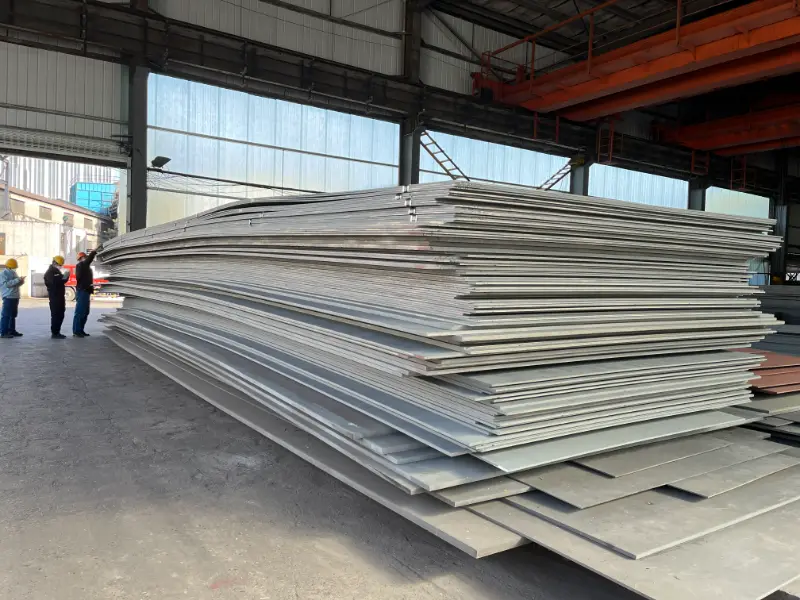
GB/T1591 Q390E High-Strength Low-Alloy Structural Steel Plate
GB/T1591 Q390E High-Strength Low-Alloy Structural Steel Plate - Properties, Equivalents & Applications
Explore detailed data for Q390E carbon and low-alloy high-strength steel plate to GB/T1591: chemical composition, mechanical and thermal properties, international equivalents, and typical applications in bridges, buildings, and heavy machinery.
Hot rolling, controlled rolling, normalizing, welding, cold forming, machining
- Phone : +8618037372205
- Email : [email protected]
- WhatsApp: Contact via Whtsapp
- WeChat: +8618037372205
GB/T1591 Q390E High-Strength Low-Alloy Structural Steel Plate Introduction
Q390E is a low-alloy high-strength structural steel grade specified in Chinese standard GB/T 1591-2018. It offers a minimum yield strength of 390 MPa and excellent low-temperature toughness, with guaranteed impact energy at -40°C (Grade E). The steel is primarily supplied in the normalized or hot-rolled condition and exhibits good weldability and formability. Key characteristics include:
- High strength combined with superior toughness, suitable for dynamic loads
- Excellent welding performance with conventional methods
- Fine-grain structure achieved by controlled alloying with Nb, V, Ti
- Available in thicknesses up to 100 mm, with slightly reduced yield strength for thicker gauges
GB/T1591 Q390E High-Strength Low-Alloy Structural Steel Plate Chemical Composition
The following table lists the ladle chemical composition requirements for Q390E according to GB/T 1591-2018. Values apply to product thicknesses up to 100 mm. The steel is microalloyed with niobium, vanadium, and titanium to refine grain size and enhance strength and toughness. Grain refining elements Al and one or more of Nb, V, Ti shall be present.
| Element | Specified Value (%) | Remarks |
|---|---|---|
| Carbon (C) | ≤ 0.20 | |
| Silicon (Si) | ≤ 0.55 | |
| Manganese (Mn) | 1.00 – 1.60 | |
| Phosphorus (P) | ≤ 0.025 | |
| Sulfur (S) | ≤ 0.020 | |
| Niobium (Nb) | 0.015 – 0.060 | Microalloying for grain refinement |
| Vanadium (V) | 0.02 – 0.20 | Optional microalloying, may be added singly or in combination |
| Titanium (Ti) | 0.02 – 0.20 | Optional microalloying |
| Chromium (Cr) | ≤ 0.30 | Residual |
| Nickel (Ni) | ≤ 0.30 | Residual |
| Copper (Cu) | ≤ 0.40 | Residual |
| Molybdenum (Mo) | ≤ 0.10 | Residual |
| Nitrogen (N) | ≤ 0.015 | |
| Aluminum (Al, total) | ≥ 0.015 | Grain refining; or Al (acid-soluble) ≥ 0.015 |
GB/T1591 Q390E High-Strength Low-Alloy Structural Steel Plate Thermal and Electrical Physical Properties
The following physical properties are typical for low-carbon low-alloy steels like Q390E at room temperature, unless otherwise noted. They are not mandatory in the product standard but are useful for design calculations. Values may vary slightly depending on exact composition and heat treatment.
| Property | Typical Value | Unit | Test Condition |
|---|---|---|---|
| Density (ρ) | 7.85 | g/cm³ | 20°C |
| Elastic modulus (E) | 200 – 210 | GPa | At room temperature |
| Shear modulus (G) | ≈ 80 | GPa | Calculated from E and ν |
| Poisson's ratio (ν) | 0.3 | – | In elastic range |
| Thermal expansion coefficient (α) | 11.5 – 12.5 | 10⁻⁶/K | 20°C – 100°C |
| Thermal conductivity (λ) | ≈ 50 | W/(m·K) | At 100°C |
| Specific heat capacity (cp) | ≈ 460 | J/(kg·K) | At 20°C |
| Electrical resistivity (ρ_e) | ≈ 0.20 – 0.25 | µΩ·m | At 20°C |
GB/T1591 Q390E High-Strength Low-Alloy Structural Steel Plate Mechanical Properties
Minimum mechanical property requirements for Q390E steel plate, strip, and sections are taken from GB/T 1591-2018. Yield strength decreases as thickness increases. Impact test at -40°C is mandatory for grade E, guaranteeing good low-temperature toughness. Charpy V-notch specimens are longitudinal unless otherwise required.
| Property | Required Value | Unit | Test Condition / Remarks |
|---|---|---|---|
| Yield strength (ReH) | ≥ 390 | MPa | Thickness ≤ 16 mm |
| Yield strength (ReH) | ≥ 370 | MPa | 16 mm < thickness ≤ 40 mm |
| Yield strength (ReH) | ≥ 350 | MPa | 40 mm < thickness ≤ 63 mm |
| Yield strength (ReH) | ≥ 330 | MPa | 63 mm < thickness ≤ 80 mm |
| Yield strength (ReH) | ≥ 310 | MPa | 80 mm < thickness ≤ 100 mm |
| Tensile strength (Rm) | 510 – 680 | MPa | All thicknesses |
| Elongation after fracture (A) | ≥ 20 | % | Thickness ≤ 40 mm, gauge length 5.65√So |
| Elongation after fracture (A) | ≥ 19 | % | 40 mm < thickness ≤ 63 mm |
| Elongation after fracture (A) | ≥ 19 | % | 63 mm < thickness ≤ 80 mm |
| Elongation after fracture (A) | ≥ 18 | % | 80 mm < thickness ≤ 100 mm |
| Charpy V-notch impact energy (KV2) | ≥ 34 | J | Test temperature -40°C, longitudinal |
| Bend test (mandrel diameter) | d = 3a | – | For thickness ≤ 16 mm, bending through 180° |
| Bend test | d = 3a | – | 16 mm < thickness ≤ 100 mm, bending 180°; mandrel diameter 3a |
GB/T1591 Q390E High-Strength Low-Alloy Structural Steel Plate Exact Equivalent Standards & Substitutable Grades
| Country/Region | Standard | Grade | Remarks |
|---|---|---|---|
| China | GB/T 1591 | Q390E | Original grade, -40°C impact |
| International | ISO 4950-2 | E420 DD | Quenched and tempered; slightly higher strength but similar toughness class for -40°C |
| Europe | EN 10025-4 | S420ML | Thermomechanical rolled; minimum yield 420 MPa, -50°C impact; can substitute but strength level is higher |
| USA | ASTM A709 | Grade 50T | High strength low alloy for bridges; minimum yield 345 MPa (50 ksi), but toughness grade T at -34°C; overmatch in toughness, under in strength |
| Japan | JIS G3106 | SM490YA | Yield ~355–365 MPa, impact test at 0°C; not a direct match but widely used for welded structures |
GB/T1591 Q390E High-Strength Low-Alloy Structural Steel Plate Application Introduction
Q390E steel is designed for heavy-duty welded structures that must retain toughness at low temperatures. Its combination of high strength, good weldability, and guaranteed impact energy at -40°C makes it ideal for critical applications in structural engineering and transportation.
- Key processing: thermal cutting, cold forming, welding (preheat may be required for thick sections), hot-dip galvanizing.
- Welding: suitable for SMAW, GMAW, SAW; low-hydrogen consumables recommended.
Product Applications: Plate girders and box girders, Dozer blades and excavator arms, Crane booms and jibs, Offshore platform structural components, Wind turbine towers, Shipbuilding frames and hull stiffeners, Heavy-duty truck and trailer chassis, High-stress welded beams and columns
Processed into products: Flanges and webs for built-up sections, Stiffener plates for large bridges, Mining truck dump bodies and buckets, Booms, sticks, and arms for construction equipment, Weldments subject to fatigue and low-temperature service, Connecting plates and gussets, Load-bearing frames for presses and machine tools
Application industries: Bridge construction, Building and civil engineering, Offshore and marine engineering, Heavy machinery and equipment manufacturing, Railway vehicles and automotive frames, Pressure vessel and storage tank fabrication, Tower and mast structures
GB/T1591 Q390E High-Strength Low-Alloy Structural Steel Plate Similar/Alternative Material Recommendations
| Country/Region | Standard | Grade | Remarks |
|---|---|---|---|
| China | GB/T 1591 | Q420E | Higher yield strength (420 MPa min), same toughness level; direct upgrade |
| Europe | EN 10025-3 | S420N/NL | Normalized; NL version provides -50°C impact, excellent alternative for heavy welded structures |
| USA | ASTM A572 | Grade 60 | Yield 415 MPa (60 ksi); not specifically impact-tested but can be supplied with Charpy requirements |
| USA | ASTM A1011 | SS Grade 60 | Hot-rolled sheet; lower strength and no impact guarantee, but economical substitute where toughness is not critical |
| Japan | JIS G3106 | SM490YA | Welded structural steel; yield 355-365 MPa, impact test at 0°C; suitable for ambient temperature applications |
Notes:
- For thicknesses above 100 mm, mechanical properties shall be agreed upon at the time of ordering.
- If the product is to be used in sour service or other aggressive environments, additional testing for HIC/SSC may be required.
- For improved atmospheric corrosion resistance, a weathering steel variant (e.g., Q390GNH) should be considered.
- Values in the chemical composition table are based on heat analysis; product analysis tolerances are specified in GB/T 222.
- Physical properties are typical for informational purposes and not part of the standard specification.
- Share



