
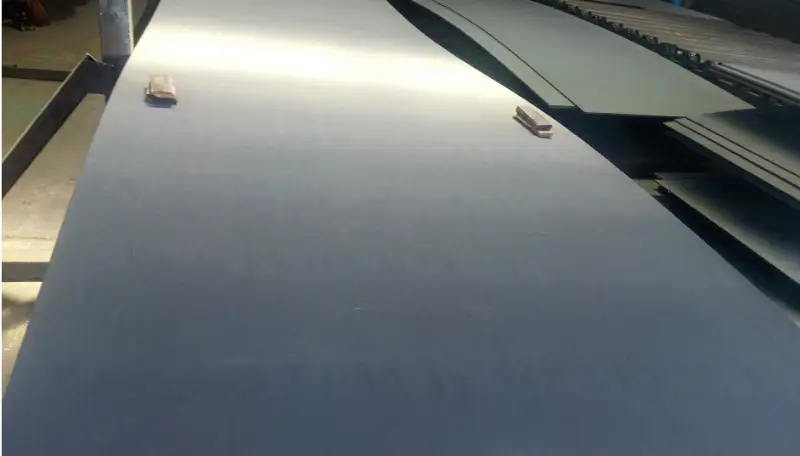
GB/T 1591 Q390D Carbon and Low-alloy High-strength Steel Plate
GB/T 1591 Q390D Carbon and Low-alloy High-strength Steel Plate - Data & Equivalents
Comprehensive material data for GB/T 1591 Q390D high-strength structural steel: chemical composition, mechanical properties, thermal & electrical properties, international equivalents, and application guidelines.
Hot rolling, normalizing, thermo-mechanical control process (TMCP), welding, cutting, bending, forming, and machining
- Phone : +8618037372205
- Email : [email protected]
- WhatsApp: Contact via Whtsapp
- WeChat: +8618037372205
GB/T 1591 Q390D Carbon and Low-alloy High-strength Steel Plate Introduction
Q390D is a low-alloy high-strength structural steel specified in Chinese standard GB/T 1591-2018. With a minimum yield strength of 390 MPa and guaranteed Charpy impact energy of at least 34 J at -20°C (Grade D), it offers an excellent combination of strength, weldability, and low-temperature toughness. The steel is typically produced as heavy plates, hot-rolled strips, sections, and bars. It is widely used in large welded structures such as bridges, buildings, offshore platforms, and heavy machinery. Delivery conditions include as-rolled (AR), normalized (N), or thermo-mechanical control processed (TMCP), depending on thickness and customer requirements. The balanced microalloying content (Nb, V, Ti) ensures fine grain size and good formability.
GB/T 1591 Q390D Carbon and Low-alloy High-strength Steel Plate Chemical Composition
Chemical composition according to GB/T 1591-2018. The steel may contain optional microalloying elements such as Nb, V, Ti, or combinations. The sum of Nb+V+Ti shall not exceed 0.22%. Carbon equivalent (Ceq) is typically agreed upon between purchaser and manufacturer, with a common maximum of 0.45% for controlled processing conditions.
| Element | Standard Value (wt%) | Notes |
|---|---|---|
| C (Carbon) | ≤0.20 | |
| Si (Silicon) | ≤0.55 | May be raised to ≤0.60 by agreement |
| Mn (Manganese) | 1.00 - 1.60 | |
| P (Phosphorus) | ≤0.025 | Grade D requirement |
| S (Sulfur) | ≤0.020 | |
| Nb (Niobium) | ≤0.07 | Optional microalloying element |
| V (Vanadium) | ≤0.20 | Optional, typically 0.02-0.20 |
| Ti (Titanium) | ≤0.20 | Optional, typically 0.02-0.20 |
| Cr (Chromium) | ≤0.30 | Residual or intentional addition |
| Ni (Nickel) | ≤0.80 | Residual or intentional addition |
| Cu (Copper) | ≤0.55 | Residual or intentional addition |
| Mo (Molybdenum) | ≤0.20 | Residual or intentional addition |
| N (Nitrogen) | ≤0.015 | When combined with Al for grain refinement |
| Alt (Total Aluminum) | ≥0.020 | Acid-soluble Al may be specified instead |
| Ceq (Carbon Equivalent) | ≤0.45 (by agreement) | Typical for TMCP or normalized condition |
GB/T 1591 Q390D Carbon and Low-alloy High-strength Steel Plate Thermal & Electrical Physical Properties
The following physical properties are typical reference values for low-alloy structural steels similar to Q390D. They are not specified in GB/T 1591 but are widely accepted engineering data for preliminary design and calculation. Actual values may vary slightly with chemical composition and processing path.
| Property | Typical Value | Unit | Test Condition / Remarks |
|---|---|---|---|
| Density (ρ) | 7.85 | g/cm³ | At 20°C |
| Modulus of Elasticity (E) | 205 - 210 | GPa | At 20°C, typical for structural steel |
| Shear Modulus (G) | 79 - 81 | GPa | Calculated from E and ν=0.3 |
| Poisson's Ratio (ν) | 0.29 - 0.31 | - | At 20°C |
| Thermal Expansion Coefficient (α) | 11.5 - 12.5 | ×10⁻⁶/K | 20°C to 100°C |
| Thermal Conductivity (λ) | 45 - 50 | W/(m·K) | At 20°C |
| Specific Heat Capacity (c) | 450 - 520 | J/(kg·K) | At 20°C |
| Electrical Resistivity (ρ_e) | 0.15 - 0.25 | ×10⁻⁶ Ω·m | At 20°C |
GB/T 1591 Q390D Carbon and Low-alloy High-strength Steel Plate Mechanical Properties
Mechanical properties as per GB/T 1591-2018 for thicknesses up to 100 mm. For plates thicker than 100 mm, values are agreed upon. Bend test is optional and performed only when specified. Impact test temperature is -20°C for Grade D; longitudinal Charpy V-notch specimens are used with an average energy of ≥34 J, allowing one individual value not less than 70% of the average (24 J).
| Performance Item | Requirement | Unit | Test Condition |
|---|---|---|---|
| Yield Strength (ReH or Rp0.2) | ≥390 | MPa | Plate thickness ≤16 mm |
| Yield Strength (ReH or Rp0.2) | ≥370 | MPa | Plate thickness >16 mm to ≤40 mm |
| Yield Strength (ReH or Rp0.2) | ≥350 | MPa | Plate thickness >40 mm to ≤63 mm |
| Yield Strength (ReH or Rp0.2) | ≥330 | MPa | Plate thickness >63 mm to ≤80 mm |
| Yield Strength (ReH or Rp0.2) | ≥310 | MPa | Plate thickness >80 mm to ≤100 mm |
| Tensile Strength (Rm) | 490 - 650 | MPa | Plate thickness ≤100 mm; for thickness >100 mm, values agreed |
| Elongation after fracture (A) | ≥20 | % | Plate thickness ≤40 mm, proportional gauge L0=5.65√S0 |
| Elongation after fracture (A) | ≥19 | % | Plate thickness >40 mm to ≤63 mm |
| Elongation after fracture (A) | ≥18 | % | Plate thickness >63 mm to ≤100 mm |
| Charpy V-notch impact energy (KV2) | ≥34 (average) | J | Longitudinal, -20°C, 10×10×55 mm specimen; one individual min. 24 J |
| Bend test (optional) | No cracks | - | 180° bending; mandrel diameter d=2a for t≤16 mm, d=3a for 16 |
GB/T 1591 Q390D Carbon and Low-alloy High-strength Steel Plate Exactly Equivalent Material Standards & Substitute Grades
| Country/Region | Standard | Grade | Remarks |
|---|---|---|---|
| International | ISO 630-3:2021 | S390N / S390NL | Fine-grain normalized/normalized rolled structural steel; yield strength 390 MPa min., similar chemistry; S390NL offers guaranteed impact at -50°C, S390N at -20°C; closest international match to Q390D. |
GB/T 1591 Q390D Carbon and Low-alloy High-strength Steel Plate Application Introduction
Q390D steel is engineered for heavy structural applications where high strength combined with reliable low-temperature toughness is critical. Its good weldability and formability make it a preferred choice for large, dynamically loaded welded assemblies. Typical fields of use and products are listed below.
Product Applications: Bridge main and cross girders, High-rise building columns and beams, Offshore platform decks, braces and legs, Heavy-duty crane booms and telescopic arms, Excavator and bulldozer structural components, Wind turbine tower shells and internals, Pressure vessel shells and reinforcing pads
Processed into products: Welded I- and H-beams, box columns, Flanges and web plates for plate girders, Base plates, bearing plates, and stiffeners, Crane runway beams and mounting brackets, Mine truck frames and dump bodies, Brackets for offshore modules, Fabricated pipe spools and headers
Application industries: Civil engineering and infrastructure construction, Bridge and viaduct building, Offshore and marine structures, Heavy vehicle, railway wagon and trailer manufacturing, Wind power generation (towers and foundations), Mining and earthmoving equipment, Pressure vessel and storage tank fabrication
GB/T 1591 Q390D Carbon and Low-alloy High-strength Steel Plate Similar / Alternative Material Recommendations
| Country/Region | Standard | Grade | Remarks |
|---|---|---|---|
| Europe | EN 10025-3 | S355N / S355NL | Yield strength 355 MPa, slightly lower strength but very similar toughness and weldability; may be used with increased section thicknesses if design permits. |
| Europe | EN 10025-3 | S420N / S420NL | Yield strength 420 MPa, higher strength alternative; match of toughness and processability; may require redesign for strength level. |
| USA | ASTM A572/A572M | Grade 60 [415] | Yield strength 415 MPa, similar low-alloy composition; impact test is optional and must be specified separately to match Q390D toughness. |
| China | GB/T 1591 | Q345D | Domestic lower-grade alternative; yield strength 345 MPa; can be substituted if 390 MPa is not strictly required. |
| China | GB/T 1591 | Q420D | Higher strength version within the same standard; yield strength 420 MPa; suitable for upgrading when higher capacity is needed. |
Notes:
For structural applications with demanding thickness-direction loading, Z-direction (through-thickness) properties can be specified according to GB/T 5313 or equivalent, requiring additional ultrasonic testing. The material can be supplied with improved corrosion resistance through ultra-low sulfur and calcium treatment if agreed. TMCP processing is recommended to achieve optimal balance of strength, toughness, and weldability for plate thicknesses up to 100 mm.
- Share



