
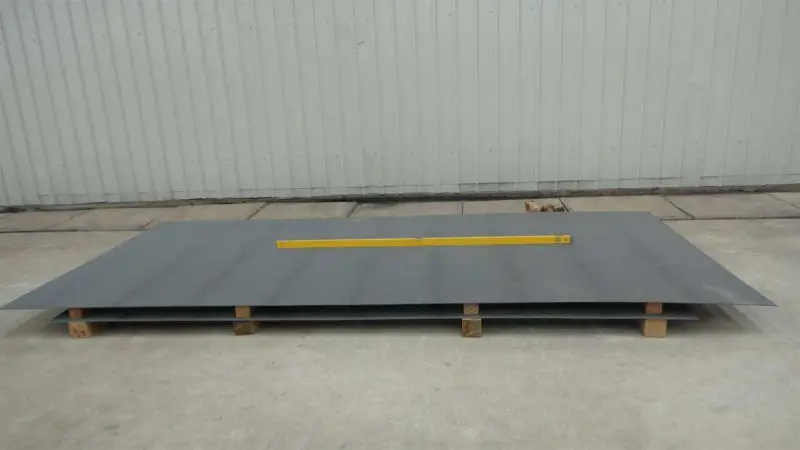
Q390C High-Strength Low-Alloy Structural Steel Plate
Q390C High-Strength Low-Alloy Structural Steel Plate - Composition, Properties & Equivalent Grades
Detailed technical data for Q390C steel under GB/T 1591: chemical composition, mechanical properties, physical properties, international equivalents, and application guide.
Hot rolling, normalizing, controlled rolling, thermomechanical rolling, welding, bending, and machining
- Phone : +8618037372205
- Email : [email protected]
- WhatsApp: Contact via Whtsapp
- WeChat: +8618037372205
Q390C High-Strength Low-Alloy Structural Steel Plate Introduction
Q390C is a Chinese standard high-strength low-alloy structural steel defined in GB/T 1591-2018 (High strength low alloy structural steels). It belongs to the Q390 strength class with a minimum yield strength of 390 MPa for thicknesses up to 16 mm. The quality designation 'C' indicates that the steel guarantees impact energy of at least 34 J at 0 °C.
This grade exhibits good weldability, toughness, and strength, making it suitable for welded structures in construction, bridge building, and heavy machinery. It is typically supplied in the normalized or hot-rolled condition. Q390C offers a fine balance between mechanical performance and workability, and it is often used as a cost-effective alternative to higher-alloyed steels in demanding structural applications.
Q390C High-Strength Low-Alloy Structural Steel Plate Chemical Composition
The chemical composition of Q390C steel shall be in accordance with GB/T 1591-2018. Microalloying elements such as Nb, V, Ti are added singly or in combination to refine grain size and improve strength. The sum of Nb+V+Ti shall not exceed 0.22%, and the sum of Mo+Cr+Ni+Cu shall not exceed 0.80%. The steel may also contain Al as a grain refiner or deoxidizer.
| Element | Standard Value (%) | Remarks |
|---|---|---|
| C | ≤0.20 | Carbon |
| Si | ≤0.50 | Silicon |
| Mn | ≤1.70 | Manganese |
| P | ≤0.030 | Phosphorus |
| S | ≤0.030 | Sulfur |
| Nb | ≤0.07 | Niobium |
| V | ≤0.20 | Vanadium |
| Ti | ≤0.20 | Titanium |
| Cr | ≤0.30 | Chromium |
| Ni | ≤0.50 | Nickel |
| Cu | ≤0.30 | Copper |
| Mo | ≤0.10 | Molybdenum |
| N | ≤0.015 | Nitrogen |
| Als | ≥0.015 | Acid soluble aluminum, or Alt ≥0.020% |
Q390C High-Strength Low-Alloy Structural Steel Plate Physical Properties
The following physical properties are generic reference values for low‑alloy structural steels and are not part of the mandatory requirements of GB/T 1591. They are provided for design and calculation purposes. Actual values may vary slightly depending on exact composition and heat treatment.
| Property | Typical Value | Unit | Test Condition |
|---|---|---|---|
| Density (ρ) | 7.85 | g/cm³ | 20 °C |
| Modulus of Elasticity (E) | 200–215 | GPa | Room temperature |
| Shear Modulus (G) | 80–83 | GPa | Room temperature |
| Poisson's Ratio (ν) | 0.27–0.30 | — | Room temperature |
| Thermal Expansion Coefficient (α) | 11.5–12.5 | 10⁻⁶/K | 20–200 °C |
| Thermal Expansion Coefficient (α) | 12.5–13.5 | 10⁻⁶/K | 20–400 °C |
| Thermal Conductivity (λ) | 36–42 | W/(m·K) | 100–200 °C |
| Specific Heat Capacity | 460–480 | J/(kg·K) | 20–200 °C |
| Electrical Resistivity (ρe) | 0.16–0.20 | μΩ·m | 20 °C |
Q390C High-Strength Low-Alloy Structural Steel Plate Mechanical Properties
Mechanical properties depend on product thickness. The values below represent minimum requirements for tensile testing at room temperature and Charpy V-notch impact testing at 0 °C. The bending test is performed with a specified mandrel diameter. All results apply to longitudinal test pieces unless otherwise agreed.
| Property | Standard Required Value | Unit | Test Condition / Thickness |
|---|---|---|---|
| Yield Strength (ReH) | ≥390 | MPa | Thickness ≤16 mm |
| Yield Strength (ReH) | ≥370 | MPa | Thickness >16–40 mm |
| Yield Strength (ReH) | ≥350 | MPa | Thickness >40–63 mm |
| Yield Strength (ReH) | ≥330 | MPa | Thickness >63–80 mm |
| Yield Strength (ReH) | ≥310 | MPa | Thickness >80–100 mm |
| Yield Strength (ReH) | ≥290 | MPa | Thickness >100–150 mm |
| Tensile Strength (Rm) | 490–650 | MPa | Thickness ≤100 mm |
| Tensile Strength (Rm) | 470–620 | MPa | Thickness >100–150 mm |
| Elongation (A) | ≥20 | % | Thickness ≤16 mm, gauge length 5.65√S₀ |
| Elongation (A) | ≥19 | % | Thickness >16–150 mm |
| Impact Energy (KV2) | ≥34 | J | 0 °C, longitudinal |
| Bend Test (Mandrel Diameter) | d = 3a | — | Thickness ≤100 mm, 180° bend |
| Bend Test (Mandrel Diameter) | d = 4a | — | Thickness >100–150 mm, 180° bend |
Q390C High-Strength Low-Alloy Structural Steel Plate Fully Equivalent Standards and Substitutable Grades
| Country/Region | Standard | Grade | Remarks |
|---|---|---|---|
| — | — | — | Q390C is a Chinese national designation; no foreign standard contains a fully identical grade with exactly matching chemical composition, tensile properties, and impact requirement. |
Q390C High-Strength Low-Alloy Structural Steel Plate Application Introduction
Q390C combines high strength, good low-temperature toughness, and excellent weldability, making it a preferred choice for heavy welded structures, especially those subjected to dynamic loading or requiring reduced weight. It can be readily formed and machined using common workshop practices. Typical applications include structural frameworks, bridges, offshore engineering, lifting equipment, and transport vehicles.
It is suitable for a wide range of downstream processing, including cutting, bending, welding, and surface treatment, and can be delivered in various shapes and sizes to meet specific project requirements.
Product Applications: Welded beams and columns for high-rise buildings, Bridge girders, box sections, and orthotropic decks, Offshore jacket legs and deck structures, Excavator booms, crane masts, and heavy-duty chassis, Wind turbine towers and foundation flanges, Railcar underframes and container corner castings, Penstock pipes and spiral casings
Processed into products: Structural nodes and gusset plates, Flanges, stiffeners, and web plates, Welded tubular sections and hollow profiles, Cut and machined parts such as brackets, brackets, and wear plates, Bent profiles and cold-formed sections, Heavy bolted splice plates and end plates
Application industries: Civil engineering and construction, Bridge and highway infrastructure, Shipbuilding and offshore platforms, Railway wagon and automotive manufacturing, Crane, mining, and heavy machinery, Power generation and transmission towers, Pressure vessel and pipeline components (when supplementary requirements are met)
Q390C High-Strength Low-Alloy Structural Steel Plate Similar and Alternative Materials
| Country/Region | Standard | Grade | Remarks |
|---|---|---|---|
| International | ISO 630-2 | S420N / S420NL | Yield strength ≥420 MPa, impact at –20 / –50 °C; slightly higher strength, good compatibility after design adjustments. |
| Europe | EN 10025-3 | S420N / S420NL | Normalized fine grain steel; similar mechanical properties; Q390C may be used as an economical alternative where 390 MPa yield suffices. |
| USA | ASTM A572 / A572M | Grade 60 [415] | Yield 415 MPa; similar HSLA steel; chemistry and impact test temperatures differ; verify weldability and toughness. |
| Japan | JIS G 3106 | SM490A/B/C | Yield ≥325–365 MPa (thickness dependent); lower strength than Q390C; suitable for less demanding applications. |
| Russia | GOST 19281 | 20K (type 20) | Yield ~245–295 MPa; lower strength; not a direct replacement; for reference only. |
Notes:
Welding: Q390C exhibits low carbon equivalent and good weldability. Preheating may be required for thick sections or when using high heat input processes. Post-weld heat treatment is generally not required.
Surface condition: Plates are usually supplied as hot-rolled, with optional shot blasting and primer coating available upon request.
Certification: Mill test certificates (EN 10204 type 3.1 or 3.2) confirming chemical analysis and mechanical properties are standard. Impact tests at 0 °C are mandatory for grade C.
Ordering notes: Specify thickness, width, length, standard, grade, and any supplementary requirements (e.g., improved flatness, through-thickness properties, nondestructive testing).
- Share



