
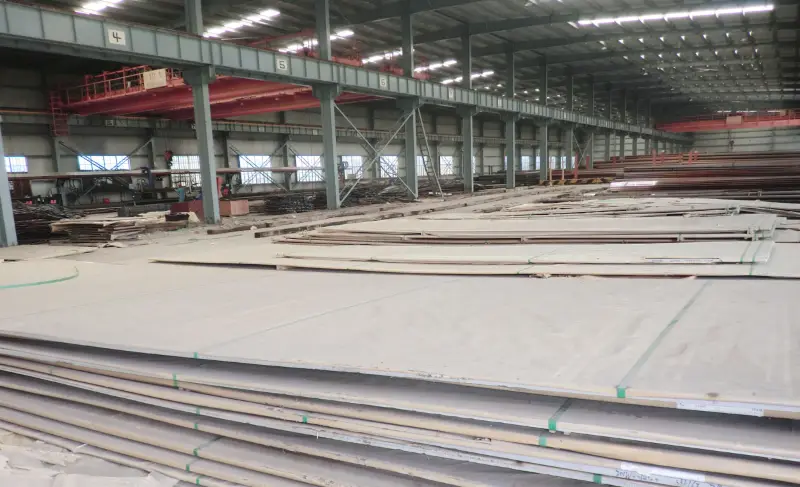
GB/T 1591 Q390B HSLA Steel Equivalent Grades
Q390B Low-Alloy High-Strength Structural Steel Plate | GB/T 1591 Data Sheet
Complete material properties, chemical composition, mechanical and thermal data for Q390B low-alloy high-strength structural steel as per Chinese standard GB/T 1591. Includes international equivalents and application guidance.
Hot rolling, normalizing, welding, thermal cutting, cold forming, and machining
- Phone : +8618037372205
- Email : [email protected]
- WhatsApp: Contact via Whtsapp
- WeChat: +8618037372205
GB/T 1591 Q390B HSLA Steel Equivalent Grades Introduction
Q390B is a low-alloy high-strength structural steel grade specified in the Chinese standard GB/T 1591 (High strength low alloy structural steels). It exhibits a minimum yield strength of 390 MPa in delivery condition and is widely used in welded structures, bridges, buildings, and heavy machinery. The 'B' designation indicates a minimum impact energy of 34 J at 0°C. Typical delivery condition is hot-rolled or normalized.
Key features include:
- High strength combined with good notch toughness at low temperatures
- Excellent weldability with suitable preheating and low-carbon equivalent
- Good formability and machinability
- Controlled microalloying (Nb, V, Ti) for fine-grain strengthening
GB/T 1591 Q390B HSLA Steel Equivalent Grades Chemical Composition
The chemical composition of Q390B is governed by GB/T 1591-2018. Microalloying elements such as niobium, vanadium, and titanium are added individually or in combination to achieve the required strength and toughness. The maximum phosphorus and sulfur contents are controlled for improved weldability. Aluminium is added for grain refinement.
| Element | Value (mass%) | Remarks |
|---|---|---|
| Carbon (C) | ≤0.20 | |
| Silicon (Si) | ≤0.50 | |
| Manganese (Mn) | ≤1.70 | For plates and strips; ≤1.65 for sections/bars |
| Phosphorus (P) | ≤0.035 | Grade B requirement |
| Sulfur (S) | ≤0.035 | Grade B requirement |
| Niobium (Nb) | ≤0.07 | Optional microalloy |
| Vanadium (V) | ≤0.15 | Optional microalloy |
| Titanium (Ti) | ≤0.20 | Optional microalloy |
| Nb+V+Ti | ≤0.22 | Combined limit |
| Chromium (Cr) | ≤0.30 | |
| Nickel (Ni) | ≤0.50 | |
| Copper (Cu) | ≤0.30 | |
| Molybdenum (Mo) | ≤0.10 | |
| Nitrogen (N) | ≤0.012 | |
| Aluminium (Als) | ≥0.015 | Acid-soluble aluminium, if added |
GB/T 1591 Q390B HSLA Steel Equivalent Grades Thermal and Electrical Physical Properties
The following physical properties are typical for low-alloy structural steels and are provided for general engineering calculations. They are not part of the mandatory requirements of GB/T 1591. Values may vary slightly depending on actual heat treatment and microstructural condition.
| Property | Typical Value | Unit | Condition / Remarks |
|---|---|---|---|
| Density (ρ) | 7.85 | g/cm³ | Room temperature |
| Modulus of elasticity (E) | 210 | GPa | Room temperature |
| Shear modulus (G) | 81 | GPa | Calculated from E and ν |
| Poisson's ratio (ν) | 0.3 | - | Room temperature |
| Coefficient of thermal expansion (α) | 12.0 | 10⁻⁶/K | 20–100°C |
| Thermal conductivity (λ) | 50 | W/(m·K) | At 100°C |
| Specific heat capacity (cp) | 460 | J/(kg·K) | At 20–100°C |
| Electrical resistivity (ρe) | 0.22 | 10⁻⁶ Ω·m | At 20°C |
GB/T 1591 Q390B HSLA Steel Equivalent Grades Mechanical Properties
Mechanical properties of Q390B are specified in GB/T 1591-2018. Values below represent the minimum requirements for longitudinal test pieces. Impact energy is measured on Charpy V-notch specimens at 0 °C for grade B. Bend test diameter ratios are based on the specimen thickness 'a'.
| Property | Required Value | Unit | Test Condition/Thickness |
|---|---|---|---|
| Yield strength (ReH) | ≥390 | MPa | Thickness ≤16 mm |
| Yield strength (ReH) | ≥370 | MPa | Thickness >16–40 mm |
| Yield strength (ReH) | ≥350 | MPa | Thickness >40–63 mm |
| Yield strength (ReH) | ≥330 | MPa | Thickness >63–80 mm |
| Yield strength (ReH) | ≥310 | MPa | Thickness >80–100 mm |
| Yield strength (ReH) | ≥290 | MPa | Thickness >100–150 mm |
| Tensile strength (Rm) | 490–650 | MPa | Thickness ≤40 mm |
| Tensile strength (Rm) | 490–650 | MPa | Thickness >40–63 mm |
| Tensile strength (Rm) | 470–620 | MPa | Thickness >63–80 mm |
| Tensile strength (Rm) | 470–620 | MPa | Thickness >80–100 mm |
| Tensile strength (Rm) | 450–600 | MPa | Thickness >100–150 mm |
| Elongation (A) | ≥20 | % | Thickness ≤40 mm |
| Elongation (A) | ≥20 | % | Thickness >40–63 mm |
| Elongation (A) | ≥19 | % | Thickness >63–100 mm |
| Elongation (A) | ≥18 | % | Thickness >100–150 mm |
| Impact energy (KV2) | ≥34 | J | Longitudinal, 0°C (Grade B) |
| Bend test (d = bend diameter) | d = 2a | - | Thickness ≤16 mm, 180° |
| Bend test | d = 3a | - | Thickness >16–100 mm, 180° |
GB/T 1591 Q390B HSLA Steel Equivalent Grades Exact Equivalent Standards and Replaceable Grades
No international standard provides a fully identical grade to Q390B (390 MPa yield, 0°C impact). The table below lists the closest comparable standards and grades that are often used as functional equivalents in engineering applications, but careful review of mechanical and chemical requirements is advised for substitution.
| Country/Region | Standard | Grade | Remarks |
|---|---|---|---|
| China | GB/T 1591 | Q390B | Original base grade |
| Europe | EN 10025-2 | S355J0 (1.0553) | Lower yield 355 MPa; 0°C impact 27J |
| USA | ASTM A572/A572M | Grade 60 [415] | Yield 415 MPa; standard impact optional |
| Japan | JIS G3106 | SM490B | Yield ≥325 MPa (thk ≤16mm); 0°C impact ≥27J |
| International | ISO 4950-2 (withdrawn) | E390CC | 390 MPa yield; controlled rolled, higher CE |
GB/T 1591 Q390B HSLA Steel Equivalent Grades Application Introduction
Q390B is widely used in welded heavy- and medium-duty structural applications where a combination of high strength, good low-temperature toughness, and reliable weldability is required. It is suitable for static and dynamic loads. Typical industries and products include:
Product Applications: Structural beams, columns, and girders, Welded bridge members and orthotropic deck plates, Vehicle chassis and trailer frames, Boom and mast sections for cranes, Pressure vessel shells (with additional certification), Offshore platform structural components, Mine dump truck bodies and excavator booms
Processed into products: Flanges and webs of built-up I-shapes, Gusset plates and stiffeners, Bearing support pedestals, Braced frame connections, Bolted and welded splice plates, Tower base flanges and transition pieces, Reinforcement pads for cutouts
Application industries: Civil engineering and construction, Bridge building, Shipbuilding and marine structures, Pressure vessel and storage tank manufacturing, Railway vehicles and automotive heavy frames, Mining and earthmoving machinery, Wind turbine towers and support structures
GB/T 1591 Q390B HSLA Steel Equivalent Grades Similar and Comparable Substitute Grades
The following grades share comparable strength levels and may be considered after evaluating specific project requirements such as weldability, toughness, and available plate thickness. Not all are direct equivalents; they are commonly suggested as alternatives in cross-reference tables.
| Country/Region | Standard | Grade | Remarks |
|---|---|---|---|
| China | GB/T 1591 | Q355B (formerly Q345B) | Slightly lower yield (355 MPa); very common |
| China | GB/T 1591 | Q420B | Higher yield (420 MPa); similar toughness |
| Europe | EN 10025-3 | S355NL | Normalized, fine-grain; -50°C impact; costlier |
| USA | ASTM A572 | Grade 65 [450] | Higher yield 450 MPa; 0°C impact may need supplementary requirement |
| Russia | GOST 19281 | 09G2S (09Г2С) | Similar C-Mn-Cu steel; yield about 345 MPa |
Notes:
Welding: Q390B has a moderate carbon equivalent (typical CEV 0.38–0.43%), which ensures good weldability. Preheating may be required for thicknesses above 30 mm or when ambient temperatures are below 5°C; recommended preheat 50–100°C. Low-hydrogen welding processes are recommended.
Availability: Most common thickness range is 6–80 mm in plate form; thicker plates (up to 150 mm) may be ordered with specific agreement. Optional enhanced dimensional tolerances and ultrasonic testing to EN 10160 or GB/T 2970 can be specified at the time of order.
Certification: Mill test certificates according to EN 10204 type 3.1 are standard when supplied to GB/T 1591.
- Share



