
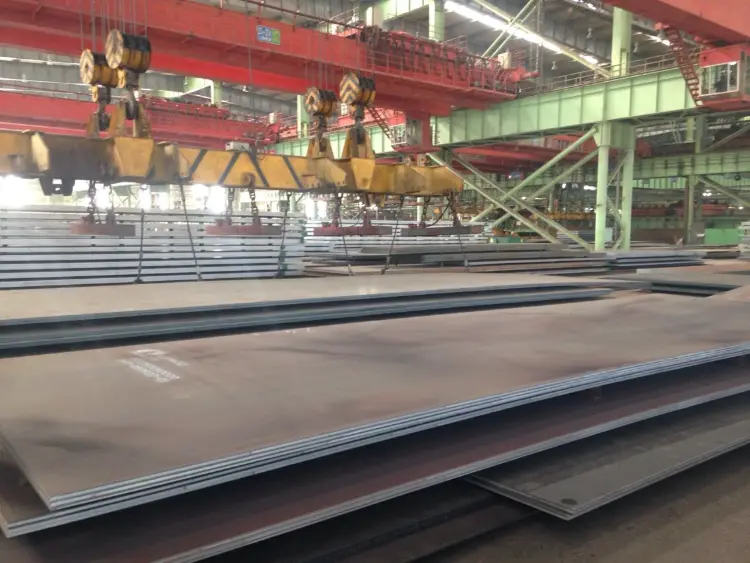
Q390A Low-Alloy High-Strength Structural Steel
Q390A Low-Alloy High-Strength Structural Steel - Comprehensive Data
Detailed material properties, chemical composition, mechanical and thermal characteristics of Q390A steel according to GB/T 1591 standard.
Hot rolling, controlled rolling, normalizing, TMCP, welding, cutting, bending, and machining
- Phone : +8618037372205
- Email : [email protected]
- WhatsApp: Contact via Whtsapp
- WeChat: +8618037372205
Q390A Low-Alloy High-Strength Structural Steel Introduction
Q390A is a low-alloy high-strength structural steel grade specified in the Chinese standard GB/T 1591-2018. It offers a minimum yield strength of 390 MPa and tensile strength in the range of 490–650 MPa. The 'A' designation indicates a quality level requiring impact testing at 0°C with a minimum absorbed energy of 34 J (longitudinal). This steel exhibits good weldability, cold formability, and toughness. It is widely used in bridges, buildings, vehicles, ships, and other welded structures subjected to heavy loads. Typical delivery conditions include hot-rolled, controlled rolled, normalized, or thermo-mechanically controlled processed (TMCP) as agreed between the purchaser and manufacturer.
Q390A Low-Alloy High-Strength Structural Steel Chemical Composition
The ladle analysis limits according to GB/T 1591-2018 for Q390A. Microalloying elements such as Nb, V, Ti may be added singly or in combination to achieve the required strength. Aluminium is used as a deoxidizer and grain refiner. Residual elements like Cr, Ni, Cu are controlled to ensure weldability and toughness.
| Element | Standard Value | Remarks |
|---|---|---|
| C | ≤0.20 | |
| Si | ≤0.50 | |
| Mn | 1.00~1.60 | |
| P | ≤0.035 | |
| S | ≤0.035 | |
| Nb | 0.015~0.060 | Present if used for grain refinement and precipitation strengthening |
| V | 0.02~0.15 | Optional microalloying element |
| Ti | 0.02~0.20 | Optional microalloying element |
| Als | ≥0.015 | Total aluminum or acid-soluble aluminum |
| Cr | ≤0.30 | Residual element |
| Ni | ≤0.50 | Residual element |
| Cu | ≤0.30 | Residual element |
| N | ≤0.012 | Residual element |
| Mo | ≤0.10 | Residual element |
Q390A Low-Alloy High-Strength Structural Steel Thermal and Electrical Physical Properties
Typical physical properties for low-alloy structural steels at room temperature. These values are not part of the mandatory standard requirements but are representative for Q390A grade. They are useful for engineering calculations and design.
| Property | Typical Value | Unit | Test Condition |
|---|---|---|---|
| Density (ρ) | 7.85 | g/cm³ | At 20°C |
| Elastic Modulus (E) | 206 | GPa | At 20°C |
| Shear Modulus (G) | 79.3 | GPa | Calculated from E and ν |
| Poisson's Ratio (ν) | 0.3 | At 20°C | |
| Thermal Expansion Coefficient (α) | 12.0 | 10⁻⁶/K | 20~100°C |
| Thermal Expansion Coefficient (α) | 12.5 | 10⁻⁶/K | 20~200°C |
| Thermal Expansion Coefficient (α) | 13.0 | 10⁻⁶/K | 20~300°C |
| Thermal Conductivity (λ) | ~48 | W/(m·K) | At 20°C |
| Specific Heat Capacity | ~480 | J/(kg·K) | At 20°C |
| Electrical Resistivity (ρ_e) | ~0.20 | μΩ·m | At 20°C |
Q390A Low-Alloy High-Strength Structural Steel Mechanical Properties
Mechanical properties as per GB/T 1591-2018 for Q390A. The yield strength decreases with increasing thickness. Tensile tests are performed on longitudinal specimens. The impact test is conducted at 0°C on Charpy V-notch specimens. Bending test is performed with a mandrel diameter of 3 times the specimen thickness (a) and a bending angle of 180°; no cracks are permitted.
| Property | Standard Requirement | Unit | Test Condition |
|---|---|---|---|
| Yield Strength (ReH) | ≥390 | MPa | Thickness ≤16 mm |
| Yield Strength (ReH) | ≥370 | MPa | Thickness >16~40 mm |
| Yield Strength (ReH) | ≥350 | MPa | Thickness >40~63 mm |
| Yield Strength (ReH) | ≥330 | MPa | Thickness >63~80 mm |
| Yield Strength (ReH) | ≥310 | MPa | Thickness >80~100 mm |
| Tensile Strength (Rm) | 490~650 | MPa | Thickness ≤100 mm |
| Elongation (A) | ≥20 | % | Gauge length 5.65√S₀, longitudinal, thickness ≤100 mm |
| Impact Energy (KV₂) | ≥34 | J | 0°C, Charpy V-notch, longitudinal |
| Bend Test (d=3a) | No cracks | Thickness ≤16 mm, 180° bending | |
| Bend Test (d=3a) | No cracks | Thickness >16~100 mm, 180° bending |
Q390A Low-Alloy High-Strength Structural Steel Equivalent Material Standards and Alternative Grades
| Country/Region | Standard | Grade | Remarks |
|---|---|---|---|
| International | ISO 4950-2 | E390 | Similar minimum yield strength of 390 MPa for thickness ≤70 mm; composition may differ. |
| Europe | EN 10025-2 | S355J0 | Lower yield strength (355 MPa); impact at 0°C. For higher strength, consider EN 10025-3 S420N. |
| USA | ASTM A572/A572M | Grade 55 [380] | Yield 380 MPa (55 ksi) for thickness ≤100 mm; closest commercial equivalent. |
| Japan | JIS G 3106 | SM490A | Yield 325 MPa for t≤16 mm; lower strength but similar weldable structural grade. |
Q390A Low-Alloy High-Strength Structural Steel Application Introduction
Q390A steel is specifically designed for welded structural applications where high strength and good toughness are required. It can be supplied in various thicknesses and shapes, making it versatile for many industries. The material shows excellent performance under static and dynamic loads when properly fabricated.
Product Applications: Steel structural frames for high-rise buildings, Bridge beams, girders, and trusses, Offshore platform decks and jackets, Storage tanks and silos, Heavy-duty truck chassis and trailer frames, Mining and earth-moving equipment
Processed into products: Welded beams and columns, Support brackets and bearing plates, Crane booms and lattice structures, Ship hull plates and stiffeners, Pressure vessel shells, Flanges and base plates, Structural tubular sections
Application industries: Construction and civil engineering, Bridge building, Shipbuilding and marine structures, Pressure vessel and storage tank manufacturing, Heavy machinery and equipment, Automotive and transportation (heavy trucks, trailers)
Q390A Low-Alloy High-Strength Structural Steel Similar Materials for Reference
| Country/Region | Standard | Grade | Remarks |
|---|---|---|---|
| China | GB/T 1591 | Q345B | Lower yield strength 345 MPa; widely used in construction, can replace Q390A where strength requirement is lower. |
| Europe | EN 10025-3 | S420N/NL | Higher yield strength 420 MPa; normalized delivery condition; suitable for heavy plates. |
| USA | ASTM A588/A588M | Grade B | Atmospheric corrosion resistant; yield 345 MPa; tensile 485 MPa; used for exposed structures. |
| Japan | JIS G 3136 | SN490B | Yield 325–445 MPa; for building structural use; often compared with Q390A. |
Notes:
Q390A is produced by microalloying and controlled rolling/thermo-mechanical processes. The 'A' classification ensures guaranteed impact properties at 0°C. When substituting with international grades, careful comparison of chemical composition, tensile properties, and impact requirements is necessary. Welding procedures should be qualified according to relevant codes, and preheating may be required for thick sections. The physical property values given are typical and may vary slightly depending on the exact composition and processing route.
- Share



