
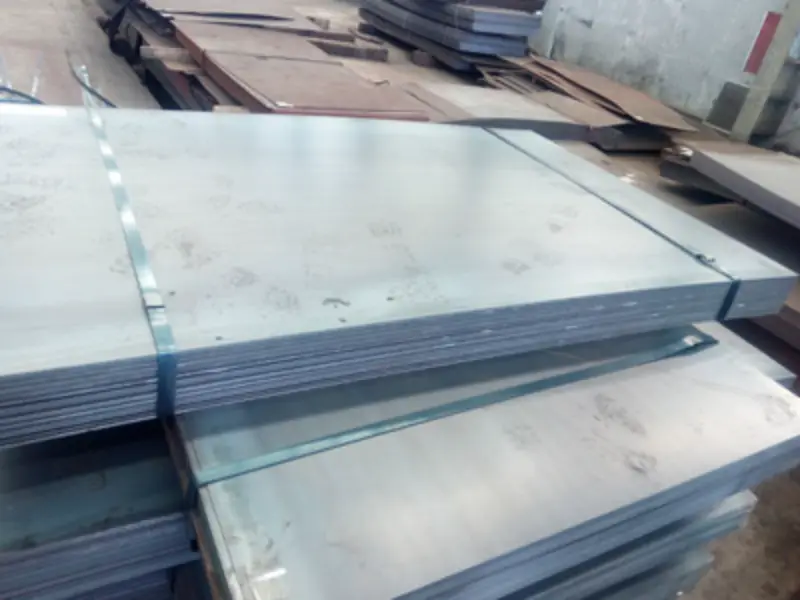
38MnB5 Boron Steel (EN 10083-3) High-Strength Quenched & Tempered Alloy for Automotive Components
38MnB5 Boron Steel (EN 10083-3) - High-Strength Quenched & Tempered Alloy for Automotive Components
Complete material data for 38MnB5 boron alloy steel according to EN 10083-3, including chemical composition, mechanical properties, physical properties, equivalents, and application guidelines.
Hot rolling, forging, cold drawing, quenching and tempering, induction hardening, machining
- Phone : +8618037372205
- Email : [email protected]
- WhatsApp: Contact via Whtsapp
- WeChat: +8618037372205
38MnB5 Boron Steel High-Strength Quenched & Tempered Alloy for Automotive Components Introduction
EN 10083-3 38MnB5 is a low-alloy boron steel designed for quenching and tempering. The addition of boron significantly increases hardenability, allowing full martensitic hardening in larger cross-sections compared to plain carbon steel. It offers an excellent balance of high tensile strength, good toughness, and wear resistance after heat treatment. Typical applications include safety-critical automotive components such as stabilizer bars, torsion bars, and steering parts. The steel is delivered in the quenched and tempered condition (+QT) or as untreated hot-rolled stock, depending on the intended manufacturing route. Its chemical composition is tightly controlled to ensure reproducible mechanical properties and reliable performance in dynamic loading conditions.
38MnB5 Boron Steel High-Strength Quenched & Tempered Alloy for Automotive Components Ladle Analysis According to EN 10083-3
The chemical composition of 38MnB5 is designed to provide deep hardenability through a boron addition of 0.0008–0.005%. Carbon and manganese are balanced to achieve a tensile strength range of 800–1100 MPa after quenching and tempering. Phosphorus and sulfur are limited to ensure cleanliness and good toughness. The values represent the cast analysis and are subject to permissible deviations in product analysis.
| Element | Specified Value (wt. %) | Remarks |
|---|---|---|
| Carbon (C) | 0.36 – 0.42 | Hardening element |
| Silicon (Si) | ≤ 0.40 | Deoxidizer, solid solution strengthener |
| Manganese (Mn) | 1.10 – 1.40 | Improves hardenability and strength |
| Phosphorus (P) | ≤ 0.025 | Maximum for ductility |
| Sulfur (S) | ≤ 0.035 | Maximum for machinability and cleanliness |
| Boron (B) | 0.0008 – 0.005 | Strong hardenability enhancer |
38MnB5 Boron Steel High-Strength Quenched & Tempered Alloy for Automotive Components Typical Physical Properties
Physical properties are largely independent of heat treatment condition within the typical service range. The data below are typical values for low-alloy steel and apply to 38MnB5. Actual values may vary depending on supplier, process, and temperature. For critical design calculations, manufacturer data should be used.
| Property | Standard Requirement Value | Unit | Test Condition / Temperature |
|---|---|---|---|
| Density (ρ) | 7.85 | g/cm³ | 20 °C |
| Modulus of elasticity (E) | 210 | GPa | 20 °C |
| Shear modulus (G) | 81 | GPa | 20 °C |
| Poisson's ratio (ν) | 0.3 | — | 20 °C |
| Thermal expansion coefficient (α) | 11.5 | 10⁻⁶/K | 20 – 100 °C |
| Thermal expansion coefficient (α) | 12.5 | 10⁻⁶/K | 20 – 200 °C |
| Thermal expansion coefficient (α) | 13.0 | 10⁻⁶/K | 20 – 300 °C |
| Thermal conductivity (λ) | 50 | W/(m·K) | 20 °C |
| Thermal conductivity (λ) | 48 | W/(m·K) | 100 °C |
| Thermal conductivity (λ) | 44 | W/(m·K) | 200 °C |
| Specific heat capacity (cp) | 460 | J/(kg·K) | 20 °C |
| Electrical resistivity (ρe) | 0.22 | µΩ·m | 20 °C |
38MnB5 Boron Steel High-Strength Quenched & Tempered Alloy for Automotive Components Mechanical Properties in Quenched & Tempered Condition
The following values are minimum requirements for bars, plates, and forgings in the quenched and tempered state according to EN 10083-3. The mechanical properties depend on the ruling section size (diameter or thickness). Toughness values (KV) are based on Charpy V-notch specimens taken in the longitudinal direction; impact energy requirements for transverse specimens are to be agreed. Properties apply to surfaces located at a distance from the edge ≤ 16 mm.
| Property | Standard Requirement | Unit | Test Condition / Thickness Range |
|---|---|---|---|
| Yield strength (ReH / Rp0.2) | ≥ 750 | MPa | d ≤ 16 mm |
| Tensile strength (Rm) | 900 – 1100 | MPa | d ≤ 16 mm |
| Elongation (A) | ≥ 12 | % | d ≤ 16 mm, L0 = 5.65√S0 |
| Reduction of area (Z) | ≥ 40 | % | d ≤ 16 mm |
| Yield strength (ReH / Rp0.2) | ≥ 650 | MPa | 16 < d ≤ 40 mm |
| Tensile strength (Rm) | 800 – 950 | MPa | 16 < d ≤ 40 mm |
| Elongation (A) | ≥ 16 | % | 16 < d ≤ 40 mm |
| Reduction of area (Z) | ≥ 45 | % | 16 < d ≤ 40 mm |
| Yield strength (ReH / Rp0.2) | ≥ 550 | MPa | 40 < d ≤ 100 mm |
| Tensile strength (Rm) | 750 – 900 | MPa | 40 < d ≤ 100 mm |
| Elongation (A) | ≥ 18 | % | 40 < d ≤ 100 mm |
| Reduction of area (Z) | ≥ 50 | % | 40 < d ≤ 100 mm |
| Charpy impact energy (KV) | ≥ 35 (longitudinal) | J | 20 °C, V‑notch, for all thickness ranges (typical) |
38MnB5 Boron Steel High-Strength Quenched & Tempered Alloy for Automotive Components Completely Equivalent Standards and Replaceable Grades
The following table lists international standards and designations that are chemically and mechanically equivalent to 38MnB5 according to EN 10083-3, permitting direct substitution.
| Country / Region | Standard | Grade | Remarks |
|---|---|---|---|
| International (ISO) | ISO 683-3 | 38MnB5 | Identical composition and properties |
| Europe | EN 10083-3 | 38MnB5 | Original standard |
38MnB5 Boron Steel High-Strength Quenched & Tempered Alloy for Automotive Components Application Introduction
38MnB5 is widely used in components that require a combination of high surface hardness, wear resistance, and core toughness after heat treatment. Its enhanced hardenability allows production of thick-walled parts without excessive alloying. Typical applications are found in vehicle dynamics systems, power transmission, and structural parts.
Product Applications: Stabilizer bars / anti-roll bars, Torsion bars (suspension), Steering knuckles and steering arms, Connecting rods, Transmission shafts and axles, Gears and pinions, Forged crankshafts (heavy-duty), Mining and earthmoving equipment parts
Processed into products: Stabilizer bar for heavy truck front axle, Torsion bar spring in passenger car suspension, Steering knuckle for agricultural tractor, Connecting rod in high-speed diesel engine, Induction-hardened shaft for mechanical power take-off
Application industries: Automotive and commercial vehicles, Agricultural machinery, Construction machinery, General mechanical engineering, Tool and die making (large tools)
38MnB5 Boron Steel High-Strength Quenched & Tempered Alloy for Automotive Components Materials with Similar Application Profile and Substitution Potential
The grades below offer comparable hardenability and mechanical properties after quenching and tempering. They may be suitable alternatives subject to design review.
| Country / Region | Standard | Grade | Remarks |
|---|---|---|---|
| Europe | EN 10083-3 | 33MnCrB5-2 | Slightly lower carbon, similar strength levels |
| Europe | EN 10083-3 | 30MnB5 | Lower carbon, higher toughness, lower strength |
| Europe | EN 10083-3 | 34MnB5 | Comparable strength and hardenability |
| Europe | EN 10083-3 | 35B2 | Lower Mn, alternative boron steel |
Notes:
- Boron effect: The boron addition increases hardenability dramatically, but effective boron content must be protected by sufficient titanium or aluminum to prevent boron nitride formation; EN 10083-3 requires an acid-soluble aluminum content of at least 0.015 % if boron is to be effective.
- Heat treatment: Typical quenching temperature 850–880 °C in oil or polymer; tempering between 400 and 600 °C depending on required strength level.
- Welding: Preheating and post-weld heat treatment are recommended to avoid cold cracking; matching consumables with low hydrogen are necessary.
- Machinability: In the quenched and tempered condition up to ~350 HBW, machining is still possible with appropriate tooling.
- Surface hardening: The steel is suitable for induction or flame hardening to achieve surface hardness of 58–62 HRC.
- Share



