
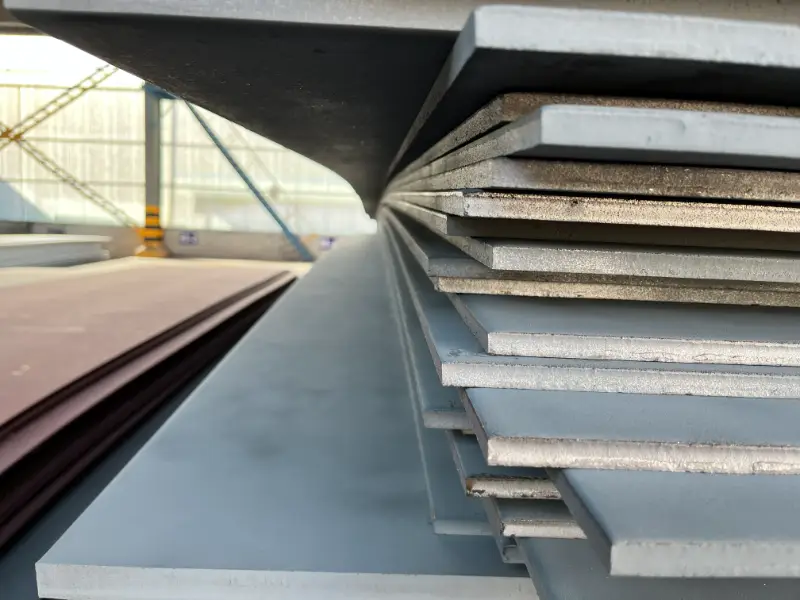
30MnB5 Boron Steel by EN 10083-3
30MnB5 Boron Steel by EN 10083-3: High-Strength Quenched and Tempered Plate for Wear Parts
Detailed material data of 30MnB5 high-alloy boron steel according to EN 10083-3, including chemical composition, mechanical properties at various sizes in quenched and tempered condition, physical and thermal properties, international equivalents, similar grades and application guidance.
Hot forming, forging, quenching and tempering, soft annealing, machining, induction hardening, welding (with precautions)
- Phone : +8618037372205
- Email : [email protected]
- WhatsApp: Contact via Whtsapp
- WeChat: +8618037372205
30MnB5 Boron Steel by EN 10083-3 Introduction
30MnB5 is a quenched and tempered boron-alloyed steel defined under EN 10083-3 (designation 1.5531). With a medium carbon content and a controlled addition of boron (0.0008–0.0050%), it achieves significantly enhanced hardenability compared to standard Mn-steels. This permits the steel to develop a fully martensitic or bainitic microstructure through the cross‑section during heat treatment, resulting in an excellent combination of high strength, yield point and wear resistance while maintaining adequate toughness.
The material is typically delivered in the quenched and tempered (+QT) condition, guaranteeing mechanical properties over a wide range of dimensions:
- Small sections (≤16 mm) reach tensile strengths of 900–1100 MPa with yield strength ≥700 MPa.
- Larger diameters (40–100 mm) still keep tensile strength 750–900 MPa and yield ≥540 MPa, coupled with improved ductility and impact energy.
30MnB5 is often chosen for dynamically loaded structural parts where surface hardness, fatigue resistance and core toughness are decisive. Its good machinability in the soft-annealed condition and the ability to be hardened by conventional oil or polymer quenching make it a cost‑efficient alternative to higher‑alloyed Cr‑Mo grades.
30MnB5 Boron Steel by EN 10083-3 Chemical Composition
The ladle analysis limits as specified in EN 10083-3 for 30MnB5. Boron is deliberately added to improve hardenability; its effect is fully active when the steel is protected by titanium or aluminium against nitrogen. Tramp elements are kept low to guarantee uniform mechanical properties.
| Chemical Element | Standard Value (wt.%) | Remarks |
|---|---|---|
| Carbon (C) | 0.27 – 0.33 | Controlled for strength and hardenability |
| Silicon (Si) | ≤ 0.40 | Deoxidation agent |
| Manganese (Mn) | 1.10 – 1.40 | Increases hardenability and strength |
| Phosphorus (P) | ≤ 0.025 | Residual element, kept low |
| Sulfur (S) | ≤ 0.035 | Residual element, improved machinability |
| Chromium (Cr) | 0.30 – 0.60 | Contributes to hardenability |
| Boron (B) | 0.0008 – 0.0050 | Very powerful hardenability booster |
30MnB5 Boron Steel by EN 10083-3 Thermal and Electrical Physical Properties
Representative physical data for quenched and tempered 30MnB5. These values are not specified in EN 10083-3 and are given as approximate engineering references. They may vary slightly with heat treatment and composition.
| Property | Typical Value | Unit | Test Condition / Remarks |
|---|---|---|---|
| Density (ρ) | 7.85 | g/cm³ | At 20 °C |
| Modulus of elasticity (E) | 210 | GPa | At 20 °C, tension |
| Shear modulus (G) | 81 | GPa | At 20 °C, calculated |
| Poisson's ratio (ν) | 0.3 | – | Room temperature |
| Thermal expansion coeff. (α) | 11.5 | 10⁻⁶/K | 20 – 100 °C |
| Thermal expansion coeff. (α) | 12.2 | 10⁻⁶/K | 20 – 200 °C |
| Thermal expansion coeff. (α) | 12.9 | 10⁻⁶/K | 20 – 300 °C |
| Thermal expansion coeff. (α) | 13.5 | 10⁻⁶/K | 20 – 400 °C |
| Thermal conductivity (λ) | 46 | W/m·K | At 20 °C |
| Thermal conductivity (λ) | 45 | W/m·K | At 100 °C |
| Thermal conductivity (λ) | 43 | W/m·K | At 200 °C |
| Thermal conductivity (λ) | 40 | W/m·K | At 300 °C |
| Thermal conductivity (λ) | 37 | W/m·K | At 400 °C |
| Specific heat capacity (c) | 460 | J/kg·K | At 20 °C |
| Electrical resistivity (ρ_e) | 0.20 | 10⁻⁶ Ω·m | At 20 °C, typical for medium‑carbon steel |
30MnB5 Boron Steel by EN 10083-3 Mechanical Properties in the Quenched and Tempered Condition
Minimum guaranteed values at room temperature as per EN 10083-3, measured on test pieces taken from the core of the specified ruling section. The impact energy is determined on ISO-V specimens at +20 °C. For heavier sections, toughness and elongation increase while strength decreases. Properties for diameters above 100 mm are subject to agreement.
| Property | Specified Value | Unit | Test Condition |
|---|---|---|---|
| Yield strength (ReH) | ≥700 | MPa | d ≤ 16 mm, +QT |
| Yield strength (ReH) | ≥590 | MPa | 16 < d ≤ 40 mm, +QT |
| Yield strength (ReH) | ≥540 | MPa | 40 < d ≤ 100 mm, +QT |
| Tensile strength (Rm) | 900 – 1100 | MPa | d ≤ 16 mm, +QT |
| Tensile strength (Rm) | 800 – 950 | MPa | 16 < d ≤ 40 mm, +QT |
| Tensile strength (Rm) | 750 – 900 | MPa | 40 < d ≤ 100 mm, +QT |
| Elongation after fracture (A) | ≥12 | % | d ≤ 16 mm, +QT |
| Elongation after fracture (A) | ≥14 | % | 16 < d ≤ 40 mm, +QT |
| Elongation after fracture (A) | ≥15 | % | 40 < d ≤ 100 mm, +QT |
| Reduction of area (Z) | ≥40 | % | d ≤ 16 mm, +QT |
| Reduction of area (Z) | ≥45 | % | 16 < d ≤ 40 mm, +QT |
| Reduction of area (Z) | ≥50 | % | 40 < d ≤ 100 mm, +QT |
| Impact energy (KV, +20 °C) | ≥25 | J | d ≤ 16 mm, +QT |
| Impact energy (KV, +20 °C) | ≥30 | J | 16 < d ≤ 40 mm, +QT |
| Impact energy (KV, +20 °C) | ≥35 | J | 40 < d ≤ 100 mm, +QT |
30MnB5 Boron Steel by EN 10083-3 Completely Equivalent Material Standards & Replaceable Grades
| Country/Region | Standard | Grade | Remarks |
|---|---|---|---|
| Europe | EN 10083-3 | 30MnB5 (1.5531) | Primary designation, quenched and tempered boron steel |
| International | ISO 683-3 | 30MnB5 | Equivalent to EN 10083-3 |
| Germany (former) | DIN 17212 | 30MnB5 | Withdrawn, superseded by EN 10083-3 |
30MnB5 Boron Steel by EN 10083-3 Application Introduction
30MnB5 is an economical choice for medium‑sized components requiring high surface hardness coupled with a tough core. The boron addition makes it possible to obtain through‑hardening or deep‑hardening in sections where a plain Mn-steel would show only a thin hardened layer. It is widely used after quenching and tempering, and can also be locally induction hardened for wear resistance.
Typical industries:
Product Applications: Transmission gears and pinions, Drive shafts and propeller shafts, Spindles and axles, Crankshafts (in some designs), Bolted connections, high-strength fasteners, Track links and track shoes for earth-moving machines, Wear plates and liners, Hydraulic cylinder rods and pistons
Processed into products: Gear wheels and ring gears, Shaft journals and king pins, Torsion bars, Piston pins, Coupling flanges, Rolling element components (heavy‑duty), Forming tool bodies for blanking and forging
Application industries: Automotive and commercial vehicles, Agricultural and construction machinery, Mining and mineral processing, General mechanical engineering, Railway components, Hydraulic and pneumatic equipment
30MnB5 Boron Steel by EN 10083-3 Similar or Nearest Alternative Grades
| Country/Region | Standard | Grade | Remarks |
|---|---|---|---|
| USA | SAE J403 | 15B30 | Comparable carbon–boron grade; higher Si (0.15–0.35%) and lower Cr (0.20–0.50%). Similar hardenability, used for heat-treated parts. |
| China | GB/T 3077 | 30MnB (non‑standardized in GB) | Approximate chemistry; not a standard GB grade; closest is 40MnB or 40MnB4. Check property alignment for specific section. |
Notes:
Heat treatment: Hardening at about 830–860 °C, quenching in oil or polymer; tempering in the range 540–680 °C depending on desired strength. Stress relieve after heavy machining is recommended.
Weldability: Can be welded with low‑hydrogen processes, but preheating and post‑weld heat treatment are mandatory to avoid cold cracks. The boron effect may be partially lost in the heat‑affected zone.
Hardenability control: The boron content must be guaranteed by the steelmaker; typical protection with Ti or Al is used to fix nitrogen. End‑quench hardenability curves are usually supplied on request.
- Share



