
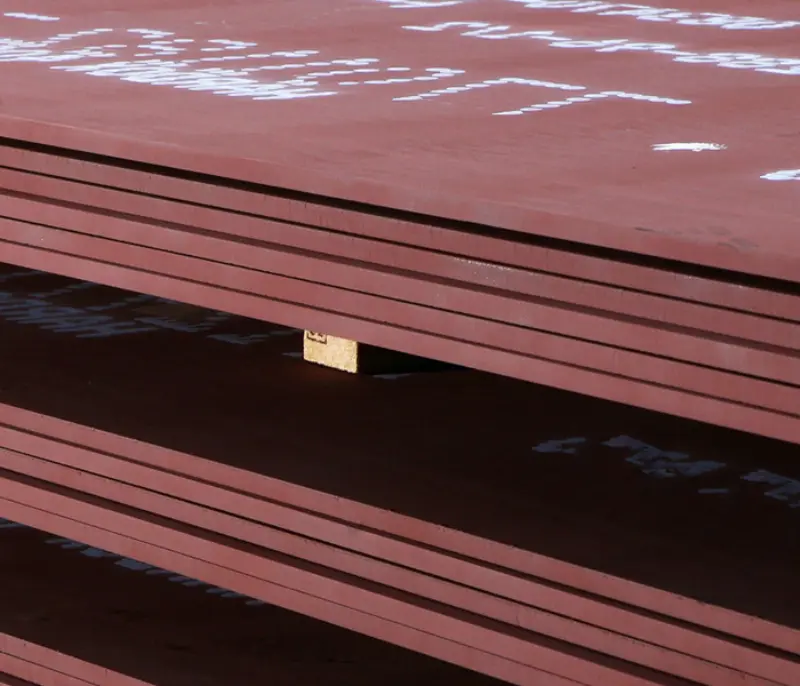
20MnB5 High Alloy Boron Steel Plate
20MnB5 High Alloy Boron Steel Plate | EN10083-3 Grade Properties & Equivalent
Explore the chemical composition, mechanical and thermal properties of 20MnB5 alloy steel according to EN10083-3. Find international equivalents, application guidelines, and processing details.
Hot rolling, forging, cold drawing, machining, welding (with precautions), induction hardening, flame hardening, nitriding
- Phone : +8618037372205
- Email : [email protected]
- WhatsApp: Contact via Whtsapp
- WeChat: +8618037372205
20MnB5 High Alloy Boron Steel Plate Introduction
20MnB5 is a heat-treatable low-alloy boron steel specified in EN10083-3. It offers a balanced combination of strength, toughness, and wear resistance after quenching and tempering. Thanks to a micro-addition of boron (0.0008–0.005%), hardenability is significantly enhanced without substantially increasing carbon content, making it suitable for medium-stressed components in automotive and machinery industries. Typical delivery condition is untreated (+U) or quenched and tempered (+QT). The grade is often chosen for parts requiring a hard surface and a tough core, such as gears, shafts, and fasteners, and it can be surface-hardened by induction or flame heating. Weldability is acceptable with proper preheating and post-weld heat treatment. Machining is best performed in the annealed condition.
20MnB5 High Alloy Boron Steel Plate Chemical Composition
The chemical limits comply with EN 10083-3:2006, Table 1. Residual elements not shown are controlled as per standard requirements. For effective boron hardenability, sufficient nitrogen-binding elements (e.g., titanium, aluminium) are typically present but not mandated by the table.
| Element | Standard Value | Remarks |
|---|---|---|
| Carbon (C) | 0.17 – 0.23 | Core hardenability |
| Silicon (Si) | ≤ 0.40 | Deoxidation |
| Manganese (Mn) | 1.10 – 1.40 | Strength & hardenability |
| Phosphorus (P) | ≤ 0.025 | Residual control |
| Sulfur (S) | ≤ 0.035 | Machinability |
| Chromium (Cr) | ≤ 0.30 | Residual element |
| Molybdenum (Mo) | ≤ 0.10 | Residual element |
| Nickel (Ni) | ≤ 0.40 | Residual element |
| Boron (B) | 0.0008 – 0.0050 | Hardenability booster |
20MnB5 High Alloy Boron Steel Plate Physical Properties – Typical Reference Values
Physical data represent room temperature values unless a range is given. These are indicative for a low-alloy boron steel in the annealed condition and are not part of mandatory standard requirements. Thermal treatment can slightly modify properties.
| Property | Typical Value | Unit | Remarks / Condition |
|---|---|---|---|
| Density (ρ) | 7.85 | g/cm³ | Ambient temperature |
| Modulus of Elasticity (E) | 210 | GPa | 20°C |
| Shear Modulus (G) | 81 | GPa | Calculated from E and ν |
| Poisson's Ratio (ν) | 0.30 | – | Elastic range |
| Thermal Expansion (α) 20–100°C | 11.5 | 10⁻⁶/K | Mean coefficient |
| Thermal Expansion (α) 20–200°C | 12.5 | 10⁻⁶/K | Mean coefficient |
| Thermal Expansion (α) 20–300°C | 13.0 | 10⁻⁶/K | Mean coefficient |
| Thermal Conductivity (λ) | 42 | W/(m·K) | 20°C |
| Specific Heat Capacity (cp) | 460 | J/(kg·K) | 20–200°C |
| Electrical Resistivity (ρe) | 0.25 | µΩ·m | 20°C |
20MnB5 High Alloy Boron Steel Plate Mechanical Properties in Quenched and Tempered Condition
Mechanical values are derived from EN 10083-3:2006, Table 5, for round bars Ø ≤ 100 mm. Testing is performed at room temperature on longitudinal samples. Charpy-V impact test at +20°C. For alternative diameters or flat products, properties must be agreed upon. Hardness in the annealed condition (+A) is ≤ 217 HBW.
| Property | Standard Value | Unit | Test Conditions |
|---|---|---|---|
| Yield Strength (ReH) | ≥ 650 | MPa | d ≤ 16 mm |
| Yield Strength (ReH) | ≥ 550 | MPa | 16 < d ≤ 40 mm |
| Yield Strength (ReH) | ≥ 450 | MPa | 40 < d ≤ 100 mm |
| Tensile Strength (Rm) | 750 – 950 | MPa | d ≤ 16 mm |
| Tensile Strength (Rm) | 700 – 850 | MPa | 16 < d ≤ 40 mm |
| Tensile Strength (Rm) | 600 – 750 | MPa | 40 < d ≤ 100 mm |
| Elongation (A) | ≥ 12 | % | d ≤ 16 mm, 5.65√S₀ |
| Elongation (A) | ≥ 14 | % | 16 < d ≤ 40 mm, 5.65√S₀ |
| Elongation (A) | ≥ 15 | % | 40 < d ≤ 100 mm, 5.65√S₀ |
| Reduction of Area (Z) | ≥ 50 | % | d ≤ 16 mm |
| Reduction of Area (Z) | ≥ 55 | % | 16 < d ≤ 40 mm |
| Reduction of Area (Z) | ≥ 60 | % | 40 < d ≤ 100 mm |
| Impact Energy (KV₂) at +20°C | ≥ 35 | J | d ≤ 16 mm (longitudinal) |
| Impact Energy (KV₂) at +20°C | ≥ 45 | J | 16 < d ≤ 40 mm |
| Impact Energy (KV₂) at +20°C | ≥ 45 | J | 40 < d ≤ 100 mm |
20MnB5 High Alloy Boron Steel Plate Direct International Equivalents & Replaceable Designations
| Country/Region | Standard | Designation | Remarks |
|---|---|---|---|
| Europe | EN 10083-3:2006 | 20MnB5 | Original grade; identical to DIN EN 10083-3 |
| Germany (withdrawn) | DIN 17200:1987 | 20MnB5 | Superseded by EN 10083-3 |
| France | NF A35-565:1999 | 20MnB5 | Withdrawn, replaced by EN version |
| ISO | ISO 683-2:2016 (draft) | 20MnB5 | Under consideration; composition similar |
| United Kingdom | BS 970-1:1996 | 170H20B | Comparable boron steel (C 0.17–0.23, Mn 1.10–1.40, B 0.0008–0.005). Not officially declared equivalent. |
20MnB5 High Alloy Boron Steel Plate Application Introduction
20MnB5 is selected where a combination of high core strength, toughness, and wear resistance is required after quench and tempering. Boron permits reduced alloy content while achieving high hardenability. It is particularly suited for the manufacturing of medium-stressed components in automotive powertrains and machinery.
Product Applications: Transmission gears and shafts, Differential pinion gears, CV joint cages and races, King pins, wheel hubs, and steering knuckles, Cold-headed bolts, nuts, and studs (Property Class 10.9/12.9), Hydraulic piston rods and sleeves, Crankshafts and connecting rods (medium-duty engines)
Processed into products: Gear wheels (after induction hardening), Shaft stubs and splined shafts, Flange yokes for drive shafts, Track pins for tracked vehicles, Cold-formed hollow sections for automotive columns, Sprockets and drive chain parts, Twist drills and tool holders (soft usage)
Application industries: Automotive (transmission, engine, chassis), Agricultural & construction machinery, Hydraulic & pneumatic cylinder components, General mechanical engineering, Fastener manufacturing
20MnB5 High Alloy Boron Steel Plate Materials with Similar Performance & Alternative Recommendations
| Country/Region | Standard | Designation | Remarks |
|---|---|---|---|
| USA | SAE J403 | 15B21 (15B21H) | Lower manganese (0.80–1.10%), slightly lower core hardenability. Suitable for similar heat-treated parts. |
| China | GB/T 3077 | 20MnTiB | Mn 1.30–1.60, Ti 0.04–0.10, B 0.0005–0.0035. Used for gears and universal joints. |
| Japan | JIS G4107 | SNB22-1-5 (boron steel) | Approximate chemistry: C 0.19–0.25, Mn 1.20–1.50, B ≥0.0005. Designed for high-strength fasteners. |
| Russia | GOST 4543 | 20ХГНР | Contains Cr and Ni; similar strength class after carburising. Not direct boron steel. |
| Europe (carburising) | EN 10084 | 20MnCr5 | Chromium-manganese steel with similar core properties when case-hardened. No boron. |
Notes:
Heat treatment: Austenitising at 860–900°C, quench in oil or polymer, temper 150–650°C depending on required strength. Weldability: CEV ≈ 0.52–0.58; preheat 150–250°C, low-hydrogen process, stress relieve after welding. Machinability: Best in spheroidised annealed condition (approx. 60–70% rating compared to AISI 1212). Boron effectiveness: Requires protection from nitrogen; use aluminium or titanium-killed steel practices.
- Share



