
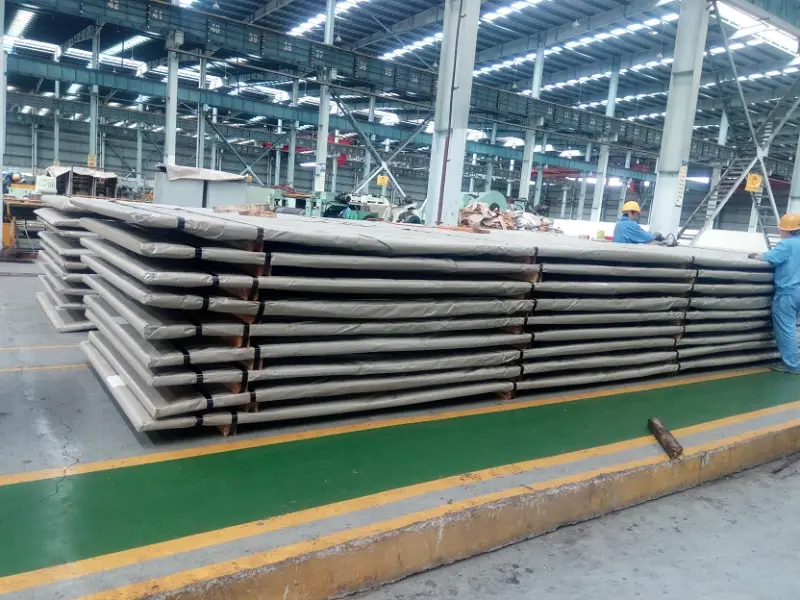
EN10083-3 51CrV4 Alloy Spring Steel
EN10083-3 51CrV4 Alloy Spring Steel - Composition, Properties & Equivalents
Complete material data for 51CrV4 steel according to EN 10083-3. Includes chemical composition, mechanical and thermal properties, equivalent grades, and application guide.
Hot rolling, cold drawing, forging, turning, milling, grinding, limited welding (with preheating and post-weld heat treatment)
- Phone : +8618037372205
- Email : [email protected]
- WhatsApp: Contact via Whtsapp
- WeChat: +8618037372205
EN10083-3 51CrV4 Alloy Spring Steel Introduction
51CrV4 is a chromium-vanadium alloy steel specified in EN 10083-3:2006 for quenching and tempering. It is widely known as a high-performance spring steel, providing an excellent combination of high fatigue strength, good ductility, and superior wear resistance after proper heat treatment. The addition of vanadium refines the grain structure and enhances hardenability, making the steel suitable for highly stressed components that must withstand dynamic loads. Typical delivery conditions include quenched and tempered (+QT), soft annealed (+A), or as-rolled, allowing versatile processing routes. This grade is used extensively in automotive, railway, and general mechanical engineering for critical spring elements, torsion bars, stabilizers, and wear-resistant parts.
EN10083-3 51CrV4 Alloy Spring Steel Chemical Composition
Chemical composition according to heat analysis as required by EN 10083-3:2006 for grade 51CrV4. Residual elements like copper and nickel are allowed up to certain limits but are not alloying additions.
- Values represent the permissible range for ladle analysis.
- Product analysis tolerances apply per the standard.
| Element | Standard Value (%) | Remarks |
|---|---|---|
| Carbon (C) | 0.47 – 0.55 | Typical for high hardenability |
| Silicon (Si) | ≤ 0.40 | Deoxidizer |
| Manganese (Mn) | 0.70 – 1.10 | Aids hardenability |
| Phosphorus (P) | ≤ 0.025 | Impurity limit |
| Sulfur (S) | ≤ 0.025 | Impurity limit |
| Chromium (Cr) | 0.90 – 1.20 | Primary hardening element |
| Vanadium (V) | 0.10 – 0.25 | Grain refinement, wear resistance |
| Copper (Cu) | ≤ 0.30 | Residual element |
| Nickel (Ni) | ≤ 0.40 | Residual element |
EN10083-3 51CrV4 Alloy Spring Steel Thermal and Electrical Physical Properties
These values are typical for 51CrV4 steel in the quenched and tempered condition and are obtained from general engineering material data. They are not specified as mandatory requirements in EN 10083-3 but are representative for design calculations.
- Values at room temperature unless stated otherwise.
- Thermal conductivity and specific heat may vary slightly with temperature and heat treatment.
| Property | Typical Value | Unit | Test Condition / Remarks |
|---|---|---|---|
| Density (ρ) | 7.85 | g/cm³ | Room temperature |
| Modulus of elasticity (E) | 206 | GPa | Tension, room temperature |
| Shear modulus (G) | 80 | GPa | Calculated |
| Poisson's ratio (ν) | 0.30 | – | Typical for steel |
| Thermal expansion (α) | 11.5 × 10⁻⁶ | /K | 20 – 100 °C |
| Thermal conductivity (λ) | 42 | W/(m·K) | Room temperature |
| Specific heat capacity | 460 | J/(kg·K) | Room temperature |
| Electrical resistivity (ρₑ) | 0.22 × 10⁻⁶ | Ω·m | Room temperature |
EN10083-3 51CrV4 Alloy Spring Steel Mechanical Properties
Mechanical properties specified in EN 10083-3:2006 for 51CrV4 at room temperature, measured on longitudinal test pieces after quenching and tempering (+QT). The values depend on the ruling section (thickness or diameter). Impact energy and bending tests are not part of the mandatory requirements of this standard for spring steels; they can be agreed upon at the time of enquiry and order.
- ReH = Upper yield strength (or Rp0.2 if no yield phenomenon occurs).
- Rm = Tensile strength.
- A = Percentage elongation after fracture (lo = 5.65√So).
- Z = Percentage reduction of area.
| Property | Standard Requirement | Unit | Test Condition |
|---|---|---|---|
| ReH (yield strength) | ≥ 1020 | MPa | d ≤ 16 mm, +QT |
| Rm (tensile strength) | 1250 – 1450 | MPa | d ≤ 16 mm, +QT |
| A (elongation) | ≥ 8 | % | d ≤ 16 mm, +QT |
| Z (reduction of area) | ≥ 30 | % | d ≤ 16 mm, +QT |
| ReH (yield strength) | ≥ 980 | MPa | 16 < d ≤ 40 mm, +QT |
| Rm (tensile strength) | 1150 – 1350 | MPa | 16 < d ≤ 40 mm, +QT |
| A (elongation) | ≥ 9 | % | 16 < d ≤ 40 mm, +QT |
| Z (reduction of area) | ≥ 35 | % | 16 < d ≤ 40 mm, +QT |
| ReH (yield strength) | ≥ 880 | MPa | 40 < d ≤ 100 mm, +QT |
| Rm (tensile strength) | 1050 – 1250 | MPa | 40 < d ≤ 100 mm, +QT |
| A (elongation) | ≥ 10 | % | 40 < d ≤ 100 mm, +QT |
| Z (reduction of area) | ≥ 40 | % | 40 < d ≤ 100 mm, +QT |
EN10083-3 51CrV4 Alloy Spring Steel Fully Equivalent Material Standards and Replaceable Grades
| Country/Region | Standard | Grade | Remarks |
|---|---|---|---|
| Europe | EN 10083-3 | 51CrV4 | Original specification |
| Germany | DIN EN 10083-3 | 51CrV4 (1.8159) | Identical composition and properties |
| China | GB/T 1222 | 50CrVA | Slightly lower carbon range (0.46–0.54); generally interchangeable |
| Japan | JIS G4801 | SUP10 | Very close chemistry; widely used for springs |
| USA | ASTM A322 | 6150 | Similar Cr-V spring steel; may require property verification |
| International | ISO 683-14 | 51CrV4 | Identical grade, same designation |
EN10083-3 51CrV4 Alloy Spring Steel Application Introduction
51CrV4 steel is engineered for demanding spring and structural applications that require high fatigue resistance and durability. It can be processed into a variety of shapes and is suitable for both cold forming (in the soft annealed condition) and hot forging.
- Excellent choice for dynamically loaded parts.
- Provides reliable performance in automotive and railway suspension components.
- Used in manufacturing of wear-resistant tools after appropriate heat treatment.
Product Applications: Heavy-duty coil springs, Leaf springs for trucks and trailers, Torsion bars and stabilizer bars, Spring washers and disc springs, Pneumatic and hydraulic cylinder rods, Cutting tools (chisels, cold-working dies)
Processed into products: Automotive suspension coils and leaf springs, Railcar primary and secondary suspension springs, Torsion bars for vehicle stabilizer systems, Valve springs for high-performance engines, Clutch springs and belleville springs, Punches, shear blades, and stamping dies, Wear plates and high-stress shafts
Application industries: Automotive manufacturing, Railway vehicle engineering, Agricultural machinery, General mechanical engineering, Tool and die making, Energy equipment
EN10083-3 51CrV4 Alloy Spring Steel Similar / Substitute Materials Recommendations
| Country/Region | Standard | Grade | Remarks |
|---|---|---|---|
| Europe | EN 10083-3 | 50CrV4 | Lower carbon (0.46–0.54%); slightly lower strength but better toughness |
| Europe | EN 10083-3 | 51CrMoV4 | Contains molybdenum; improved temper resistance and high-temperature strength |
| Germany | DIN 17200 | 58CrV4 | Higher carbon (0.55–0.62%); higher strength, reduced ductility |
| China | GB/T 1222 | 60Si2CrVA | Silicon-manganese base with Cr and V; alternative for heavy springs |
| USA | ASTM A689 | 6150 | Same alloy base, processed for spring applications |
Notes:
Heat treatment guideline: For optimal properties, austenitize at 830–860 °C, quench in oil or polymer, and temper at 400–550 °C to achieve the desired strength level. Soft annealing at 650–700 °C produces a machinable structure. Welding: Due to the high carbon equivalent, welding of 51CrV4 requires preheating (200–300 °C) and immediate post-weld heat treatment to avoid cracking. The material is not recommended for applications where extensive welding is needed without post-treatment. Always refer to the material test certificate for the actual delivery condition and properties.
- Share



