
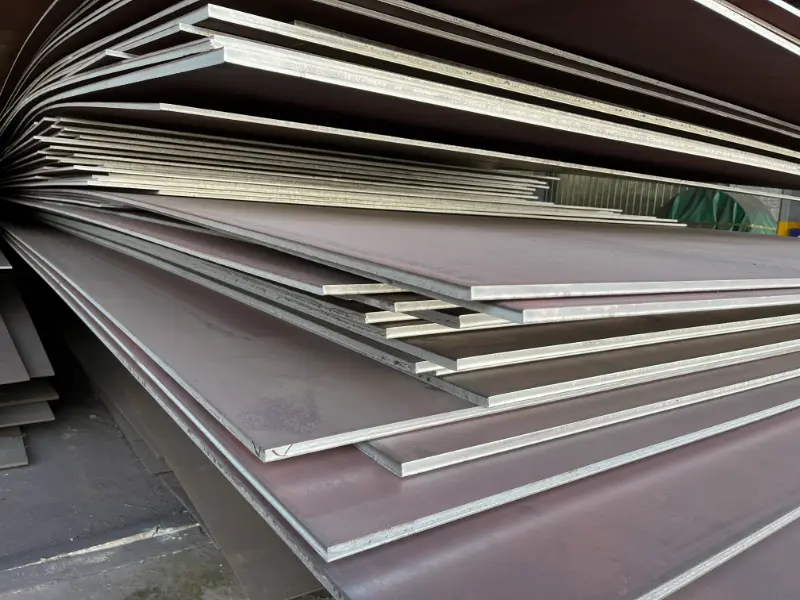
30NiCrMo16-6 High Alloy Steel Plate
30NiCrMo16-6 High Alloy Steel Plate: EN 10083-3 Properties & Equivalents
Detailed material data for 30NiCrMo16-6 (1.6747) high alloy quenched and tempered steel plate according to EN 10083-3. Includes chemical composition, mechanical properties, physical properties, international equivalents, similar materials, and application guide.
Hot forming, machining, welding (with precautions), quenching and tempering, induction hardening
- Phone : +8618037372205
- Email : [email protected]
- WhatsApp: Contact via Whtsapp
- WeChat: +8618037372205
30NiCrMo16-6 High Alloy Steel Plate Introduction
30NiCrMo16-6 (material number 1.6747) is a high-alloy quenched and tempered steel defined in EN 10083-3. It features high nickel content (approx. 4%) combined with chromium and molybdenum, providing an excellent combination of high strength, toughness, and fatigue resistance. This grade is suitable for large cross-sections and achieves tensile strengths of 1100–1300 MPa in small sizes, with good ductility and impact toughness even at low temperatures. It is typically supplied in the quenched and tempered (+QT) condition and is primarily used for heavy-duty machinery components such as shafts, gears, and high-strength fasteners. Its high hardenability allows it to be through-hardened in sections up to approximately 160 mm, making it a preferred choice for critical structural parts in the automotive, aerospace, and general engineering industries.
30NiCrMo16-6 High Alloy Steel Plate Chemical Composition
Chemical composition according to EN 10083-3:2006 for grade 30NiCrMo16-6 (1.6747). Heat analysis limits apply. Residual elements are controlled to ensure hardenability and mechanical properties. Values in weight percent.
| Element | Composition (min–max) | Notes |
|---|---|---|
| Carbon (C) | 0.26 – 0.33 | Key for strength and hardenability |
| Silicon (Si) | ≤ 0.40 | Deoxidizer |
| Manganese (Mn) | 0.30 – 0.60 | Improves hardenability |
| Phosphorus (P) | ≤ 0.025 | Max limit |
| Sulfur (S) | ≤ 0.035 | Max limit; higher for machinability grades |
| Chromium (Cr) | 1.30 – 1.70 | Carbide former, enhances wear resistance |
| Nickel (Ni) | 3.60 – 4.20 | Provides toughness and deep hardenability |
| Molybdenum (Mo) | 0.30 – 0.50 | Prevents temper embrittlement, improves high-temperature strength |
| Copper (Cu) | ≤ 0.40 | Residual; may be specified lower |
| Other elements (total) | ≤ 0.50 | Typically V, Nb, Ti may be present in traces |
30NiCrMo16-6 High Alloy Steel Plate Physical Properties
Physical properties at room temperature and elevated temperatures for 30NiCrMo16-6. These values are typical for this type of Ni-Cr-Mo steel and are suitable for engineering calculations. Thermal conditions are stable up to approx. 350°C for structural applications.
| Property | Typical Value | Unit | Test Condition |
|---|---|---|---|
| Density (ρ) | 7.85 | g/cm³ | At 20°C |
| Modulus of Elasticity (E) | 210 | GPa | At 20°C |
| Shear Modulus (G) | 81 | GPa | At 20°C |
| Poisson's Ratio (ν) | 0.30 | – | At 20°C |
| Thermal Expansion Coefficient (α) | 12.0 | 10⁻⁶/K | 20°C – 100°C |
| Thermal Expansion Coefficient (α) | 12.5 | 10⁻⁶/K | 20°C – 200°C |
| Thermal Expansion Coefficient (α) | 13.0 | 10⁻⁶/K | 20°C – 300°C |
| Thermal Expansion Coefficient (α) | 13.5 | 10⁻⁶/K | 20°C – 400°C |
| Thermal Conductivity (λ) | 35 | W/(m·K) | At 20°C |
| Thermal Conductivity (λ) | 36 | W/(m·K) | At 100°C |
| Thermal Conductivity (λ) | 36 | W/(m·K) | At 200°C |
| Thermal Conductivity (λ) | 35 | W/(m·K) | At 300°C |
| Thermal Conductivity (λ) | 33 | W/(m·K) | At 400°C |
| Specific Heat Capacity (cp) | 460 | J/(kg·K) | At 20°C |
| Electrical Resistivity (ρe) | 0.25 | μΩ·m | At 20°C |
30NiCrMo16-6 High Alloy Steel Plate Mechanical Properties
Mechanical properties for quenched and tempered (+QT) condition according to EN 10083-3. Values depend on ruling section thickness (diameter for rounds, thickness for plates). Hardness in the annealed condition: max 248 HB. For smaller sections, higher strength can be achieved. Impact test performed on Charpy-V notch specimens.
| Property | Minimum / Typical Value | Unit | Test Condition |
|---|---|---|---|
| Yield Strength (ReH) | ≥ 900 | MPa | d ≤ 16 mm, +QT |
| Tensile Strength (Rm) | 1100 – 1300 | MPa | d ≤ 16 mm, +QT |
| Elongation (A5) | ≥ 10 | % | d ≤ 16 mm, +QT |
| Reduction of Area (Z) | ≥ 45 | % | d ≤ 16 mm, +QT |
| Impact Energy (KV2) | ≥ 35 | J | +20°C, d ≤ 16 mm, +QT |
| Yield Strength (ReH) | ≥ 850 | MPa | 16 < d ≤ 40 mm, +QT |
| Tensile Strength (Rm) | 1000 – 1200 | MPa | 16 < d ≤ 40 mm, +QT |
| Elongation (A5) | ≥ 11 | % | 16 < d ≤ 40 mm, +QT |
| Reduction of Area (Z) | ≥ 50 | % | 16 < d ≤ 40 mm, +QT |
| Impact Energy (KV2) | ≥ 40 | J | +20°C, 16 < d ≤ 40 mm, +QT |
| Yield Strength (ReH) | ≥ 750 | MPa | 40 < d ≤ 100 mm, +QT |
| Tensile Strength (Rm) | 900 – 1100 | MPa | 40 < d ≤ 100 mm, +QT |
| Elongation (A5) | ≥ 12 | % | 40 < d ≤ 100 mm, +QT |
| Reduction of Area (Z) | ≥ 55 | % | 40 < d ≤ 100 mm, +QT |
| Impact Energy (KV2) | ≥ 45 | J | +20°C, 40 < d ≤ 100 mm, +QT |
| Yield Strength (ReH) | ≥ 700 | MPa | 100 < d ≤ 160 mm, +QT |
| Tensile Strength (Rm) | 850 – 1000 | MPa | 100 < d ≤ 160 mm, +QT |
| Elongation (A5) | ≥ 13 | % | 100 < d ≤ 160 mm, +QT |
| Reduction of Area (Z) | ≥ 55 | % | 100 < d ≤ 160 mm, +QT |
| Impact Energy (KV2) | ≥ 45 | J | +20°C, 100 < d ≤ 160 mm, +QT |
30NiCrMo16-6 High Alloy Steel Plate Fully Equivalent Material Standards and Replaceable Grades
| Country/Region | Standard | Grade | Remarks |
|---|---|---|---|
| European Union | EN 10083-3 | 30NiCrMo16-6 (1.6747) | Original standard designation |
| Germany | DIN EN 10083-3 | 30NiCrMo16-6 (1.6747) | Identical adoption of EN standard |
| France | NF EN 10083-3 | 30NCD16 (30NiCrMo16-6) | French designation; 30NCD16 is the historical name |
| Italy | UNI EN 10083-3 | 30NiCrMo16 (1.6747) | Italian adoption |
| United Kingdom | BS EN 10083-3 | 30NiCrMo16-6 (1.6747) | British adoption; equivalent to historical 835M30? |
| International | ISO 683-18 | 30NiCrMo16-6 | ISO standard reference, technically comparable |
30NiCrMo16-6 High Alloy Steel Plate Application Introduction
30NiCrMo16-6 is engineered for high-load components requiring deep hardenability, high fatigue strength, and toughness. Typical applications include:
- Heavy-duty shafts and axles in power transmission
- Gears and pinions subject to high bending and contact stresses
- High-strength structural bolts and studs
- Turbine and compressor rotors
- Rolling mill rolls and heavy forgings
Product Applications: Transmission shafts, Heavy-duty gear wheels, Crankshafts (large diesel engines), High-tensile fasteners (bolts, studs, nuts), Rolling mill rolls, Forged turbine discs and rotors
Processed into products: Axles for railway vehicles, Pinion shafts for wind turbines, Main shafts of industrial gearboxes, Coupling forgings, Press columns and rams, Screw conveyers
Application industries: Automotive and heavy vehicle manufacturing, Aerospace (landing gear components, structural parts), General mechanical engineering (gearboxes, machinery), Power generation (turbines, generators), Mining and construction equipment
30NiCrMo16-6 High Alloy Steel Plate Similar / Alternative Material Recommendations
| Country/Region | Standard | Grade | Remarks |
|---|---|---|---|
| European Union | EN 10083-3 | 34CrNiMo6 (1.6582) | Lower Ni (1.30–1.70%), lower hardenability but still high strength; suitable for smaller sections |
| European Union | EN 10083-3 | 36NiCrMo16 (1.6773) | Higher C (0.32–0.39%) and slightly lower Ni (3.50–4.00%); similar properties |
| USA | ASTM A29/A29M | AISI/SAE 4340 | Ni 1.65–2.00% only; lower hardenability but widely available; suitable for less demanding sections |
| USA | ASTM A646 | Type 300M | Modified 4340 with Si and V; higher strength but Ni still lower; alternative for ultra-high-strength applications |
| China | GB/T 3077 | 30CrNi2MoVA (30CrNi2MoV) | Different Ni-Cr balance; not directly interchangeable but similar strength class |
Notes:
Welding: Preheating (200–300°C) and post-weld heat treatment are required to avoid cracking. Machining: Best performed in annealed or quenched+tempered condition; use appropriate carbide tools. Surface hardening: Can be induction or flame hardened to achieve surface hardness of 58–62 HRC. Corrosion resistance: Not intended for corrosive environments; protective coatings required. For critical safety components, consult the supplier for specific testing requirements, such as ultrasonic inspection or mechanical testing per applicable dimensions.
- Share



