
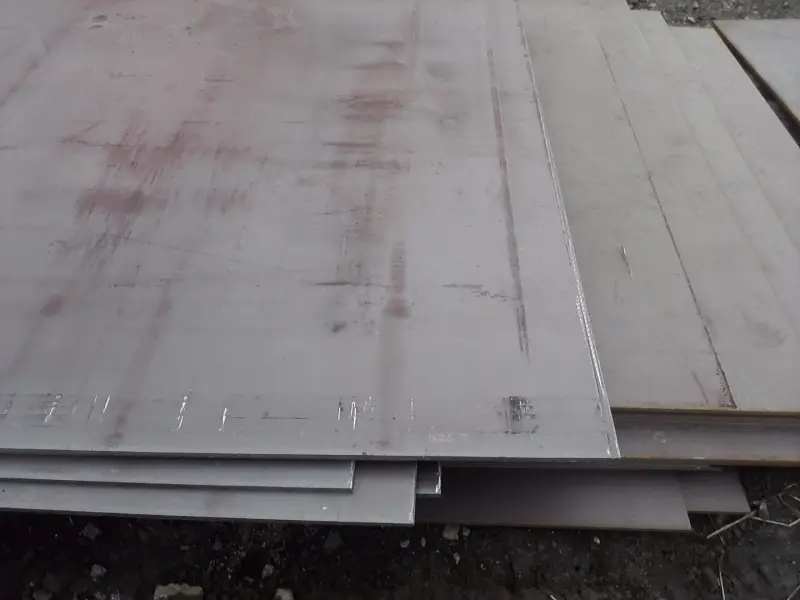
EN 10083-3 39NiCrMo3 Alloy Steel Plate
EN 10083-3 39NiCrMo3 Alloy Steel Plate - Properties, Equivalents & Applications
Detailed material data for 39NiCrMo3 high-strength alloy steel plate according to EN 10083-3, covering chemical composition, mechanical and physical properties, international equivalents, similar materials, and application guidance.
Hot rolling, forging, machining, heat treatment
- Phone : +8618037372205
- Email : [email protected]
- WhatsApp: Contact via Whtsapp
- WeChat: +8618037372205
EN 10083-3 39NiCrMo3 Alloy Steel Plate Introduction
39NiCrMo3 is a medium‑carbon nickel‑chromium‑molybdenum alloy steel designed for quenching and tempering under European standard EN 10083‑3. It combines high strength, good toughness and moderate wear resistance after heat treatment. Typical applications include heavy‑duty gears, shafts, pins and fasteners subjected to dynamic loads. The steel exhibits consistent hardenability and can be supplied in soft‑annealed, quenched and tempered or untreated condition. Its weldability is limited – adequate pre‑heat and post‑weld heat treatment are essential.
EN 10083-3 39NiCrMo3 Alloy Steel Plate Chemical Composition
The chemical composition of 39NiCrMo3 is precisely balanced to provide optimal hardenability and mechanical properties after quenching and tempering. Nickel improves toughness and fatigue strength, chromium ensures adequate wear resistance, and molybdenum counteracts temper embrittlement and enhances hot strength. Low phosphorus and sulfur levels guarantee good ductility and cleanliness.
| Chemical Element | Standard Value (wt%) | Remarks |
|---|---|---|
| Carbon (C) | 0.35 – 0.43 | Primary hardening element; controls strength and hardenability |
| Silicon (Si) | 0.10 – 0.40 | Deoxidising agent; contributes to solid‑solution strengthening |
| Manganese (Mn) | 0.50 – 0.80 | Promotes austenite stability and hardenability |
| Phosphorus (P) | ≤ 0.025 | Limited impurity; excess reduces toughness |
| Sulfur (S) | ≤ 0.035 | Controlled to avoid hot shortness; may improve machinability if intentionally added |
| Chromium (Cr) | 0.60 – 1.00 | Increases hardenability and wear resistance |
| Nickel (Ni) | 0.70 – 1.00 | Enhances toughness, fatigue strength and low‑temperature performance |
| Molybdenum (Mo) | 0.15 – 0.25 | Prevents temper embrittlement; raises high‑temperature strength |
EN 10083-3 39NiCrMo3 Alloy Steel Plate Thermal and Electrical Physical Properties
The table lists average physical properties for 39NiCrMo3 in the annealed condition at room temperature, unless otherwise noted. These values are typical for low‑alloy engineering steels and are suitable for design calculations involving thermal expansion, heat transfer or electrical conduction. Slight variations may occur depending on heat treatment and precise composition.
| Performance Property | Typical Value | Unit | Test Condition / Remarks |
|---|---|---|---|
| Density (ρ) | 7.85 | g/cm³ | At 20 °C |
| Elastic Modulus (E) | 210 | GPa | At 20 °C |
| Shear Modulus (G) | ≈ 80 | GPa | Calculated from E and ν |
| Poisson's Ratio (ν) | 0.3 | – | At 20 °C |
| Thermal Expansion Coefficient (α) | 11.5 x 10^-6 | /K | 20–100 °C |
| Thermal Expansion Coefficient (α) | 12.8 x 10^-6 | /K | 20–300 °C |
| Thermal Conductivity (λ) | 40 | W/(m·K) | At 20 °C |
| Specific Heat Capacity (cₚ) | 460 | J/(kg·K) | At 20 °C |
| Electrical Resistivity (ρₑ) | 0.22 | µΩ·m | At 20 °C |
EN 10083-3 39NiCrMo3 Alloy Steel Plate Mechanical Properties
The following values are typical for 39NiCrMo3 after quenching and tempering. Exact properties depend on ruling section thickness, austenitising temperature (830–860 °C), quenching medium and tempering temperature (540–680 °C). The steel guarantees minimum yield and tensile strengths as well as good ductility and impact toughness. In the soft‑annealed condition the Brinell hardness does not exceed 229 HBW.
| Performance Property | Standard Required Value | Unit | Test Condition |
|---|---|---|---|
| Yield Strength (ReH) | ≥ 750 | MPa | Quenched and tempered, thickness ≤ 16 mm |
| Yield Strength (ReH) | ≥ 700 | MPa | Quenched and tempered, thickness 16–40 mm |
| Yield Strength (ReH) | ≥ 600 | MPa | Quenched and tempered, thickness 40–100 mm |
| Yield Strength (ReH) | ≥ 550 | MPa | Quenched and tempered, thickness 100–250 mm |
| Tensile Strength (Rm) | 900 – 1100 | MPa | Quenched and tempered, thickness ≤ 16 mm |
| Tensile Strength (Rm) | 900 – 1100 | MPa | Quenched and tempered, thickness 16–40 mm |
| Tensile Strength (Rm) | 800 – 950 | MPa | Quenched and tempered, thickness 40–100 mm |
| Tensile Strength (Rm) | 750 – 900 | MPa | Quenched and tempered, thickness 100–250 mm |
| Elongation (A) | ≥ 10 | % | Quenched and tempered, L₀ = 5.65√S₀, thickness ≤ 16 mm |
| Elongation (A) | ≥ 10 | % | Quenched and tempered, thickness 16–40 mm |
| Elongation (A) | ≥ 10 | % | Quenched and tempered, thickness 40–100 mm |
| Elongation (A) | ≥ 11 | % | Quenched and tempered, thickness 100–250 mm |
| Impact Energy (KV, ISO‑V) | ≥ 25 | J | Quenched and tempered, at room temperature, all thicknesses up to 250 mm |
| Brinell Hardness (HBW) | ≤ 229 | HBW | Soft annealed condition (+A) |
EN 10083-3 39NiCrMo3 Alloy Steel Plate Fully Equivalent Standards and Substitute Grades
| Country/Region | Standard | Grade | Remarks |
|---|---|---|---|
| International | ISO 683-18 | 39NiCrMo3 | Identical chemical composition and mechanical properties |
| Germany | DIN EN 10083-3 | 39NiCrMo3 | Same as EN 10083-3 |
| France | NF A 35-552 | 39NiCrMo3 | Identical grade |
| Italy | UNI 7845 | 39NiCrMo3 | Identical grade |
| USA | AISI/SAE A29 | 9840 | Very close match; Cr 0.70–0.95, Ni 0.80–1.10, Mo 0.15–0.25 |
| United Kingdom | BS EN 10083-3 | 39NiCrMo3 | Adopts EN standard directly |
| Japan | JIS G4105 | SNCM439 | Ni content higher (1.60–2.00 %), used as approximate equivalent |
EN 10083-3 39NiCrMo3 Alloy Steel Plate Application Introduction
39NiCrMo3 is an excellent material for parts that must withstand high static and alternating stresses, such as those found in power transmission and heavy machinery. Because of its good response to heat treatment, it can be machined in the annealed condition and subsequently hardened to the required strength level. Typical industries and product examples are listed below.
Product Applications: Case‑hardened and through‑hardened gears, Transmission and drive shafts, Crankshafts and connecting rods, Axles and spindles, Bolts, studs and high‑strength fasteners, Forged components for mechanical ends
Processed into products: Gear wheels and pinions, Shaft extensions and pump shafts, Mechanical clutch plates, Torsion bars, Hydraulic cylinder rods, Railway wagon axles, Large engine bolts
Application industries: Automotive (transmission, drivetrain), Heavy machinery (construction, mining, agricultural), Railway (axles, suspension), Shipbuilding (shafting, propeller shafts), Power generation (turbine components, fasteners), General engineering (die blocks, tool holders)
EN 10083-3 39NiCrMo3 Alloy Steel Plate Similar or Alternative Material Recommendations
| Country/Region | Standard | Grade | Remarks |
|---|---|---|---|
| Europe | EN 10083-3 | 36CrNiMo4 | Higher Cr (0.90–1.20) and Ni (0.90–1.20); better hardenability |
| Europe | EN 10083-3 | 34CrNiMo6 | Even higher Cr and Ni; recommended for larger cross‑sections |
| Europe | EN 10083-3 | 42CrMo4 | Lacks Ni, lower toughness; economical alternative for moderate loads |
| USA | AISI/SAE | 4340 | Ni 1.65–2.00, Cr 0.70–0.90, Mo 0.20–0.30; excellent deep‑hardening and toughness |
| USA | AISI/SAE | 8640 | Cr 0.40–0.60, Ni 0.40–0.70, Mo 0.15–0.25; lower hardenability |
| Japan | JIS G4103 | SNCM431 | Similar to 36CrNiMo4; Cr 0.65–0.95, Ni 0.65–1.00 |
| China | GB/T 3077 | 40CrNiMo | Ni 1.25–1.65, higher Ni content; suitable where extra toughness is needed |
Notes:
Welding: Preheating to 200–300 °C is recommended, followed by post‑weld stress relieving at 600–650 °C to avoid hydrogen induced cracking and to homogenise hardness.
Heat treatment: Austenitise at 830–860 °C, quench in oil or water (depending on section size), and temper at 540–680 °C to achieve desired strength‑toughness combination. After tempering, slow cooling in air is sufficient.
Machinability: Best machined in the soft‑annealed condition (hardness ≤ 229 HBW). In the quenched and tempered condition, use coated carbide tools and lower cutting speeds.
- Share



