
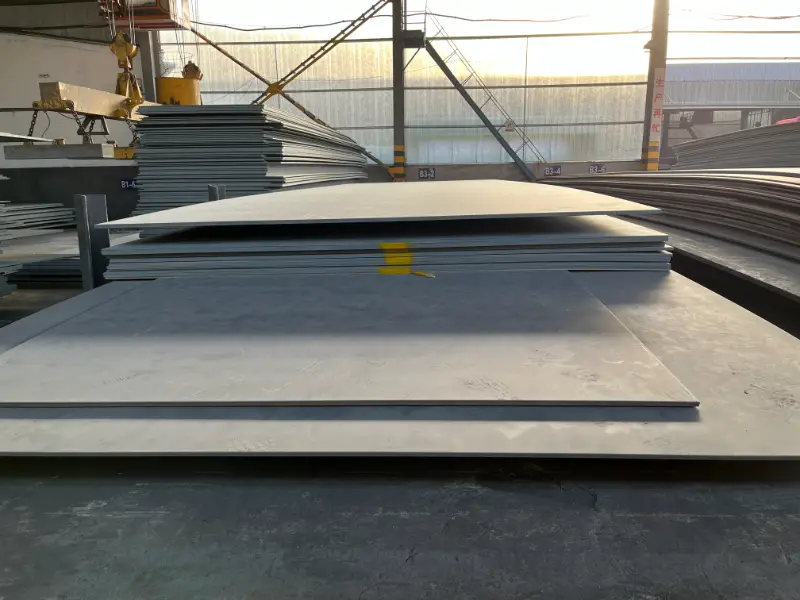
EN10083-3 36NiCrMo16 High-Strength Alloy Steel Plate
EN10083-3 36NiCrMo16 High-Strength Alloy Steel Plate - Complete Material Guide
Detailed reference for 36NiCrMo16 (1.6773) high-alloy quenched and tempered steel according to EN 10083-3. Includes chemical composition, mechanical properties under QT condition, thermal & electrical properties, global equivalent grades, similar alternatives, and application guidance.
Hot rolling, forging, quenching & tempering, surface hardening (if required)
- Phone : +8618037372205
- Email : [email protected]
- WhatsApp: Contact via Whtsapp
- WeChat: +8618037372205
EN10083-3 36NiCrMo16 High-Strength Alloy Steel Plate Introduction
36NiCrMo16 (material number 1.6773) is a high-strength, quenched and tempered alloy engineering steel defined in EN 10083-3:2006. Its elevated nickel content (3.60–4.10%) ensures excellent hardenability and high toughness even in large cross-sections. Combined with chromium and molybdenum, the grade offers a superior balance of strength, ductility, and wear resistance. Typical properties after quenching and tempering include tensile strengths in the range of 1100–1300 MPa and yield strengths above 900 MPa, while retaining good impact toughness at low temperatures. This alloy is particularly suited for heavily stressed components that must withstand dynamic loads, such as large shafts, gears, and turbine parts. It is supplied in the quenched and tempered (+QT) condition, and can be further surface hardened if required. The steel meets strict European standards and has direct equivalents across major industrial nations, making it a reliable choice for global engineering projects.
EN10083-3 36NiCrMo16 High-Strength Alloy Steel Plate Chemical Composition according to EN 10083-3
The heat analysis limits for 36NiCrMo16 (1.6773) are listed below. The steel is characterized by a carefully balanced content of nickel, chromium, and molybdenum to achieve deep hardenability and high strength after heat treatment. Phosphorus and sulfur are strictly controlled to ensure good toughness.
| Element | Standard Value (%) | Remarks |
|---|---|---|
| Carbon (C) | 0.32 – 0.39 | Key for strength after quenching |
| Silicon (Si) | ≤ 0.40 | Deoxidiser, slight solid-solution strengthening |
| Manganese (Mn) | 0.50 – 0.80 | Improves hardenability and strength |
| Phosphorus (P) | ≤ 0.025 | Low level for toughness |
| Sulfur (S) | ≤ 0.035 | Controlled for machinability |
| Chromium (Cr) | 1.50 – 1.80 | Carbide former, enhances wear resistance |
| Nickel (Ni) | 3.60 – 4.10 | Greatly improves toughness and hardenability |
| Molybdenum (Mo) | 0.35 – 0.60 | Secondary hardening, temper resistance |
EN10083-3 36NiCrMo16 High-Strength Alloy Steel Plate Typical Thermal and Electrical Physical Properties
The following physical data represent typical values for a Ni-Cr-Mo alloy steel in the quenched and tempered condition. These are indicative at room temperature unless otherwise noted and are suitable for engineering design calculations. Properties may slightly vary depending on exact heat treatment and testing direction.
| Property | Typical Value | Unit | Test Condition / Temperature |
|---|---|---|---|
| Density (ρ) | 7.85 | g/cm³ | 20 °C |
| Modulus of elasticity (E) | 210 | GPa | 20 °C, dynamic longitudinal method |
| Shear modulus (G) | 81 | GPa | 20 °C, calculated from E and ν |
| Poisson's ratio (ν) | 0.30 | – | 20 °C |
| Thermal expansion coefficient (α) | 11.5 × 10⁻⁶ | K⁻¹ | 20–100 °C, linear expansion |
| Thermal conductivity (λ) | 32 | W/(m·K) | 20 °C |
| Specific heat capacity | 460 | J/(kg·K) | 20 °C |
| Electrical resistivity (ρₑ) | 0.25 | µΩ·m | 20 °C |
EN10083-3 36NiCrMo16 High-Strength Alloy Steel Plate Typical Mechanical Properties
The indicative mechanical properties below are valid for quenched and tempered (+QT) 36NiCrMo16 with a ruling section up to 100 mm. Actual values may vary with section size and exact tempering temperature. The alloy exhibits a combination of very high tensile and yield strength with adequate ductility and notch toughness, even at sub-zero temperatures.
| Property | Standard Requirement | Unit | Test Condition |
|---|---|---|---|
| Yield strength (ReH) | ≥ 900 | MPa | +QT, d ≤ 100 mm, room temperature |
| Tensile strength (Rm) | 1100 – 1300 | MPa | +QT, d ≤ 100 mm, room temperature |
| Elongation (A) | ≥ 10 | % | +QT, d ≤ 100 mm, proportional test piece (L₀=5d) |
| Reduction of area (Z) | ≥ 40 | % | +QT, d ≤ 100 mm |
| Impact energy (KV₂) | ≥ 25 | J | +QT, -40 °C, Charpy V-notch (longitudinal) |
EN10083-3 36NiCrMo16 High-Strength Alloy Steel Plate International Equivalents – Fully Identical Standard & Grade
The table lists standards and designations that are technically identical to EN 10083-3 36NiCrMo16 (1.6773), as they either adopt the European standard directly or maintain a national standard with the same chemical composition and mechanical requirements.
| Country / Region | Standard | Grade / Number | Remarks |
|---|---|---|---|
| Europe (CEN) | EN 10083-3:2006 | 36NiCrMo16 / 1.6773 | Original standard |
| Germany | DIN EN 10083-3 | 36NiCrMo16 (1.6773) | Adopted as DIN EN |
| France | NF EN 10083-3 | 36NiCrMo16 | Former AFNOR 36NCD16 |
| United Kingdom | BS EN 10083-3 | 36NiCrMo16 | Former BS 970 / EN 36 grade |
| Italy | UNI EN 10083-3 | 36NiCrMo16 | Identical adoption |
| Spain | UNE EN 10083-3 | F.1740 (36NiCrMo16) | UNE code F.1740 |
| Sweden | SS-EN 10083-3 | 36NiCrMo16 | No separate national SS number |
EN10083-3 36NiCrMo16 High-Strength Alloy Steel Plate Application Introduction
Thanks to its deep hardenability, high strength, and excellent low-temperature toughness, 36NiCrMo16 is a preferred material for large-section, dynamically stressed components. It can be further surface hardened by induction or nitriding for enhanced wear resistance. Typical industries and applications include:
Product Applications: Heat-treated ready‑to‑use forged bars and blocks, Quench & tempered heavy plates for structural parts, Semi‑finished shafts and pinions for customized machining
Processed into products: Large transmission shafts and axles (>250 mm diameter), Mill pinions, gear rims, and gear wheels for high torque, Turbine rotors and generator shafts, Pump shafts for high‑pressure applications, Coupling flanges and forged housings, Crankshafts and camshafts in heavy‑duty engines, Extrusion press stems and bolsters, Large moulds with high core strength requirements
Application industries: Heavy machinery and plant construction, Power generation (turbines, generators), Automotive drivetrain (axles, gears), Oil & gas (downhole heavy-duty shafts), Shipbuilding (propeller shafts, rudder stocks), Forging and tooling (large die blocks, bolsters)
EN10083-3 36NiCrMo16 High-Strength Alloy Steel Plate Similar / Substitute Materials
These alloys offer comparable strength and toughness but differ slightly in nickel, chromium, or molybdenum content. They may be considered for applications where 36NiCrMo16 is specified but not available, provided design requirements are reviewed carefully.
| Country / Region | Standard | Grade / Number | Remarks |
|---|---|---|---|
| Europe | EN 10083-3 | 34CrNiMo6 (1.6582) | Lower Ni (~1.50%) and Cr; reduced hardenability; good alternative for smaller sections |
| Europe | EN 10083-3 | 30CrNiMo8 (1.6580) | Lower Ni (~2.00%) but higher C; strength similar in smaller sections |
| USA | ASTM A434 / SAE | 4340 (UNS G43400) | Ni ~1.82%, Cr ~0.80%, Mo ~0.25%; lower hardenability; widely available |
| USA | AMS 6414 | 4340 Mod | Variants with raised Ni and Cr available; close to 36NiCrMo16 |
| Japan | JIS G4105 | SNCM439 | Ni ~1.75%, Cr ~0.70%, Mo ~0.20%; lower alloy; for less demanding cross-sections |
| Germany (historical) | DIN 17200 | 36CrNiMo4 | Lower Ni (1.00–1.30%) but similar Cr-Mo; used for medium-duty shafts |
Notes:
- 36NiCrMo16 is normally delivered in the quenched and tempered (+QT) condition; other conditions (+N, +A) may be available upon agreement.
- For welding, preheating (>300 °C) and immediate post‑weld heat treatment are mandatory due to the high carbon equivalent and risk of cold cracking.
- Flame cutting and heavy machining should be carried out on the tempered material; stress relieving after rough machining is recommended.
- The material can be induction hardened or nitrided to achieve surface hardness up to ~58 HRC while maintaining a tough core.
- Data provided are in accordance with EN 10083‑3:2006 and typical reference values. For exact requirements, the purchaser should refer to the relevant standard and product specification.
- Share



