
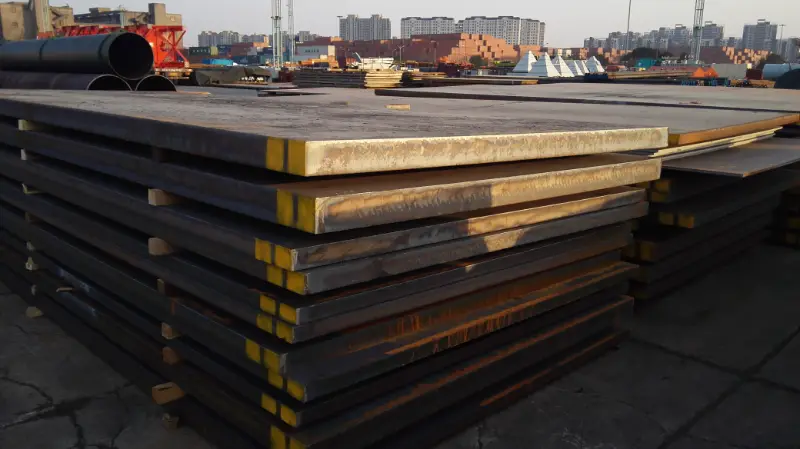
EN 10083-3 35NiCr6 High Alloy Steel Plate
35NiCr6 Alloy Steel Plate EN 10083-3 Data | Quenching & Tempering Grade
Complete material data for 35NiCr6 high alloy steel to EN 10083-3: chemical composition, mechanical properties, thermal and electrical physical properties, full equivalents, similar alternatives, and application guidance.
Machining, carburizing, carbonitriding, quenching, tempering, induction hardening, flame hardening
- Phone : +8618037372205
- Email : [email protected]
- WhatsApp: Contact via Whtsapp
- WeChat: +8618037372205
EN 10083-3 35NiCr6 High Alloy Steel Plate Introduction
35NiCr6 is a nickel-chromium alloy steel governed by EN 10083-3, designed for quenching and tempering as well as surface hardening (carburizing or carbonitriding). It achieves an excellent combination of high core strength, toughness, and wear-resistant surface hardness after case hardening. The grade is characterized by:
- Good hardenability for medium to large cross-sections
- High fatigue strength and impact resistance
- Excellent machinability in the annealed condition
- Consistent quality for critical dynamically loaded parts
The balanced Ni content (1.50–1.80 %) enhances toughness, while Cr (0.90–1.20 %) improves hardenability and corrosion resistance. It is widely used in automotive, mechanical engineering, and gearbox manufacturing where components must withstand heavy loads and abrasive wear.
EN 10083-3 35NiCr6 High Alloy Steel Plate Chemical Composition
Ladle analysis limits according to EN 10083-3:2006 for grade 35NiCr6. All values are in weight percent. No further intentional additions of other elements are specified; residual levels are controlled to standard practice.
| Chemical Element | Standard Value (%) | Remarks |
|---|---|---|
| Carbon (C) | 0.32 – 0.39 | |
| Silicon (Si) | ≤ 0.40 | |
| Manganese (Mn) | 0.50 – 0.80 | |
| Phosphorus (P) | ≤ 0.025 | |
| Sulfur (S) | ≤ 0.035 | |
| Chromium (Cr) | 0.90 – 1.20 | |
| Nickel (Ni) | 1.50 – 1.80 |
EN 10083-3 35NiCr6 High Alloy Steel Plate Thermal & Electrical Physical Properties
These data represent typical values for nickel-chromium alloy steel of this class at room temperature unless otherwise stated. Actual values may vary slightly with exact composition and heat treatment condition. Temperature-dependent properties are given where available.
| Property | Typical Value | Unit | Conditions / Remarks |
|---|---|---|---|
| Density (ρ) | 7.85 | g/cm³ | 20 °C |
| Elastic modulus (E) | 210 | GPa | 20 °C |
| Shear modulus (G) | ≈81 | GPa | Calculated from E and ν |
| Poisson's ratio (ν) | 0.30 | – | 20 °C |
| Thermal expansion coefficient (α) | 11.5 × 10⁻⁶ | /K | 20–100 °C |
| Thermal expansion coefficient (α) | 12.5 × 10⁻⁶ | /K | 20–200 °C |
| Thermal expansion coefficient (α) | 13.5 × 10⁻⁶ | /K | 20–400 °C |
| Thermal conductivity (λ) | 42 | W/(m·K) | 20 °C |
| Specific heat capacity (c) | 460 | J/(kg·K) | 20 °C |
| Electrical resistivity (ρ_e) | 0.25 × 10⁻⁶ | Ω·m | 20 °C |
EN 10083-3 35NiCr6 High Alloy Steel Plate Mechanical Properties
Properties in the quenched and tempered (+QT) condition as per EN 10083-3:2006 for longitudinal test pieces. Values depend on ruling section thickness. Charpy V-notch impact energy measured at +20 °C. No bending test is mandated by this standard for the +QT condition. Additional hardness limits for the annealed (+A) condition are also included.
| Property | Standard Requirement | Unit | Test Condition |
|---|---|---|---|
| Yield strength (ReH) | ≥ 735 | MPa | +QT, section ≤ 16 mm |
| Yield strength (ReH) | ≥ 635 | MPa | +QT, 16 < section ≤ 40 mm |
| Yield strength (ReH) | ≥ 540 | MPa | +QT, 40 < section ≤ 100 mm |
| Tensile strength (Rm) | 880 – 1080 | MPa | +QT, section ≤ 16 mm |
| Tensile strength (Rm) | 780 – 980 | MPa | +QT, 16 < section ≤ 40 mm |
| Tensile strength (Rm) | 740 – 880 | MPa | +QT, 40 < section ≤ 100 mm |
| Elongation after fracture (A5) | ≥ 10 | % | +QT, section ≤ 16 mm |
| Elongation after fracture (A5) | ≥ 11 | % | +QT, 16 < section ≤ 40 mm |
| Elongation after fracture (A5) | ≥ 12 | % | +QT, 40 < section ≤ 100 mm |
| Reduction of area (Z) | ≥ 35 | % | +QT, all quoted sections |
| Impact energy (KV2) | ≥ 25 | J | +QT, +20 °C, section ≤ 16 mm |
| Impact energy (KV2) | ≥ 30 | J | +QT, +20 °C, section > 16 mm |
| Brinell hardness | ≤ 248 | HB | Annealed (+A) condition |
EN 10083-3 35NiCr6 High Alloy Steel Plate Full Equivalent Standard Grades & Replaceable Designations
| Country / Region | Standard | Grade | Remarks |
|---|---|---|---|
| European Union | EN 10083-3 | 35NiCr6 (1.5815) | Original European standard, directly interchangeable. |
| Germany | DIN EN 10083-3 | 35NiCr6 | Identical to EN 10083-3. |
| France | NF EN 10083-3 | 35NiCr6 | Identical to EN 10083-3. |
| United Kingdom | BS EN 10083-3 | 35NiCr6 | Identical to EN 10083-3. |
| Italy | UNI EN 10083-3 | 35NiCr6 | Identical to EN 10083-3. |
EN 10083-3 35NiCr6 High Alloy Steel Plate Application Introduction
35NiCr6 is ideally suited for components that must withstand high dynamic stresses and abrasive wear. After carburizing or carbonitriding followed by quenching and tempering, the surface develops a hard, wear-resistant case (typically 58–62 HRC) while the core retains high toughness. This grade can also be used in the through-hardened condition where moderate wear resistance and high fatigue strength are required. It is frequently selected for medium to large cross-sections where moderate hardenability alloys are insufficient.
Product Applications: Heavy-duty gears and pinions, Shafts, axles, and spindles, Camshafts, Connecting rods and links, Universal joints and couplings, Track chains and sprockets, Forgings for high-strength machine elements
Processed into products: Carburized gear teeth (spur, helical, bevel), Transmission input/output shafts, Differential side gears, Drive pinions, Crankshaft counterweights (when case-hardened), Hydraulic cylinder rods (surface hardened), Torsion bars and stabilizers (if induction hardened)
Application industries: Automotive (transmission and drivetrain), Heavy machinery and construction equipment, Gear manufacturing, Railway engineering, Mining and quarrying, General mechanical engineering
EN 10083-3 35NiCr6 High Alloy Steel Plate Similar / Alternative Materials with Close Performance
| Country / Region | Standard | Grade | Remarks |
|---|---|---|---|
| USA | ASTM A29 / SAE | 3135 (UNS G31350) | Similar Ni-Cr alloy with slightly lower Ni and Cr content (Ni 1.10–1.40, Cr 0.55–0.75). Matched for comparable hardenability in smaller sections. |
| Japan | JIS G4103 | SNCM431 (formerly SNCM1) | Ni-Cr-Mo steel with similar tensile strength after Q+T, but contains 0.15–0.30 Mo for added hardenability; often substituted where higher toughness is needed. |
| ISO | ISO 683-11 | 20NiCrMoS6-4 | Case-hardening steel with lower carbon (0.16–0.22) and added Mo; used for carburized parts where core strength can be lower than 35NiCr6. |
| Germany | DIN EN 10083-3 | 34CrNiMo6 (1.6582) | Higher strength grade with Mo addition; offers deeper hardenability and higher core strength, but requires different heat treatment parameters. |
Notes:
- The recommended heat treatment route for case hardening is carburizing at 880–920 °C, followed by quenching in oil and tempering at 150–200 °C for a surface hardness ≈60 HRC.
- For through-hardening, austenitize at 830–860 °C, oil quench, and temper at 500–650 °C depending on desired strength level.
- Welding requires preheat, low-hydrogen filler, and post-weld stress relief; full mechanical properties may not be restored in the weld zone.
- This grade may be supplied with restricted hardenability (e.g., H-band grades) upon agreement.
- Always refer to the latest edition of EN 10083-3 for exact delivery condition and test requirements.
- Share



