
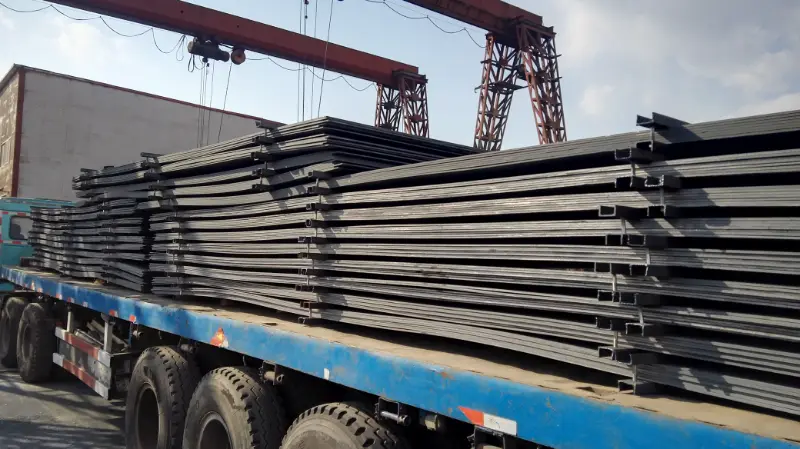
34CrNiMo6 Alloy Steel
34CrNiMo6 Alloy Steel | Quenched & Tempered High-Strength Plate EN 10083-3
Comprehensive technical data, chemical composition, mechanical and thermal properties of 34CrNiMo6 high alloy steel according to EN 10083-3, with equivalent grades and application guidelines.
Hot rolling, forging, heat treatment (quenching + tempering), machining, welding (with precautions)
- Phone : +8618037372205
- Email : [email protected]
- WhatsApp: Contact via Whtsapp
- WeChat: +8618037372205
34CrNiMo6 Alloy Steel Introduction
34CrNiMo6 is a high-alloy quenched and tempered steel defined in EN 10083-3, renowned for its exceptional combination of high strength, toughness, and fatigue resistance after appropriate heat treatment. Its chemical composition features carefully balanced additions of chromium, nickel, and molybdenum, which provide deep hardenability and consistent mechanical properties even in large cross-sections.
- Typical delivery condition is +QT (quenched and tempered), achieving tensile strengths from 750 to 1300 MPa depending on ruling section.
- Excellent wear resistance and impact toughness allow its use in dynamically loaded components.
- Widely employed for heavy-duty shafts, gears, crankshafts, and structural parts in automotive, mechanical, and energy industries.
34CrNiMo6 Alloy Steel Chemical Composition
Chemical composition according to EN 10083-3:2006 for 34CrNiMo6 grade. Values represent ladle analysis limits. Residual elements are controlled to ensure hardenability and mechanical properties.
| Element | Standard Value (wt%) | Remarks |
|---|---|---|
| C | 0.30 – 0.38 | Core hardenability element |
| Si | ≤ 0.40 | Deoxidizer, strength |
| Mn | 0.50 – 0.80 | Hardenability, strength |
| P | ≤ 0.025 | Maximum for ductility |
| S | ≤ 0.035 | Maximum for toughness |
| Cr | 1.30 – 1.70 | Hardenability, wear resistance |
| Mo | 0.15 – 0.30 | Hardenability, temper resistance |
| Ni | 1.30 – 1.70 | Toughness, hardenability |
| Cu | ≤ 0.40 | Residual element (not required) |
34CrNiMo6 Alloy Steel Thermal & Electrical Physical Properties
Typical physical properties of 34CrNiMo6 alloy steel at room temperature unless otherwise noted. These values represent non-guaranteed reference data obtained from standard steel databases and are suitable for design calculations. Actual properties can vary slightly with heat treatment condition.
| Property | Typical Value | Unit | Test Condition |
|---|---|---|---|
| Density (ρ) | 7.85 | g/cm³ | Room temperature |
| Modulus of elasticity (E) | 210 | GPa | Room temperature, tensile |
| Shear modulus (G) | 80 | GPa | Room temperature, calculated |
| Poisson's ratio (ν) | 0.3 | — | Room temperature |
| Thermal expansion coefficient (α) | 11.5 | 10⁻⁶/K | Temperature range 20 – 100 °C |
| Thermal expansion coefficient (α) | 12.5 | 10⁻⁶/K | Temperature range 20 – 200 °C |
| Thermal expansion coefficient (α) | 13.0 | 10⁻⁶/K | Temperature range 20 – 300 °C |
| Thermal conductivity (λ) | 42 | W/(m·K) | Room temperature |
| Specific heat capacity (c) | 460 | J/(kg·K) | Room temperature |
| Electrical resistivity (ρ_e) | 0.25 | µΩ·m | Room temperature |
34CrNiMo6 Alloy Steel Mechanical Properties
Typical mechanical properties of 34CrNiMo6 in quenched and tempered (+QT) condition according to EN 10083-3. Values depend on ruling section diameter. Minimum values are guaranteed; actual values are typically higher. Test specimens taken from a location according to the standard.
| Property | Value | Unit | Test Condition |
|---|---|---|---|
| Yield strength Rp0.2 | ≥ 900 | MPa | Diameter ≤ 16 mm, +QT, room temperature |
| Tensile strength Rm | 1100 – 1300 | MPa | Diameter ≤ 16 mm, +QT, room temperature |
| Elongation A | ≥ 10 | % | Diameter ≤ 16 mm, +QT, room temperature |
| Reduction of area Z | ≥ 45 | % | Diameter ≤ 16 mm, +QT, room temperature |
| Impact energy KV (ISO-V) | ≥ 35 | J | Diameter ≤ 16 mm, +QT, room temperature |
| Yield strength Rp0.2 | ≥ 800 | MPa | 16 mm < diameter ≤ 40 mm, +QT, room temperature |
| Tensile strength Rm | 1000 – 1200 | MPa | 16 mm < diameter ≤ 40 mm, +QT, room temperature |
| Elongation A | ≥ 11 | % | 16 mm < diameter ≤ 40 mm, +QT, room temperature |
| Reduction of area Z | ≥ 50 | % | 16 mm < diameter ≤ 40 mm, +QT, room temperature |
| Impact energy KV (ISO-V) | ≥ 45 | J | 16 mm < diameter ≤ 40 mm, +QT, room temperature |
| Yield strength Rp0.2 | ≥ 700 | MPa | 40 mm < diameter ≤ 100 mm, +QT, room temperature |
| Tensile strength Rm | 900 – 1100 | MPa | 40 mm < diameter ≤ 100 mm, +QT, room temperature |
| Elongation A | ≥ 12 | % | 40 mm < diameter ≤ 100 mm, +QT, room temperature |
| Reduction of area Z | ≥ 55 | % | 40 mm < diameter ≤ 100 mm, +QT, room temperature |
| Impact energy KV (ISO-V) | ≥ 45 | J | 40 mm < diameter ≤ 100 mm, +QT, room temperature |
| Yield strength Rp0.2 | ≥ 600 | MPa | 100 mm < diameter ≤ 160 mm, +QT, room temperature |
| Tensile strength Rm | 800 – 950 | MPa | 100 mm < diameter ≤ 160 mm, +QT, room temperature |
| Elongation A | ≥ 13 | % | 100 mm < diameter ≤ 160 mm, +QT, room temperature |
| Reduction of area Z | ≥ 60 | % | 100 mm < diameter ≤ 160 mm, +QT, room temperature |
| Impact energy KV (ISO-V) | ≥ 45 | J | 100 mm < diameter ≤ 160 mm, +QT, room temperature |
| Yield strength Rp0.2 | ≥ 550 | MPa | 160 mm < diameter ≤ 250 mm, +QT, room temperature |
| Tensile strength Rm | 750 – 900 | MPa | 160 mm < diameter ≤ 250 mm, +QT, room temperature |
| Elongation A | ≥ 14 | % | 160 mm < diameter ≤ 250 mm, +QT, room temperature |
| Reduction of area Z | ≥ 60 | % | 160 mm < diameter ≤ 250 mm, +QT, room temperature |
| Impact energy KV (ISO-V) | ≥ 45 | J | 160 mm < diameter ≤ 250 mm, +QT, room temperature |
34CrNiMo6 Alloy Steel Completely Equivalent Material Standards & Substitutable Grades
| Country/Region | Standard | Grade | Remarks |
|---|---|---|---|
| Europe | EN 10083-3 | 34CrNiMo6 (1.6582) | Primary standard, identical |
| International | ISO 683-2 | 34CrNiMo6 | Equivalent chemistry and mechanical requirements |
| Germany | DIN EN 10083-3 | 34CrNiMo6 | National adoption, identical to EN |
34CrNiMo6 Alloy Steel Application Introduction
34CrNiMo6 is designed for components subjected to high dynamic loads where both strength and toughness are critical. It is typically used in the quenched and tempered (+QT) condition with surface hardening (induction, nitriding) when wear resistance is required. The alloy can be welded with special precautions and preheating.
Product Applications: High-strength gears and pinions, Drive and propeller shafts, Crankshafts and camshafts, Connecting rods and toggle levers, Axle beams and steering knuckles, Bolts, studs and fasteners with high fatigue resistance, Forged rollers, sleeves and rings
Processed into products: Transmission shafts for heavy-duty gearboxes, Wind turbine main shafts, Crankshafts for diesel engines, Forged connecting rods for compressors, Power train pinion shafts, Heavy truck axle shafts, Pump shafts for high pressure service, Induction hardened hollow spindles, High-strength structural bolts (grade 10.9/12.9)
Application industries: Heavy machinery and equipment, Automotive and commercial vehicles, Power generation (turbines, generators), Oil and gas (drilling tools, wellhead components), Mining and earthmoving, General mechanical engineering
34CrNiMo6 Alloy Steel Similar / Alternative Material Recommendations
| Country/Region | Standard | Grade | Remarks |
|---|---|---|---|
| USA | ASTM A29 / A322 | 4340 | Ni 1.65-2.00, Cr 0.70-0.90, Mo 0.20-0.30; very similar hardenability, widely used substitute |
| China | GB/T 3077 | 40CrNiMoA | C 0.37-0.44, comparable Cr-Ni-Mo alloy, often used for similar shaft and gear applications |
| Japan | JIS G4103 | SNCM439 | Similar quenched and tempered Cr-Ni-Mo steel, equivalent hardenability band |
| Russia | GOST 4543 | 40KHNMA (40ХНМА) | Analogous chemical composition, used in heavy-loaded engineering components |
Notes:
Heat treatment recommendation: Austenitizing at 830–870 °C, oil or polymer quenching, tempering typically at 540–660 °C depending on desired strength level. For optimal toughness, double tempering may be applied. Weldability: Limited; preheat to 200–300 °C is mandatory; post-weld heat treatment recommended. Surface hardening: Can be induction hardened or nitrided for enhanced wear resistance without loss of core toughness. Testing certification: EN 10204 type 3.1 or 3.2 certificates are standard for this grade.
- Share



