
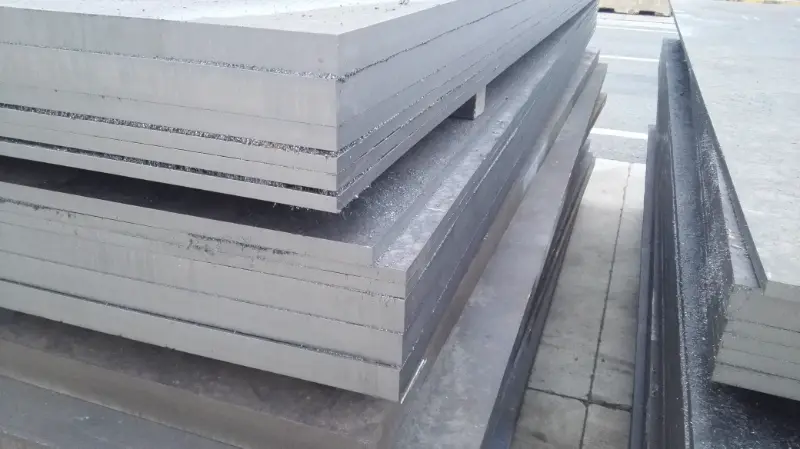
EN10083-3 30CrNiMo8 (1.6580) High Alloy Steel Plate
EN10083-3 30CrNiMo8 (1.6580) High Alloy Steel Plate - Quenched & Tempered for Heavy-Duty Engineering
30CrNiMo8 is a high-strength chromium-nickel-molybdenum alloy steel conforming to EN 10083-3, designed for large-section components requiring excellent fatigue resistance, toughness, and wear performance after quenching and tempering.
Hot rolling, forging, quenching and tempering (QT), soft annealing (+A), normalizing (+N)
- Phone : +8618037372205
- Email : [email protected]
- WhatsApp: Contact via Whtsapp
- WeChat: +8618037372205
EN10083-3 30CrNiMo8 High Alloy Steel Plate Introduction
30CrNiMo8 (1.6580) is a quenched and tempered alloy steel defined in EN 10083-3. It features a carefully balanced composition of chromium, nickel, and molybdenum, providing deep hardenability and uniform mechanical properties even in thick sections. Typical characteristics include:
- High tensile and yield strength after heat treatment
- Excellent toughness and ductility at low temperatures
- Superior fatigue and wear resistance
- Good machinability in the soft-annealed or tempered condition
This grade is predominantly supplied in the form of heavy plates, bars, and forgings, widely used for demanding structural and mechanical engineering applications.
EN10083-3 30CrNiMo8 High Alloy Steel Plate Chemical Composition
Heat analysis according to EN 10083-3. The alloy design provides high hardenability through combined additions of Cr, Ni, and Mo, enabling uniform strength in thick sections. Phosphorus and sulfur are controlled to ensure good toughness and cleanliness.
| Element | Standard Value (wt%) | Remarks |
|---|---|---|
| Carbon (C) | 0.26 - 0.34 | Key hardenability element |
| Silicon (Si) | ≤ 0.40 | Deoxidizer, improves strength slightly |
| Manganese (Mn) | 0.30 - 0.60 | Contributes to hardenability and sulfide control |
| Phosphorus (P) | ≤ 0.025 | Restricted for toughness |
| Sulfur (S) | ≤ 0.035 | Restricted for inclusion control |
| Chromium (Cr) | 1.80 - 2.20 | Primary carbide former and hardenability agent |
| Nickel (Ni) | 1.80 - 2.20 | Improves toughness and hardenability |
| Molybdenum (Mo) | 0.30 - 0.50 | Reduces temper embrittlement, enhances high-temperature strength |
EN10083-3 30CrNiMo8 High Alloy Steel Plate Thermal & Electrical Physical Properties
Room temperature physical properties typical for 30CrNiMo8 in heat-treated condition. Data valid for material in quenched and tempered state unless otherwise noted. Variations may occur depending on exact heat treatment and product form.
| Property | Typical Value | Unit | Test Conditions / Remarks |
|---|---|---|---|
| Density (ρ) | 7.85 | g/cm³ | 20 °C |
| Modulus of elasticity (E) | 210 | GPa | 20 °C |
| Shear modulus (G) | 81 | GPa | Calculated from E and ν |
| Poisson's ratio (ν) | 0.3 | - | Typical for steel |
| Thermal expansion coefficient (α) | 11.1 × 10⁻⁶ | K⁻¹ | 20–100 °C |
| Thermal expansion coefficient (α) | 12.1 × 10⁻⁶ | K⁻¹ | 20–200 °C |
| Thermal expansion coefficient (α) | 13.1 × 10⁻⁶ | K⁻¹ | 20–400 °C |
| Thermal conductivity (λ) | 42.6 | W/(m·K) | 20 °C |
| Specific heat capacity (cp) | 460 | J/(kg·K) | 20 °C |
| Electrical resistivity (ρe) | 0.22 × 10⁻⁶ | Ω·m | 20 °C |
EN10083-3 30CrNiMo8 High Alloy Steel Plate Mechanical Properties
Mechanical properties as per EN 10083-3 for quenched and tempered (+QT) condition. Values are dependent on ruling section thickness.
- Quenching temperature: 830–860 °C (oil or water)
- Tempering temperature: 540–660 °C
Impact energy determined on Charpy V-notch specimens (KV at 20 °C, unless otherwise specified).
| Property | Minimum Value | Unit | Test Conditions / Ruling Section (mm) |
|---|---|---|---|
| Yield strength (ReH) | 900 | MPa | d ≤ 16 |
| Yield strength (ReH) | 800 | MPa | 16 < d ≤ 40 |
| Yield strength (ReH) | 700 | MPa | 40 < d ≤ 100 |
| Tensile strength (Rm) | 1000 - 1200 | MPa | d ≤ 16 |
| Tensile strength (Rm) | 900 - 1100 | MPa | 16 < d ≤ 40 |
| Tensile strength (Rm) | 800 - 950 | MPa | 40 < d ≤ 100 |
| Elongation (A) | 9 | % | d ≤ 16, L₀ = 5d₀ |
| Elongation (A) | 10 | % | 16 < d ≤ 40, L₀ = 5d₀ |
| Elongation (A) | 11 | % | 40 < d ≤ 100, L₀ = 5d₀ |
| Impact energy (KV₂) | 30 | J | 20 °C, d ≤ 16 |
| Impact energy (KV₂) | 35 | J | 20 °C, 16 < d ≤ 40 |
| Impact energy (KV₂) | 40 | J | 20 °C, 40 < d ≤ 100 |
EN10083-3 30CrNiMo8 High Alloy Steel Plate Fully Equivalent Material Standards & Replaceable Designations
| Country/Region | Standard | Designation | Remarks |
|---|---|---|---|
| Europe | EN 10083-3 | 30CrNiMo8 (1.6580) | Original designation |
| Germany | DIN EN 10083-3 | 30CrNiMo8 (1.6580) | Identical to EN |
| UK | BS EN 10083-3 | 30CrNiMo8 (1.6580) | Identical to EN |
| France | NF EN 10083-3 | 30CrNiMo8 (1.6580) | Identical to EN |
| Italy | UNI EN 10083-3 | 30CrNiMo8 (1.6580) | Identical to EN |
EN10083-3 30CrNiMo8 High Alloy Steel Plate Application Introduction
30CrNiMo8 is engineered for high-stress components in thick sections where safety and durability are critical. It is widely used across heavy engineering sectors due to its balance of strength, toughness, and fatigue resistance. Typical applications include:
Product Applications: Forged shafts and axles for heavy trucks, Crankshafts and connecting rods, Gears and pinions for wind turbine gearboxes, High-pressure pump components, Rotary drill collars and subs, Turbine and generator rotor shafts
Processed into products: Differential gears and shafts, Bearing races and housings, Structural pins and bushings, Drive couplings and flanges, Hydraulic cylinder rods, Mining crusher main shafts
Application industries: Heavy machinery and equipment manufacturing, Automotive and commercial vehicle powertrain, Wind energy and power generation, Oil and gas drilling and extraction, Mining and earthmoving equipment, Shipbuilding and marine engineering
EN10083-3 30CrNiMo8 High Alloy Steel Plate Near-Similar / Alternative Material Recommendations
| Country/Region | Standard | Designation | Remarks |
|---|---|---|---|
| Europe | EN 10083-3 | 34CrNiMo6 (1.6582) | Higher carbon variant, slightly higher strength, lower toughness |
| USA | AISI/SAE | 4340 | Approximate equivalent (C 0.38-0.43); similar but not identical Cr-Ni-Mo balance |
| Japan | JIS G4105 | SNCM447 | Close match; similar use in large section quenched and tempered parts |
| China | GB/T 3077 | 30CrNiMo8 | Direct adoption of EN designation in Chinese standards for alloy structural steel |
| International | ISO 683-2 | 36CrNiMo4 | Comparable hardenability and strength; often used interchangeably |
Notes:
Heat treatment guidelines: Austenitize at 830–860 °C, oil or water quench, then temper at 540–660 °C to achieve required strength. For improved machinability, soft annealing at 650–700 °C with slow cooling is recommended. Welding is possible with preheating and post-weld heat treatment using low-hydrogen consumables. Always refer to the latest edition of EN 10083-3 for full requirements.
- Share



