
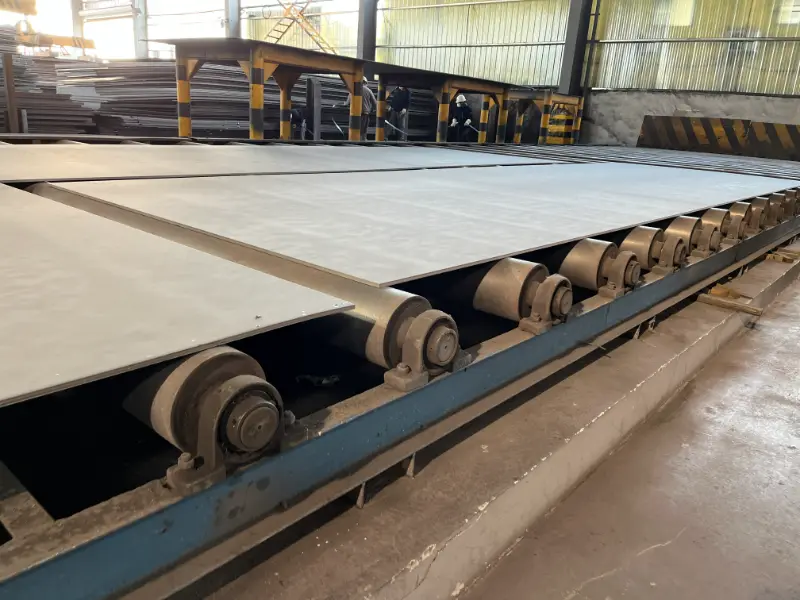
EN 10083-3 50CrMo4 High Tensile Alloy Steel
EN 10083-3 50CrMo4 High Tensile Alloy Steel: Composition, Properties, Equivalents, and Application Guide
Comprehensive material data for 50CrMo4 alloy steel according to EN 10083-3. Includes chemical composition, mechanical and thermal properties, international equivalent grades, and application guidance for high-strength components.
Hot forming, forging, machining, welding (with precautions), induction hardening, nitriding
- Phone : +8618037372205
- Email : [email protected]
- WhatsApp: Contact via Whtsapp
- WeChat: +8618037372205
EN 10083-3 50CrMo4 High Tensile Alloy Steel Introduction
50CrMo4 is a medium-carbon chromium-molybdenum alloy steel specified in EN 10083-3 for quenching and tempering. It offers high hardenability, excellent strength, and good toughness after heat treatment, making it suitable for highly stressed parts. This grade is widely used in mechanical engineering for components such as shafts, gears, and bolts. The material combines good wear resistance with the ability to withstand dynamic loads, and can be surface-hardened by induction or flame hardening. It is delivered in the quenched and tempered condition (+QT) to achieve the required mechanical properties.
EN 10083-3 50CrMo4 High Tensile Alloy Steel Chemical Composition
The chemical composition of 50CrMo4 is controlled to achieve high hardenability and uniform response to heat treatment. Chromium and molybdenum are key alloying elements that increase strength and toughness after quenching and tempering. Carbon content around 0.50% provides a balance between hardness and ductility. Maximum limits are imposed on phosphorus and sulfur to ensure cleanliness and optimal mechanical properties.
| Chemical Element | Standard Value (wt%) | Remarks |
|---|---|---|
| Carbon (C) | 0.46 – 0.54 | Based on EN 10083-3 ladle analysis |
| Silicon (Si) | ≤ 0.40 | Deoxidation element |
| Manganese (Mn) | 0.50 – 0.80 | Improves hardenability |
| Phosphorus (P) | ≤ 0.025 | Maximum for premium quality |
| Sulfur (S) | ≤ 0.035 | Control for machinability |
| Chromium (Cr) | 0.90 – 1.20 | Primary hardenability element |
| Molybdenum (Mo) | 0.15 – 0.30 | Enhances hardenability and temper resistance |
EN 10083-3 50CrMo4 High Tensile Alloy Steel Physical Properties
The physical properties of 50CrMo4 are representative of chromium-molybdenum alloy steels. Thermal conductivity and expansion are average for this class of materials, allowing predictable behavior during heat treatment and in service. Electrical resistivity is typical of low-alloy steels. Values are provided for general engineering calculations and are not part of the standard's acceptance criteria.
| Property | Typical Value | Unit | Condition / Note |
|---|---|---|---|
| Density (ρ) | 7.83 – 7.85 | g/cm³ | Room temperature, average |
| Modulus of elasticity (E) | 205 – 215 | GPa | 20 °C, dynamic method |
| Shear modulus (G) | ~ 80 | GPa | Calculated from E and ν |
| Poisson's ratio (ν) | 0.28 – 0.30 | – | Elastic region |
| Thermal expansion coefficient (α) | 11.5 × 10⁻⁶ | K⁻¹ | 20 – 100 °C |
| Thermal expansion coefficient | 12.5 × 10⁻⁶ | K⁻¹ | 20 – 200 °C |
| Thermal expansion coefficient | 13.0 × 10⁻⁶ | K⁻¹ | 20 – 300 °C |
| Thermal conductivity (λ) | 42 – 44 | W/(m·K) | At 20 °C |
| Specific heat capacity (cp) | ~ 460 | J/(kg·K) | Room temperature |
| Electrical resistivity (ρe) | 0.20 – 0.25 | µΩ·m | 20 °C |
EN 10083-3 50CrMo4 High Tensile Alloy Steel Mechanical Properties
The mechanical properties of 50CrMo4 are strongly dependent on section size. Values below represent minimum requirements as specified in EN 10083-3 for different ruling sections. Tensile strength and yield strength decrease with increasing diameter, while ductility and toughness improve. Impact energy is measured on Charpy-V specimens at room temperature. For critical applications supplementary requirements may be agreed.
| Property | Standard Required Value | Unit | Test Condition |
|---|---|---|---|
| Tensile strength (Rm) | 1100 – 1300 | MPa | Thickness ≤ 16 mm, +QT |
| Yield strength (ReH) | ≥ 900 | MPa | Thickness ≤ 16 mm, +QT |
| Elongation (A5) | ≥ 9 | % | Thickness ≤ 16 mm, gauge length L0 = 5d |
| Reduction of area (Z) | ≥ 40 | % | Thickness ≤ 16 mm |
| Impact energy (KV2) | ≥ 35 | J | Room temperature, ≤ 16 mm |
| Tensile strength (Rm) | 1000 – 1200 | MPa | 16 mm < thickness ≤ 40 mm, +QT |
| Yield strength (ReH) | ≥ 800 | MPa | 16 mm < thickness ≤ 40 mm, +QT |
| Elongation (A5) | ≥ 10 | % | 16 mm < t ≤ 40 mm |
| Reduction of area (Z) | ≥ 45 | % | 16 mm < t ≤ 40 mm |
| Impact energy (KV2) | ≥ 35 | J | Room temperature, 16–40 mm |
| Tensile strength (Rm) | 900 – 1100 | MPa | 40 mm < thickness ≤ 100 mm, +QT |
| Yield strength (ReH) | ≥ 700 | MPa | 40 mm < thickness ≤ 100 mm, +QT |
| Elongation (A5) | ≥ 11 | % | 40 mm < t ≤ 100 mm |
| Reduction of area (Z) | ≥ 50 | % | 40 mm < t ≤ 100 mm |
| Impact energy (KV2) | ≥ 35 | J | Room temperature, 40–100 mm |
| Tensile strength (Rm) | 800 – 950 | MPa | 100 mm < thickness ≤ 160 mm, +QT |
| Yield strength (ReH) | ≥ 600 | MPa | 100 mm < thickness ≤ 160 mm, +QT |
| Elongation (A5) | ≥ 12 | % | 100 mm < t ≤ 160 mm |
| Reduction of area (Z) | ≥ 55 | % | 100 mm < t ≤ 160 mm |
| Tensile strength (Rm) | 750 – 900 | MPa | 160 mm < thickness ≤ 250 mm, +QT |
| Yield strength (ReH) | ≥ 550 | MPa | 160 mm < thickness ≤ 250 mm, +QT |
| Elongation (A5) | ≥ 13 | % | 160 mm < t ≤ 250 mm |
| Reduction of area (Z) | ≥ 60 | % | 160 mm < t ≤ 250 mm |
EN 10083-3 50CrMo4 High Tensile Alloy Steel Fully Equivalent Material Standards and Alternative Designations
| Country / Region | Standard | Designation / Grade | Remarks |
|---|---|---|---|
| Europe | EN 10083-3 | 50CrMo4 | Original specification |
| Germany | DIN EN 10083-3 | 50CrMo4 | Identical to EN |
| International | ISO 683-2 | 50CrMo4 | Chemically identical |
| China | GB/T 3077 | 50CrMo | Equivalent chemistry and properties |
| USA | ASTM A29 / SAE J404 | 4150 (SAE 4150) | Similar, slight variations in Mn range |
| Japan | JIS G4053 | SCM445 | Approximate, similar composition |
EN 10083-3 50CrMo4 High Tensile Alloy Steel Application Introduction
50CrMo4 is specified where high static and dynamic strength, combined with moderate toughness, are required. It is particularly suited for components that undergo heat treatment (quenching and tempering) and can benefit from surface hardening. Typical delivery condition +QT provides a ready-to-use material with guaranteed mechanical properties, reducing manufacturing steps. Machining is best performed in the pre-hardened state, and welding requires preheating and post-weld heat treatment due to its high carbon equivalent.
Product Applications: Quenched and tempered steel plates for structural components, Forged round bars and flat bars for machine parts, Seamless pipes and cylinders for hydraulic applications, Wire for high-strength fasteners and springs
Processed into products: Transmission shafts and pinion shafts, Heavy-duty gears, sprockets and gear blanks, Crankshafts and camshafts, High-tensile bolts, studs and nuts (property class 12.9), Piston rods and hydraulic cylinder rods, Steering knuckles and ball joints, Torsion bars and stabilizer links
Application industries: Automotive and heavy vehicle (axles, gears, connecting rods), General mechanical engineering (shafts, spindles, bolts), Oil and gas equipment (flanges, studs, valve bodies), Power generation (turbine shafts, generator rotors), Mining and construction machinery (pins, bushings, track links)
EN 10083-3 50CrMo4 High Tensile Alloy Steel Similar / Closely Related Grades for Alternative Selection
| Country / Region | Standard | Designation / Grade | Comparison Notes |
|---|---|---|---|
| Europe | EN 10083-3 | 42CrMo4 (1.7225) | Lower carbon (0.38–0.45%), lower core strength but better toughness; widely used substitute for slightly lower loads |
| Europe | EN 10083-3 | 34CrNiMo6 (1.6582) | Ni-added grade with higher toughness and through-hardening capability for heavier sections |
| Germany | DIN 17200 | 50CrV4 | Vanadium microalloyed; higher fatigue strength, often used for springs and torsion bars |
| USA | ASTM A322 | 4140 (SAE 4140) | Lower carbon and chromium; less hardenable than 50CrMo4, suitable where moderate strength is adequate |
| Japan | JIS G4053 | SCM440 | Similar to 42CrMo4; lower strength compared to 50CrMo4 |
Notes:
Additional considerations:
- For optimal properties, quenching should be carried out in oil or polymer; water quenching may cause cracking in complex shapes.
- Stress relieving after machining is recommended at 550–600 °C.
- Surface hardening can achieve a nitrided layer or induction-hardened case depth for improved wear resistance.
- Welding should be performed according to approved procedures; filler metals of comparable composition (e.g., ER80S-D2) and preheating to 250–350 °C are typical.
- This grade can be supplied in the +QT (quenched and tempered) or +A (annealed) condition as per EN 10083-3; the tensile test values shown are mandatory for the +QT condition and are guaranteed for ruling sections specified in the standard.
- Share



