
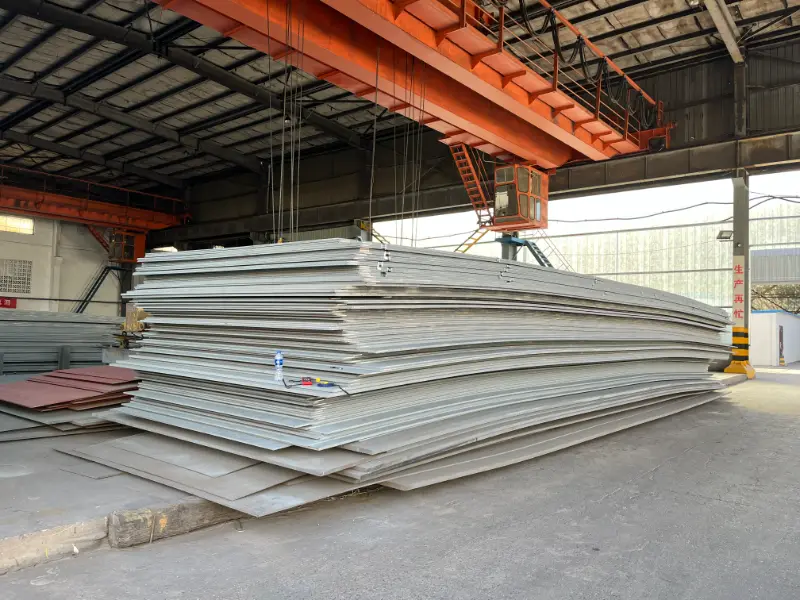
EN 10083-3 42CrMoS4 Alloy Steel Plate
EN 10083-3 42CrMoS4 Alloy Steel Plate: Properties, Equivalents & Applications
Comprehensive material data for 42CrMoS4 steel plate as per EN 10083-3, including chemical composition, mechanical and thermal properties, international equivalents, and application guidance.
Hot rolling, hot forging, quenching and tempering (+QT), soft annealing (+A), normalizing, surface hardening, machining
- Phone : +8618037372205
- Email : [email protected]
- WhatsApp: Contact via Whtsapp
- WeChat: +8618037372205
EN 10083-3 42CrMoS4 Alloy Steel Plate Introduction
42CrMoS4 is a quenched and tempered chromium-molybdenum alloy steel with intentional sulfur addition to improve machinability. It combines high tensile strength, good toughness, and excellent hardenability. Widely used for medium to heavy-duty components, this grade is typically supplied in the +QT condition, achieving optimal strength-toughness balance for demanding engineering applications.
EN 10083-3 42CrMoS4 Alloy Steel Plate Chemical Composition
Chemical composition of 42CrMoS4 according to EN 10083-3. The intentional addition of sulfur (0.020-0.040%) improves machinability without significantly degrading mechanical properties when properly heat treated.
| Chemical Element | Standard Value (wt%) | Remarks |
|---|---|---|
| C | 0.38 – 0.45 | Key for hardenability and strength |
| Si | ≤ 0.40 | Deoxidizer, contributes to strength |
| Mn | 0.60 – 0.90 | Improves hardenability and toughness |
| P | ≤ 0.025 | Phosphorus – controlled for ductility |
| S | 0.020 – 0.040 | Added for enhanced machinability |
| Cr | 0.90 – 1.20 | Increases hardenability and wear resistance |
| Mo | 0.15 – 0.30 | Improves high-temperature strength and hardenability |
EN 10083-3 42CrMoS4 Alloy Steel Plate Thermal and Electrical Physical Properties
Representative physical properties for 42CrMoS4 in the quenched and tempered condition. Actual values may vary with heat treatment and testing conditions.
| Physical Property | Typical Value | Unit | Test Condition |
|---|---|---|---|
| Density (ρ) | 7.85 | g/cm³ | Room temperature |
| Modulus of Elasticity (E) | 210 | GPa | 20°C |
| Shear Modulus (G) | 81 | GPa | 20°C |
| Poisson's Ratio (ν) | 0.30 | – | 20°C |
| Thermal Expansion (α) | 11.1 | 10⁻⁶/K | 20 – 100°C |
| Thermal Expansion (α) | 12.1 | 10⁻⁶/K | 20 – 200°C |
| Thermal Expansion (α) | 12.9 | 10⁻⁶/K | 20 – 300°C |
| Thermal Expansion (α) | 13.5 | 10⁻⁶/K | 20 – 400°C |
| Thermal Expansion (α) | 13.9 | 10⁻⁶/K | 20 – 500°C |
| Thermal Conductivity (λ) | 42.6 | W/(m·K) | 20°C |
| Thermal Conductivity (λ) | 42.3 | W/(m·K) | 200°C |
| Thermal Conductivity (λ) | 37.7 | W/(m·K) | 400°C |
| Specific Heat Capacity (c) | 460 | J/(kg·K) | 20°C |
| Electrical Resistivity (ρₑ) | 0.22 | µΩ·m | 20°C |
EN 10083-3 42CrMoS4 Alloy Steel Plate Mechanical Properties in Quenched and Tempered Condition
Minimum mechanical properties of 42CrMoS4 per EN 10083-3. Values depend on the ruling section size (diameter or thickness). Tension test at room temperature; impact test on longitudinal Charpy-V specimens at -20°C.
| Property | Standard Value | Unit | Test Condition |
|---|---|---|---|
| Yield Strength (ReH) | ≥ 750 | MPa | d ≤ 16 mm or t ≤ 8 mm, +QT |
| Yield Strength (ReH) | ≥ 650 | MPa | 16 < d ≤ 40 mm or t ≤ 20 mm, +QT |
| Yield Strength (ReH) | ≥ 550 | MPa | 40 < d ≤ 100 mm or t ≤ 60 mm, +QT |
| Tensile Strength (Rm) | 1000 – 1200 | MPa | d ≤ 16 mm or t ≤ 8 mm, +QT |
| Tensile Strength (Rm) | 900 – 1100 | MPa | 16 < d ≤ 40 mm or t ≤ 20 mm, +QT |
| Tensile Strength (Rm) | 800 – 950 | MPa | 40 < d ≤ 100 mm or t ≤ 60 mm, +QT |
| Elongation (A) | ≥ 11 | % | d ≤ 16 mm or t ≤ 8 mm, +QT |
| Elongation (A) | ≥ 12 | % | 16 < d ≤ 40 mm or t ≤ 20 mm, +QT |
| Elongation (A) | ≥ 14 | % | 40 < d ≤ 100 mm or t ≤ 60 mm, +QT |
| Reduction of Area (Z) | ≥ 45 | % | d ≤ 16 mm or t ≤ 8 mm, +QT |
| Reduction of Area (Z) | ≥ 50 | % | 16 < d ≤ 40 mm or t ≤ 20 mm, +QT |
| Reduction of Area (Z) | ≥ 55 | % | 40 < d ≤ 100 mm or t ≤ 60 mm, +QT |
| Impact Energy (KV₂) -20°C | ≥ 30 | J | Longitudinal, d ≤ 16 mm or t ≤ 8 mm, +QT |
| Impact Energy (KV₂) -20°C | ≥ 30 | J | Longitudinal, 16 < d ≤ 40 mm or t ≤ 20 mm, +QT |
| Impact Energy (KV₂) -20°C | ≥ 30 | J | Longitudinal, 40 < d ≤ 100 mm or t ≤ 60 mm, +QT |
EN 10083-3 42CrMoS4 Alloy Steel Plate Completely Equivalent Standards and Substitute Grades
| Region/Country | Standard | Grade | Remarks |
|---|---|---|---|
| Europe | EN 10083-3 | 42CrMoS4 (1.7227) | Original standard designation |
| Germany | DIN EN 10083-3 | 42CrMoS4 (1.7227) | Identical to EN |
| France | NF EN 10083-3 | 42CrMoS4 | Identical to EN |
| UK | BS EN 10083-3 | 42CrMoS4 | Identical to EN |
| International | ISO 683-2 | 42CrMoS4 | Equivalent designation |
EN 10083-3 42CrMoS4 Alloy Steel Plate Application Introduction
42CrMoS4 is most widely utilized where high strength, good fatigue resistance, and improved machinability are required. The controlled sulfur content reduces tool wear and improves chip formation, making it especially suitable for automated CNC machining of complex parts. Typical applications include:
Product Applications: Transmission gears and shafts, Crankshafts and connecting rods, Wheel hubs and steering knuckles, High-strength bolts and studs, Hydraulic cylinder rods and piston rods, Pump shafts and rotors
Processed into products: Gears and pinions, Splined shafts and axles, Flanges and couplings, Spindles and drive shafts, Tool holders and die components, Fasteners requiring class 10.9/12.9 properties
Application industries: Automotive (powertrain, chassis, steering), Mechanical engineering and heavy machinery, Oil & gas (valve bodies, flanges, drilling components), Power generation (turbine shafts, fasteners), Mining and construction equipment
EN 10083-3 42CrMoS4 Alloy Steel Plate Similar / Alternative Materials Recommendation
| Region/Country | Standard | Grade | Remarks |
|---|---|---|---|
| Europe | EN 10083-3 | 42CrMo4 (1.7225) | Same base chemistry without intentional S addition; slightly lower machinability, similar mechanical properties |
| USA | ASTM A29/A29M | 4140 (UNS G41400) | Comparable Cr-Mo alloy steel; no controlled S range, may differ in hardenability |
| Japan | JIS G4105 | SCM440 | Equivalent to AISI 4140; machinability depends on S content, similar strength |
| China | GB/T 3077 | 42CrMo | Similar composition; S content not specified as elevated, may require additional machining allowance |
| Sweden | SS | 2244 | Comparable to 42CrMo4, not free-machining variant |
Notes:
42CrMoS4 is characterized by improved machinability due to sulfide inclusions. However, these inclusions may slightly reduce the transverse ductility and fatigue strength when compared with the non-sulfur 42CrMo4 grade. It is weldable under specific conditions (preheat, low-hydrogen process), but special care is required to avoid cracking. For components needing high surface hardness, induction hardening or nitriding can be applied after rough machining. Always refer to EN 10083-3 for full technical delivery conditions, including permissible deviations, testing, and marking.
- Share



