
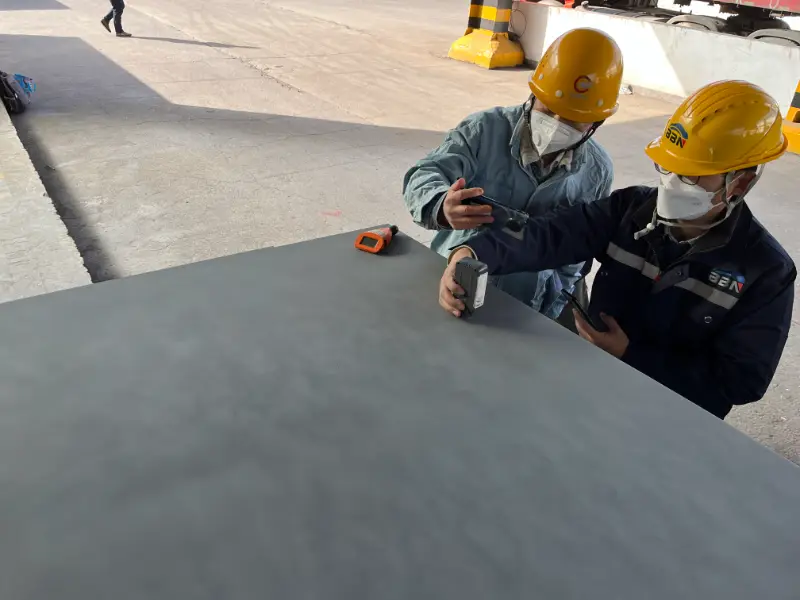
42CrMo4 Alloy Steel Plate to EN 10083-3
42CrMo4 Alloy Steel Plate to EN 10083-3 - Properties, Equivalents & Applications
Comprehensive data for 42CrMo4 high alloy steel plate under EN 10083-3. Includes chemical composition, mechanical and physical properties, international equivalent grades, and application guidance for engineering and automotive components.
Hot rolling, forging, quenching, tempering, normalizing, induction hardening, nitriding
- Phone : +8618037372205
- Email : [email protected]
- WhatsApp: Contact via Whtsapp
- WeChat: +8618037372205
42CrMo4 Alloy Steel Plate to EN 10083-3 Introduction
42CrMo4 is a chromium-molybdenum alloy steel designated as 1.7225 under EN 10083-3, intended for quenching and tempering. It offers an excellent combination of high strength, toughness, and wear resistance after heat treatment.
Key characteristics:
- Good hardenability with through-hardening capability in medium sections
- High fatigue strength and impact toughness
- Can be induction hardened or nitrided for surface wear resistance
- Weldable with precautions and suitable for hot forming
This grade is widely used in automotive, machinery, and oil & gas industries where heavy-duty components must withstand dynamic loading.
42CrMo4 Alloy Steel Plate to EN 10083-3 Chemical Composition
The ladle analysis limits comply with EN 10083-3:2006 for 42CrMo4. The steel is microalloyed with chromium and molybdenum to improve hardenability and strength. Phosphorus and sulfur are kept low to ensure cleanliness and toughness.
| Element | Value (%) | Remarks |
|---|---|---|
| Carbon (C) | 0.38 – 0.45 | Primary hardening element |
| Silicon (Si) | ≤ 0.40 | Deoxidizer |
| Manganese (Mn) | 0.60 – 0.90 | Improves hardenability |
| Phosphorus (P) | ≤ 0.025 | Maximum allowed |
| Sulfur (S) | ≤ 0.035 | Maximum allowed |
| Chromium (Cr) | 0.90 – 1.20 | Forms carbides, increases hardenability |
| Molybdenum (Mo) | 0.15 – 0.30 | Promotes toughness and hardenability |
42CrMo4 Alloy Steel Plate to EN 10083-3 Physical Properties
The following data are representative engineering values for 42CrMo4 in the quenched and tempered condition. Actual values may vary slightly depending on heat treatment and composition. Thermal conductivity and expansion are especially relevant for welded or thermally cycled designs.
| Property | Typical Value | Unit | Test Condition / Remarks |
|---|---|---|---|
| Density (ρ) | 7.85 | g/cm³ | Room temperature |
| Elastic modulus (E) | 210 | GPa | Room temperature |
| Shear modulus (G) | 80 | GPa | Room temperature |
| Poisson's ratio (ν) | 0.30 | — | — |
| Thermal expansion coef. (α) | 11.1 | 10⁻⁶/K | 20 – 100 °C |
| Thermal expansion coef. (α) | 12.5 | 10⁻⁶/K | 20 – 200 °C |
| Thermal expansion coef. (α) | 13.6 | 10⁻⁶/K | 20 – 400 °C |
| Thermal conductivity (λ) | 42.6 | W/(m·K) | At 100 °C |
| Thermal conductivity (λ) | 38.5 | W/(m·K) | At 300 °C |
| Specific heat capacity | 460 | J/(kg·K) | At 20 °C |
| Electrical resistivity (ρ_e) | 0.23 | µΩ·m | At 20 °C |
42CrMo4 Alloy Steel Plate to EN 10083-3 Mechanical Properties
Values below are longitudinal properties extracted from EN 10083-3. The steel exhibits high strength levels that decrease with increasing section size, while ductility and impact toughness improve. Testing is performed at room temperature unless stated otherwise. More restrictive requirements may be agreed upon during ordering.
| Property | Minimum / Range | Unit | Condition (thickness or diameter) |
|---|---|---|---|
| Tensile strength (Rm) | 1000 – 1200 | MPa | t ≤ 16 mm |
| Tensile strength (Rm) | 900 – 1100 | MPa | 16 < t ≤ 40 mm |
| Tensile strength (Rm) | 800 – 950 | MPa | 40 < t ≤ 100 mm |
| Tensile strength (Rm) | 750 – 900 | MPa | 100 < t ≤ 160 mm |
| Tensile strength (Rm) | 650 – 800 | MPa | 160 < t ≤ 250 mm |
| Yield strength (ReH) | ≥ 750 | MPa | t ≤ 16 mm |
| Yield strength (ReH) | ≥ 650 | MPa | 16 < t ≤ 40 mm |
| Yield strength (ReH) | ≥ 550 | MPa | 40 < t ≤ 100 mm |
| Yield strength (ReH) | ≥ 500 | MPa | 100 < t ≤ 160 mm |
| Yield strength (ReH) | ≥ 450 | MPa | 160 < t ≤ 250 mm |
| Elongation (A) | ≥ 11 | % | t ≤ 16 mm |
| Elongation (A) | ≥ 12 | % | 16 < t ≤ 40 mm |
| Elongation (A) | ≥ 13 | % | 40 < t ≤ 100 mm |
| Elongation (A) | ≥ 14 | % | 100 < t ≤ 160 mm |
| Elongation (A) | ≥ 15 | % | 160 < t ≤ 250 mm |
| Reduction of area (Z) | ≥ 40 | % | t ≤ 16 mm |
| Reduction of area (Z) | ≥ 45 | % | 16 < t ≤ 40 mm |
| Reduction of area (Z) | ≥ 50 | % | 40 < t ≤ 100 mm |
| Reduction of area (Z) | ≥ 55 | % | 100 < t ≤ 160 mm |
| Reduction of area (Z) | ≥ 60 | % | 160 < t ≤ 250 mm |
| Impact energy (KV₂, longitudinal) | ≥ 27 | J | At +20 °C, all sections |
| Impact energy (KV₂, longitudinal) | ≥ 16 | J | At -20 °C, all sections |
42CrMo4 Alloy Steel Plate to EN 10083-3 Fully Equivalent Grades – International Cross-Reference
| Country / Region | Standard | Designation / Grade | Remarks |
|---|---|---|---|
| Europe | EN 10083-3 | 42CrMo4 (1.7225) | Base specification (quenching and tempering) |
| International | ISO 683-2 | 42CrMo4 | Identical chemical and property requirements |
| USA | ASTM A29 / A322 / A331 | 4140 | AISI/SAE 4140 – minor carbon range variation |
| China | GB/T 3077 | 42CrMo | Equivalent grade, widely used |
| Japan | JIS G4053 | SCM440 | Identical Cr-Mo steel |
| Germany (historical) | DIN 17200 / 17204 | 42CrMo4 | Legacy designation, fully convertible |
| Russia | GOST 4543 | 38ХМ (38KhM) / 40ХФА | Approximate match; verify for critical applications |
42CrMo4 Alloy Steel Plate to EN 10083-3 Application Introduction
42CrMo4 is a versatile engineering alloy steel designed for heavily loaded parts that require high strength, good toughness, and resistance to wear. After quenching and tempering, it achieves an optimal balance of mechanical properties. For enhanced surface hardness, induction hardening or nitriding may be applied without sacrificing core toughness. Machinability is good in the tempered condition; however, special care is required during welding (preheating, post-weld heat treatment).
Typical industries and components:
Product Applications: Automobile gearbox components, crankshafts, connecting rods, axle shafts, Hydraulic cylinder rods and pistons, Heavy-duty bolts, studs, and fasteners, Drill collars, mud motor shafts, and wellhead equipment, Forged crane wheels, rolls, and mill spindles, Structural forgings for bridges and offshore platforms
Processed into products: Shafts (transmission, pump, propeller), Gears (spur, helical, ring gears), Pinions and spline hubs, Crankshafts and camshafts, Connecting rods and yokes, Tool holders and adapters, Press columns and tie rods, Wear plates and shear blades
Application industries: Automotive and transportation, Heavy machinery and construction equipment, Oil & gas (wellhead, pump, and compressor parts), Power generation (shafts, rotors), Mining and mineral processing, General mechanical engineering
42CrMo4 Alloy Steel Plate to EN 10083-3 Similar / Alternative Materials with Performance Overlap
| Country / Region | Standard | Grade | Remarks |
|---|---|---|---|
| Europe | EN 10083-3 | 34CrMo4 (1.7220) | Lower carbon → lower strength, higher toughness |
| Europe | EN 10083-3 | 50CrMo4 (1.7228) | Higher carbon → higher strength, reduced ductility |
| Europe | EN 10083-3 | 34CrNiMo6 (1.6582) | Excellent toughness, higher hardenability, more costly |
| Europe | EN 10083-3 | 30CrNiMo8 (1.6580) | Ni improved toughness for large sections |
| USA | ASTM A322 | 4142 / 4145 | Slightly higher carbon variants of 4140 |
| Japan | JIS G4105 | SCM435 | Lower carbon Cr-Mo steel; better weldability |
Notes:
Heat treatment reference: Austenitizing at 830–860 °C, oil or polymer quenching, followed by tempering at 540–680 °C depending on desired strength. For maximum toughness, tempering temperatures above 550 °C are recommended.
Weldability: Carbon equivalent typically 0.65–0.75; preheating (200–300 °C) and immediate post-weld stress relieving are mandatory.
Surface hardening: Suitable for induction hardening (surface hardness >55 HRC) and nitriding (hardness up to ~650 HV).
Delivery conditions: Unless otherwise agreed, material is supplied in the quenched and tempered (+QT) state. Alternative conditions (+U, +A, +N) may be specified for subsequent machining or forming.
- Share



