
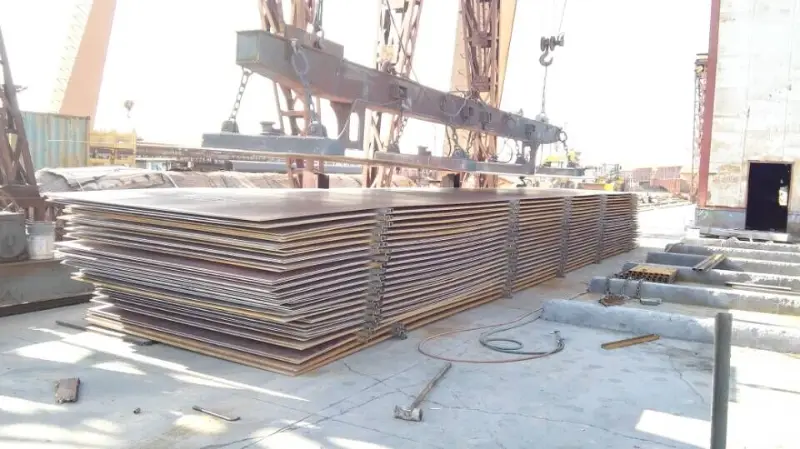
EN10083-3 34CrMoS4 Quenched & Tempered Alloy Steel
EN10083-3 34CrMoS4 Quenched & Tempered Alloy Steel - Datasheet & Properties
Comprehensive technical data for 34CrMoS4 steel plate in accordance with EN 10083-3, including chemical composition, mechanical properties, thermal and electrical physical properties, international equivalent grades, and application guidance.
Hot rolling, forging, quench and temper heat treatment, machining, welding (with preheat/PWHT)
- Phone : +8618037372205
- Email : [email protected]
- WhatsApp: Contact via Whtsapp
- WeChat: +8618037372205
EN10083-3 34CrMoS4 Quenched & Tempered Alloy Steel Introduction
34CrMoS4 is a low-alloy quenched and tempered steel defined by the European standard EN 10083-3. It is a chromium‑molybdenum grade with controlled sulfur addition (0.020 – 0.040 %) to significantly improve machinability while maintaining high strength and toughness. The steel is typically supplied in the quenched and tempered (+QT) condition, achieving tensile strengths from 750 to 1200 MPa depending on section thickness. Key features include:
- Excellent hardenability, allowing through‑hardening in medium to large cross‑sections
- Good high‑temperature strength and creep resistance up to approximately 500°C
- Enhanced machinability due to sulfur‑induced chip breaking, reducing tool wear
- High fatigue strength and wear resistance after heat treatment
It is widely used for highly stressed automotive and machinery components such as gears, shafts, crankshafts and bolts. The combination of chromium and molybdenum provides a fine tempered martensite structure with a good balance of strength, toughness and ductility.
EN10083-3 34CrMoS4 Quenched & Tempered Alloy Steel Chemical Composition
The chemical composition conforms to EN 10083-3:2006 for grade 34CrMoS4. Sulfur is tightly controlled to enhance machinability. All values are in percent by weight.
| Element | Standard Value (wt%) | Remarks |
|---|---|---|
| C | 0.30 - 0.37 | |
| Si | ≤ 0.40 | |
| Mn | 0.60 - 0.90 | |
| P | ≤ 0.025 | |
| S | 0.020 - 0.040 | Controlled range for machinability (S suffix) |
| Cr | 0.90 - 1.20 | |
| Mo | 0.15 - 0.30 |
EN10083-3 34CrMoS4 Quenched & Tempered Alloy Steel Thermal & Electrical Physical Properties
The following properties are representative for 34CrMoS4 in the quenched and tempered condition. Values are measured at ambient temperature unless otherwise indicated. Thermal expansion and conductivity vary with temperature; multiple data points are given.
| Property | Typical Value | Unit | Temperature / Condition |
|---|---|---|---|
| Density ρ | 7850 | kg/m³ | 20°C |
| Modulus of elasticity E | 210 | GPa | 20°C |
| Shear modulus G | 81 | GPa | 20°C |
| Poisson's ratio ν | 0.29 - 0.30 | - | 20°C |
| Thermal expansion coefficient α | 11.5 | 10⁻⁶/K | 20 - 100°C |
| Thermal expansion coefficient α | 12.5 | 10⁻⁶/K | 20 - 200°C |
| Thermal expansion coefficient α | 12.9 | 10⁻⁶/K | 20 - 300°C |
| Thermal expansion coefficient α | 13.3 | 10⁻⁶/K | 20 - 400°C |
| Thermal expansion coefficient α | 13.7 | 10⁻⁶/K | 20 - 500°C |
| Thermal conductivity λ | 42 | W/(m·K) | 20°C |
| Thermal conductivity λ | 42 | W/(m·K) | 100°C |
| Thermal conductivity λ | 41 | W/(m·K) | 200°C |
| Thermal conductivity λ | 39 | W/(m·K) | 300°C |
| Thermal conductivity λ | 37 | W/(m·K) | 400°C |
| Thermal conductivity λ | 35 | W/(m·K) | 500°C |
| Specific heat capacity c | 460 | J/(kg·K) | 20°C |
| Specific heat capacity c | 500 | J/(kg·K) | 100°C |
| Specific heat capacity c | 530 | J/(kg·K) | 200°C |
| Specific heat capacity c | 560 | J/(kg·K) | 300°C |
| Specific heat capacity c | 580 | J/(kg·K) | 400°C |
| Specific heat capacity c | 600 | J/(kg·K) | 500°C |
| Electrical resistivity ρ_e | 0.20 | μΩ·m | 20°C |
EN10083-3 34CrMoS4 Quenched & Tempered Alloy Steel Mechanical Properties at Room Temperature
Typical mechanical properties as specified in EN 10083-3. The values depend on the ruling section thickness after quenching and tempering. All tests are performed on longitudinal specimens in the heat‑treated condition. Impact energies are measured using ISO‑V Charpy specimens at 20°C.
| Property | Standard Requirement | Unit | Test Condition (Thickness range) |
|---|---|---|---|
| Tensile strength Rm | 1000 - 1200 | MPa | t ≤ 8 mm, QT |
| Tensile strength Rm | 900 - 1100 | MPa | 8 < t ≤ 20 mm, QT |
| Tensile strength Rm | 800 - 950 | MPa | 20 < t ≤ 60 mm, QT |
| Tensile strength Rm | 750 - 900 | MPa | 60 < t ≤ 100 mm, QT |
| Yield strength ReH (0.2%) | ≥ 800 | MPa | t ≤ 8 mm, QT |
| Yield strength ReH (0.2%) | ≥ 750 | MPa | 8 < t ≤ 20 mm, QT |
| Yield strength ReH (0.2%) | ≥ 650 | MPa | 20 < t ≤ 60 mm, QT |
| Yield strength ReH (0.2%) | ≥ 600 | MPa | 60 < t ≤ 100 mm, QT |
| Elongation A (%) | ≥ 10 | % | t ≤ 8 mm, QT |
| Elongation A (%) | ≥ 12 | % | 8 < t ≤ 20 mm, QT |
| Elongation A (%) | ≥ 14 | % | 20 < t ≤ 60 mm, QT |
| Elongation A (%) | ≥ 15 | % | 60 < t ≤ 100 mm, QT |
| Reduction of area Z | ≥ 45 | % | t ≤ 8 mm, QT |
| Reduction of area Z | ≥ 50 | % | 8 < t ≤ 20 mm, QT |
| Reduction of area Z | ≥ 55 | % | 20 < t ≤ 60 mm, QT |
| Reduction of area Z | ≥ 55 | % | 60 < t ≤ 100 mm, QT |
| Impact energy KV (ISO-V, 20°C) | ≥ 25 | J | t ≤ 8 mm, QT |
| Impact energy KV (ISO-V, 20°C) | ≥ 30 | J | 8 < t ≤ 20 mm, QT |
| Impact energy KV (ISO-V, 20°C) | ≥ 35 | J | 20 < t ≤ 60 mm, QT |
| Impact energy KV (ISO-V, 20°C) | ≥ 35 | J | 60 < t ≤ 100 mm, QT |
EN10083-3 34CrMoS4 Quenched & Tempered Alloy Steel Fully Equivalent Standards & Alternative Designations
| Country/Region | Standard | Designation | Remarks |
|---|---|---|---|
| Europe | EN 10083-3 | 34CrMoS4 | Original standard; sulfur-controlled QT steel |
| International | ISO 683-2 | 34CrMoS4 | Identical to EN 10083-3 |
| Germany | DIN EN 10083-3 | 34CrMoS4 | Adopted EN standard |
| China | GB/T 3077 | 35CrMo | Close chemistry, but sulfur not controlled (general alloy steel grade) |
| USA | AISI/SAE | 4135 (mod.) | Base chemistry matches 34CrMo4; for S addition use leaded version 41L35 or specify sulfur range |
| Japan | JIS G4105 | SCM435 | Similar Cr-Mo steel without intentional sulfur addition |
| United Kingdom | BS 970-3 | 708M35 | Similar hardenable steel, no sulfur specification |
EN10083-3 34CrMoS4 Quenched & Tempered Alloy Steel Application Introduction
34CrMoS4 is extensively used for highly stressed machine parts that require high strength, toughness, and wear resistance after heat treatment. Its excellent machinability, due to controlled sulfur, makes it particularly suitable for mass production of complex geometries by turning, milling, and drilling. Typical applications span automotive, heavy equipment, and energy sectors.
Product Applications: Crankshafts and camshafts, Connecting rods, Gears, pinions and gear rings, Drive shafts and axles, High-tensile bolts, studs and nuts, Hydraulic cylinder parts, Forged flanges and hubs
Processed into products: Spline shafts and propeller shafts, Pinion gears and rim gears, Engine connecting rods, Steering knuckles, Pump and compressor shafts, Flanged bearing rings, Heavy-duty fasteners (M12–M36 bolts)
Application industries: Automotive and transportation, Heavy machinery and construction equipment, Power generation (steam and gas turbines), Oil & gas extraction and processing, General mechanical engineering
EN10083-3 34CrMoS4 Quenched & Tempered Alloy Steel Similar & Alternative Materials
| Country/Region | Standard | Designation | Remarks |
|---|---|---|---|
| Europe | EN 10083-3 | 34CrMo4 | Base grade without sulfur; same strength and hardenability, slightly lower machinability |
| Europe | EN 10083-3 | 42CrMo4 | Higher carbon and molybdenum, slightly higher strength and improved hardenability |
| China | GB/T 3077 | 42CrMo | Higher strength variant, often used for larger cross-section parts |
| USA | AISI/SAE | 4135 / 4137 | Standard Cr-Mo grades, no sulfur control; equivalent in strength and toughness |
| Japan | JIS G4105 | SCM435 / SCM440 | SCM435 comparable to 34CrMo4; SCM440 higher carbon for higher strength |
Notes:
Heat treatment: Quenching from 830–870°C in oil or water, followed by tempering at 540–680°C depending on desired strength. The steel should not be used at temperatures exceeding 500°C for extended periods. Welding: Preheating to 200–300°C is mandatory; post-weld heat treatment (stress relieving at tempering temperature) reduces cracking risk. Machinability: The sulfur addition provides short chips and reduces tool wear compared to 34CrMo4; carbide tools are recommended for high-speed operations. Forms available: Thick plates, round bars, square bars, and custom forgings.
- Share



