
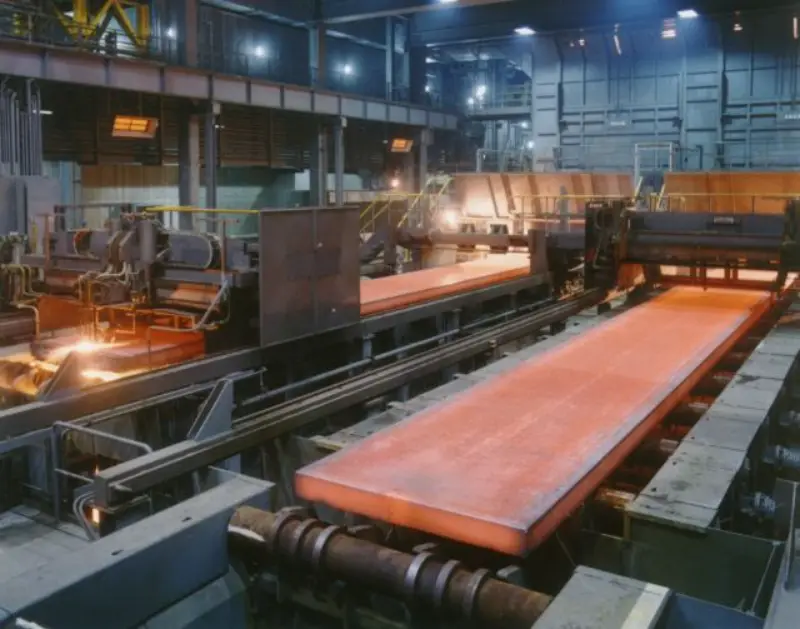
EN 10083-3 34CrMo4 Alloy Steel Plate
EN 10083-3 34CrMo4 Alloy Steel Plate | Chemical & Mechanical Properties
Comprehensive technical data for 34CrMo4 alloy steel per EN 10083-3, including chemistry, mechanical properties at various thicknesses, thermal physics, and international equivalent grades. Ideal for high-stress quenched and tempered components.
Hot rolling, forging, quenching and tempering, soft annealing, machining, welding (with care)
- Phone : +8618037372205
- Email : [email protected]
- WhatsApp: Contact via Whtsapp
- WeChat: +8618037372205
EN 10083-3 34CrMo4 Alloy Steel Plate Introduction
34CrMo4 is a chromium-molybdenum alloy steel defined in EN 10083-3 for quenching and tempering. It offers a well-balanced combination of strength, toughness, and wear resistance, making it suitable for highly stressed components in mechanical engineering. The steel can be through-hardened in sections up to approximately 40 mm, depending on the quenching medium. After tempering, it exhibits high tensile strength, good ductility, and adequate fatigue properties. Typical applications include axles, shafts, gears, bolts, and pressure vessels.
With a carbon content of 0.30–0.37%, it achieves a tensile strength between 700 and 1100 MPa depending on the tempering temperature. The addition of chromium (0.90–1.20%) enhances hardenability and wear resistance, while molybdenum (0.15–0.30%) suppresses temper embrittlement and improves elevated-temperature strength. The steel is typically delivered in the quenched and tempered (+QT) condition, but soft annealing (+A) is also available for improved machinability.
EN 10083-3 34CrMo4 Alloy Steel Plate Chemical Composition
Chemical requirements as per EN 10083-3:2006 table 3 for 34CrMo4. The heat analysis values must be within the limits stated. Product analysis tolerances apply according to the standard. All elements listed are mandatory; no other intentional additions are permitted without agreement.
| Element | Standard Value (%) | Remarks |
|---|---|---|
| Carbon (C) | 0.30 – 0.37 | Key for hardenability and strength level |
| Silicon (Si) | ≤ 0.40 | Deoxidizer, improves strength slightly |
| Manganese (Mn) | 0.60 – 0.90 | Contributes to hardenability and toughness |
| Phosphorus (P) | ≤ 0.025 | Residual element, controlled for ductility |
| Sulfur (S) | ≤ 0.035 | Residual element; for machinability a controlled range 0.020–0.040 may be agreed |
| Chromium (Cr) | 0.90 – 1.20 | Primary hardenability agent, carbide former |
| Molybdenum (Mo) | 0.15 – 0.30 | Suppresses temper embrittlement, improves high-temperature strength |
| Copper (Cu) | ≤ 0.40 | Residual; if added intentionally, max. 0.30 |
EN 10083-3 34CrMo4 Alloy Steel Plate Thermal and Electrical Physical Properties
Physical constants for 34CrMo4 in the quenched and tempered condition. These values are derived from literature and standard data for similar Cr-Mo steels, and may vary slightly with exact composition and heat treatment. Values are given for room temperature unless otherwise noted.
| Property | Typical Value | Unit | Test Condition |
|---|---|---|---|
| Density (ρ) | 7.85 | g/cm³ | At 20 °C |
| Elastic modulus (E) | 210 | GPa | At 20 °C, static |
| Shear modulus (G) | 80 | GPa | At 20 °C |
| Poisson's ratio (ν) | 0.30 | – | At 20 °C, elastic range |
| Thermal expansion coefficient (α) | 11.1 | 10⁻⁶/K | 20 – 100 °C |
| Thermal expansion coefficient (α) | 12.1 | 10⁻⁶/K | 20 – 200 °C |
| Thermal expansion coefficient (α) | 12.9 | 10⁻⁶/K | 20 – 300 °C |
| Thermal expansion coefficient (α) | 13.5 | 10⁻⁶/K | 20 – 400 °C |
| Thermal expansion coefficient (α) | 13.9 | 10⁻⁶/K | 20 – 500 °C |
| Thermal conductivity (λ) | 42.6 | W/(m·K) | At 20 °C |
| Thermal conductivity (λ) | 41.0 | W/(m·K) | At 100 °C |
| Thermal conductivity (λ) | 38.5 | W/(m·K) | At 200 °C |
| Thermal conductivity (λ) | 36.0 | W/(m·K) | At 300 °C |
| Specific heat capacity (cp) | 460 | J/(kg·K) | At 20 °C |
| Specific heat capacity (cp) | 500 | J/(kg·K) | At 200 °C |
| Specific heat capacity (cp) | 530 | J/(kg·K) | At 300 °C |
| Specific heat capacity (cp) | 550 | J/(kg·K) | At 400 °C |
| Electrical resistivity (ρe) | 0.20 – 0.25 | µΩ·m | At 20 °C |
EN 10083-3 34CrMo4 Alloy Steel Plate Mechanical Properties
Minimum mechanical properties for bright bars and flat products with thickness up to 100 mm, as per EN 10083-3. Values depend on the applicable diameter/thickness after tempering at specified temperatures. Testing is performed on separately cast samples or test pieces taken from the product after agreed heat treatment. For plates, the direction of sampling shall be agreed upon.
| Property | Required Value | Unit | Test Condition/Thickness Range |
|---|---|---|---|
| Tensile strength (Rm) | 900 – 1100 | MPa | d ≤ 16 mm; tempering ≥ 540 °C, typical |
| Tensile strength (Rm) | 800 – 950 | MPa | 16 < d ≤ 40 mm; tempering ≥ 540 °C |
| Tensile strength (Rm) | 650 – 800 | MPa | 40 < d ≤ 100 mm; tempering ≥ 540 °C |
| Yield strength (ReH) | ≥ 650 | MPa | d ≤ 16 mm; 0.2% proof stress applies for thicker sections |
| Yield strength (ReH) | ≥ 550 | MPa | 16 < d ≤ 40 mm |
| Yield strength (ReH) | ≥ 430 | MPa | 40 < d ≤ 100 mm |
| Elongation after fracture (A) | ≥ 13 | % | d ≤ 16 mm; gauge length L0 = 5.65√S0 |
| Elongation after fracture (A) | ≥ 14 | % | 16 < d ≤ 40 mm |
| Elongation after fracture (A) | ≥ 15 | % | 40 < d ≤ 100 mm |
| Impact energy (KV, transverse) | ≥ 25 | J | At -20 °C, unless otherwise agreed (reference value for quenched & tempered condition, not always mandatory) |
| Hardness (after quenching and tempering, delivery condition) | 217 – 285 HBW | – | Typical for strength classes above; soft annealed delivery condition: max 217 HBW |
| Bend test | Not normally required; bend radius depends on application. For specific requirements consult the standard. |
EN 10083-3 34CrMo4 Alloy Steel Plate Fully Equivalent Material Standards and Substitutable Grades
| Country/Region | Standard | Grade | Remarks |
|---|---|---|---|
| Europe | EN 10083-3 | 34CrMo4 | Original designation; harmonized European standard |
| Germany | DIN 17204 / DIN 17200 | 34CrMo4 | Historically identical; withdrawn and replaced by EN |
| Italy | UNI 7845 / UNI 5333 | 34CrMo4 | Identical |
| France | NF A35-552 / NF A35-553 | 34CrMo4 | Identical |
| Spain | UNE 36054 | 34CrMo4 | Identical |
| Sweden | SS 14 22 34 | 2234 | Equivalent chromium-molybdenum steel |
| United Kingdom | BS 970-1 (withdrawn) | 708M40 | Former BS equivalent; corresponds to 34CrMo4 |
| ISO | ISO 683-18 | 34CrMo4 | International standard, technically identical in this category |
| China (approximate) | GB/T 3077 | 35CrMo | Slight difference in C and Mn ranges; often considered interchangeable |
| Japan (approximate) | JIS G4105 | SCM435 | C range 0.33-0.38, Mn 0.60-0.85, Cr 0.90-1.20, Mo 0.15-0.30; closest JIS grade |
| USA (approximate) | ASTM A29 / A322 | 4135 / 4137 | AISI/SAE 4135 (C 0.33-0.38, Mn 0.70-0.90, Cr 0.80-1.10, Mo 0.15-0.25); 4137 (C 0.35-0.40) also used |
EN 10083-3 34CrMo4 Alloy Steel Plate Application Introduction
Thanks to its excellent balance of strength and toughness after quenching and tempering, 34CrMo4 is widely used in general mechanical engineering for components that must withstand high static and alternating loads. It is suitable for moderate section sizes and offers reliable response to heat treatment. The steel can be surface hardened by induction or flame if additional wear resistance is needed.
Product Applications: High-strength bolts and studs (e.g., class 10.9), Forged crankshafts and connecting rods, Heat-treated plates for welded constructions, Transmission shafts and gear wheels, Pressurized cylinders and vessels
Processed into products: Axle shafts and stub axles, Gears and pinions, Cylinder liners, Tool holders and clamps, Coupling components, Flanges and rotors, Spindles and guide rods
Application industries: Automotive and transportation: powertrain parts, chassis fasteners, Mechanical engineering: general machine building, gear manufacturing, Oil and gas: pressure-containing parts, wellhead equipment components, Power generation: turbine fasteners, shafts, Tool manufacturing: holders, fixtures
EN 10083-3 34CrMo4 Alloy Steel Plate Similar or Closely Related Substitute Materials
| Country/Region | Standard | Grade | Remarks |
|---|---|---|---|
| Europe | EN 10083-3 | 42CrMo4 | Higher carbon (0.38-0.45) and slightly higher hardenability; often used when higher strength is required |
| Europe | EN 10083-3 | 25CrMo4 | Lower carbon (0.22-0.29), better weldability, lower strength; suitable for heat-treated structural parts |
| Germany | DIN 17200 | 30CrMo4 | Intermediate carbon content, somewhat lower strength than 34CrMo4 |
| USA | ASTM A29 | 4140 | Higher carbon and chromium; widely used for similar applications but not a direct substitution |
| Japan | JIS G4105 | SCM430 | Lower carbon version of SCM435; similar hardenability but lower strength |
| China | GB/T 3077 | 30CrMo | Lower carbon, lower strength, slightly improved toughness |
Notes:
Welding: Due to the medium carbon and alloy content, 34CrMo4 is prone to cold cracking. Preheating to 200–300 °C and post-weld stress relieving are mandatory. Filler metals of similar composition (e.g., AWS ER80S-B2) are recommended.
Heat treatment: Typical austenitizing temperature 840–870 °C, oil or water quenching depending on section size, tempering between 540–680 °C to achieve desired mechanical properties. Soft annealing at 680–720 °C with slow cooling yields a ferrite-pearlite structure for machinability.
Machinability: In the annealed condition, machinability is about 55–65% of that of a free-cutting steel. In the quenched and tempered condition, machinability improves at hardness levels around 250–300 HBW.
Surface hardening: Suitable for induction or flame hardening to a minimum surface hardness of 52 HRC, followed by low-temperature tempering.
- Share



