
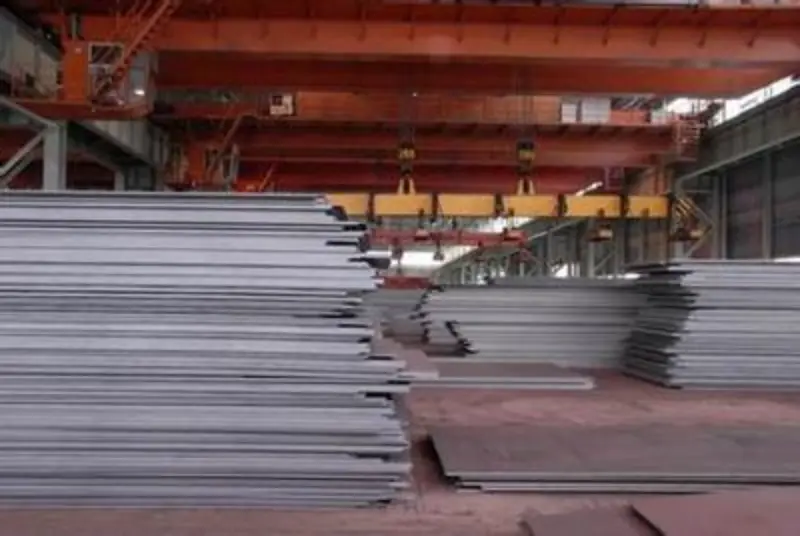
EN10083-3 25CrMoS4 Alloy Steel
25CrMoS4 Alloy Steel - EN10083-3 Quenched & Tempered Plate with Enhanced Machinability
Comprehensive material data for 25CrMoS4 high alloy steel plate per EN10083-3: chemical composition, mechanical and thermal properties, international equivalents, and application recommendations.
Hot rolling, forging, quenching and tempering, machining
- Phone : +8618037372205
- Email : [email protected]
- WhatsApp: Contact via Whtsapp
- WeChat: +8618037372205
EN10083-3 25CrMoS4 Alloy Steel Introduction
25CrMoS4 is a chromium-molybdenum alloy steel defined in EN 10083-3, intended for quenching and tempering. The controlled addition of sulfur (S) distinguishes it from the standard 25CrMo4 grade, significantly improving machinability while maintaining a robust combination of strength, toughness, and wear resistance. The steel is characterized by:
- Medium carbon content (0.22-0.29%) for balanced hardness and ductility after heat treatment
- Chromium (0.90-1.20%) to enhance hardenability and wear resistance
- Molybdenum (0.15-0.30%) to increase high-temperature strength and temper resistance
- Sulfur (0.020-0.040%) to promote chip breaking and prolong tool life in machining operations
In the quenched and tempered (+QT) condition, 25CrMoS4 achieves tensile strengths typically in the range of 900–1200 MPa, depending on section size, with good ductility and impact energy. It is widely used for automotive transmission components, high-strength fasteners, and general mechanical engineering parts where both machinability and elevated mechanical properties are required. The sulfur addition may slightly reduce transverse impact toughness and weldability; therefore, design and processing precautions should be observed for critical applications.
EN10083-3 25CrMoS4 Alloy Steel Chemical Composition
The chemical composition below represents the standard heat analysis according to EN 10083-3. Maximum limits for residual elements such as nickel (Ni ≤0.40%) and copper (Cu ≤0.30%) are typically controlled but not listed as intentional alloying additions. All values are in weight percent.
| Chemical Element | Standard Value (wt. %) | Notes |
|---|---|---|
| Carbon (C) | 0.22 – 0.29 | Key element for hardenability and strength |
| Silicon (Si) | ≤ 0.40 | Deoxidizer |
| Manganese (Mn) | 0.60 – 0.90 | Contributes to hardenability and strength |
| Phosphorus (P) | ≤ 0.025 | Residual, kept low for toughness |
| Sulfur (S) | 0.020 – 0.040 | Added for improved machinability |
| Chromium (Cr) | 0.90 – 1.20 | Increases hardenability and wear resistance |
| Molybdenum (Mo) | 0.15 – 0.30 | Enhances high-temperature strength and temper resistance |
EN10083-3 25CrMoS4 Alloy Steel Thermal and Electrical Physical Properties
The following physical properties are considered typical reference values for 25CrMoS4 in the quenched and tempered condition. Slight variations may occur depending on exact heat treatment and microstructure.
| Property | Typical Value | Unit | Test Condition |
|---|---|---|---|
| Density (ρ) | 7.85 | g/cm³ | 20 °C |
| Elastic Modulus (E) | 210 | GPa | 20 °C |
| Shear Modulus (G) | 81 | GPa | 20 °C |
| Poisson's Ratio (ν) | 0.30 | — | 20 °C |
| Thermal Expansion Coefficient (α) | 11.5 × 10⁻⁶ | K⁻¹ | 20 – 100 °C |
| Thermal Expansion Coefficient (α) | 12.0 × 10⁻⁶ | K⁻¹ | 20 – 200 °C |
| Thermal Expansion Coefficient (α) | 12.5 × 10⁻⁶ | K⁻¹ | 20 – 300 °C |
| Thermal Conductivity (λ) | 42 | W/(m·K) | 20 °C |
| Specific Heat Capacity | 460 | J/(kg·K) | 20 °C |
| Electrical Resistivity (ρₑ) | 0.22 × 10⁻⁶ | Ω·m | 20 °C |
EN10083-3 25CrMoS4 Alloy Steel Mechanical Properties
Mechanical properties are strongly influenced by section size and tempering temperature. The table below presents the minimum required values for quenched and tempered (+QT) condition according to EN 10083-3 for two common thickness ranges. Hardness values are indicative.
| Property | Standard Value | Unit | Test Condition |
|---|---|---|---|
| Yield Strength (ReH) | ≥ 800 | MPa | Section thickness ≤ 16 mm |
| Yield Strength (ReH) | ≥ 700 | MPa | Section thickness 16 mm – 40 mm |
| Tensile Strength (Rm) | 1000 – 1200 | MPa | Section thickness ≤ 16 mm |
| Tensile Strength (Rm) | 900 – 1100 | MPa | Section thickness 16 mm – 40 mm |
| Elongation (A) | ≥ 10 | % | Section thickness ≤ 16 mm, L0 = 5.65√S0 |
| Elongation (A) | ≥ 12 | % | Section thickness 16 mm – 40 mm |
| Reduction of Area (Z) | ≥ 40 | % | Section thickness ≤ 16 mm |
| Reduction of Area (Z) | ≥ 45 | % | Section thickness 16 mm – 40 mm |
| Impact Energy (KV, 20°C) | ≥ 30 | J | Charpy-V, mean of 3 tests |
| Brinell Hardness (HBW) | 300 – 360 | — | Section thickness ≤ 16 mm |
| Brinell Hardness (HBW) | 270 – 330 | — | Section thickness 16 mm – 40 mm |
EN10083-3 25CrMoS4 Alloy Steel Direct Equivalent Material Standards and Substitutable Grades
| Country/Region | Standard | Grade | Remarks |
|---|---|---|---|
| Europe | EN 10083-3 | 25CrMoS4 (1.7213) | Fully equivalent, resulfurized Cr-Mo steel |
| International | ISO 683-2 | 25CrMoS4 | Identical to EN grade |
EN10083-3 25CrMoS4 Alloy Steel Application Introduction
25CrMoS4 is optimized for parts that require both high strength and good machinability. It is widely used in mass-produced automotive and machinery components where manufacturing efficiency and reliable mechanical properties are essential. The sulfur addition facilitates chip breaking in automatic machining, reducing tool wear and improving surface finish.
Product Applications: Gears and pinions, Shafts and axles, Bolts, studs, and high-strength fasteners, Connecting rods, Crankshafts and camshafts
Processed into products: Transmission shafts, Drive pinions, Piston pins, Universal joint components, Hydraulic cylinder rods, Machined couplings and flanges
Application industries: Automotive manufacturing, Mechanical engineering, Oil and gas equipment, Tooling and die production
EN10083-3 25CrMoS4 Alloy Steel Similar / Alternative Alloy Steel Recommendations
The following grades have a similar base composition but may not contain added sulfur for machinability. They offer comparable mechanical properties after heat treatment and can serve as alternatives where enhanced chip breaking is not critical.
| Country/Region | Standard | Grade | Remarks |
|---|---|---|---|
| USA | ASTM A29 / A29M | 4130 (UNS G41300) | Similar Cr-Mo steel, no intentional sulfur addition; machinability lower |
| Japan | JIS G4105 | SCM430 | Cr-Mo steel with equivalent carbon range but no sulfur range specified |
| Europe | EN 10083-3 | 25CrMo4 (1.7218) | Non-resulfurized version; identical base alloy except S ≤0.025% |
| China | GB/T 3077 | 30CrMo | Slightly higher carbon (0.26-0.34%), similar alloy design, no sulfur control |
Notes:
Machinability and Welding Considerations: The controlled sulfur content (0.020-0.040%) in 25CrMoS4 enhances chip breaking and tool life but may slightly reduce transverse impact toughness and cause a tendency towards hot shortness during welding. Preheating to 200–300 °C is recommended before welding, followed by post-weld heat treatment at 550–650 °C to relieve stresses and reduce the risk of hydrogen-induced cracking. For critical fatigue-loaded components, cleanliness requirements (e.g., steel with low oxygen and inclusion content) should be specified. Heat treatment guideline: Austenitize at 850–880 °C, oil or water quench, then temper at 540–680 °C depending on the desired strength level. Hardness and strength decrease as tempering temperature increases. The alloy achieves good through-hardening in sections up to approximately 40 mm.
- Share



