
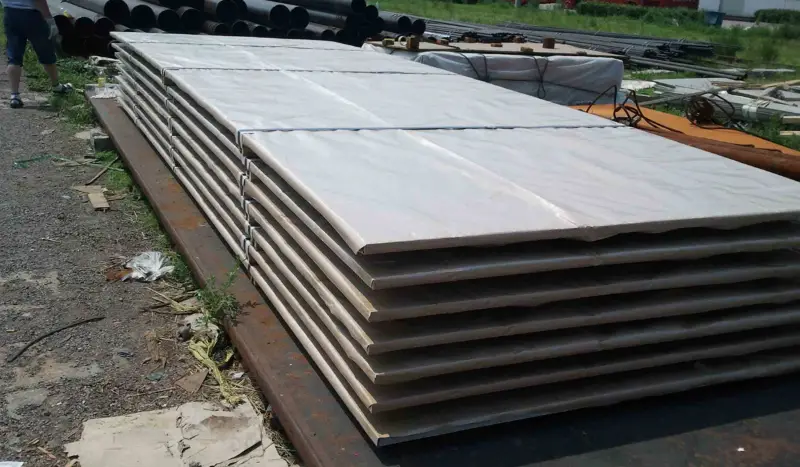
EN10083-3 25CrMo4 High Alloy Steel Plate
EN10083-3 25CrMo4 High Alloy Steel Plate - Properties, Equivalents & Applications
Complete material data for 25CrMo4 alloy steel according to EN10083-3: chemical composition, mechanical properties, physical properties, international equivalents, and typical applications.
Hot rolling, forging, cold drawing, machining, welding (with preheating and post-weld heat treatment)
- Phone : +8618037372205
- Email : [email protected]
- WhatsApp: Contact via Whtsapp
- WeChat: +8618037372205
EN10083-3 25CrMo4 High Alloy Steel Plate Introduction
25CrMo4 (material number 1.7218) is a chromium-molybdenum alloy special steel defined in the European standard EN 10083-3 for quenched and tempered steels. It is characterised by high strength, good toughness, excellent wear resistance, and moderate hardenability. The addition of chromium and molybdenum provides superior heat resistance and suitable creep strength for components operating at elevated temperatures. This steel is widely used in the manufacture of highly stressed parts in automotive, mechanical engineering, and oil & gas industries. The material is typically supplied in the quenched and tempered condition (+QT) to achieve optimal mechanical properties. It also exhibits good machinability in the heat-treated state and can be welded under controlled conditions. Typical applications include shafts, gears, connecting rods, bolts, and structural parts requiring a combination of high fatigue strength and toughness.
EN10083-3 25CrMo4 High Alloy Steel Plate Chemical Composition
The chemical composition in accordance with EN 10083-3:2006 for 25CrMo4 grade. The values are applicable for product thicknesses specified in the standard.
- Carbon (C) provides hardenability and strength.
- Chromium (Cr) and Molybdenum (Mo) enhance hardenability, high-temperature strength, and corrosion resistance.
- Manganese (Mn) acts as a deoxidizer and improves hardenability.
- Phosphorus and sulfur are controlled to low levels to maintain ductility and toughness.
Residual elements such as copper and nickel are not deliberately added but may be present within limits of the standard.
| Element | Standard Value (wt. %) | Remarks |
|---|---|---|
| Carbon (C) | 0.22 - 0.29 | Primary hardening element |
| Silicon (Si) | ≤ 0.40 | Deoxidizer, improves strength |
| Manganese (Mn) | 0.60 - 0.90 | Deoxidizer, increases hardenability |
| Phosphorus (P) | ≤ 0.025 | Impurity, controlled for toughness |
| Sulfur (S) | ≤ 0.035 | Impurity, improves machinability but high content reduces toughness |
| Chromium (Cr) | 0.90 - 1.20 | Improves hardenability and wear resistance |
| Molybdenum (Mo) | 0.15 - 0.30 | Increases high-temperature strength and creep resistance |
EN10083-3 25CrMo4 High Alloy Steel Plate Physical Properties
The physical and thermal properties of 25CrMo4 steel are typical for low-alloy Cr-Mo steels. These values are derived from material data sheets and are not normative in EN 10083-3 but are widely accepted for engineering calculations.
- Density is used for weight and inertia calculations.
- Elastic modulus and shear modulus are essential for stiffness design.
- Thermal expansion is critical for assemblies that experience temperature changes.
- Thermal conductivity influences heat transfer in thermal processing.
- Electrical resistivity is relevant for electrical applications.
Values may vary slightly depending on heat treatment condition.
| Property | Typical Value | Unit | Test Condition / Reference |
|---|---|---|---|
| Density (ρ) | 7.85 | g/cm³ | 20 °C |
| Elastic Modulus (E) | 210 | GPa | 20 °C |
| Shear Modulus (G) | approx. 81 | GPa | Calculated from E and Poisson's ratio, 20 °C |
| Poisson's Ratio (ν) | 0.3 | - | 20 °C, elastic region |
| Thermal Expansion Coefficient (α) | 11.1 | 10⁻⁶/K | 20–100 °C |
| Thermal Conductivity (λ) | 42 | W/(m·K) | 20 °C |
| Specific Heat Capacity (cp) | 460 | J/(kg·K) | 20 °C |
| Electrical Resistivity (ρ_e) | approx. 0.23 | μΩ·m | 20 °C |
EN10083-3 25CrMo4 High Alloy Steel Plate Mechanical Properties
The following mechanical properties are specified in EN 10083-3 for 25CrMo4 steel in the quenched and tempered state (+QT). The values depend on the ruling section (diameter or thickness). The test pieces are taken in the longitudinal direction.
- Yield strength (ReH): minimum stress at which the material begins to deform plastically.
- Tensile strength (Rm): maximum stress the material can withstand before fracture.
- Elongation (A): percentage increase in length after fracture, indicating ductility.
Impact properties are not mandatory but can be agreed upon; for reference, typical KV at room temperature is ≥ 40 J for small sections.
| Property | Value | Unit | Test Condition |
|---|---|---|---|
| Yield Strength (ReH, min.) | 700 | MPa | Ruling section d ≤ 16 mm, +QT, room temperature |
| Tensile Strength (Rm) | 900 - 1100 | MPa | d ≤ 16 mm, +QT, room temperature |
| Elongation (A, min.) | 12 | % | d ≤ 16 mm, gauge length L0=5d0 |
| Yield Strength (ReH, min.) | 600 | MPa | 16 mm < d ≤ 40 mm, +QT |
| Tensile Strength (Rm) | 800 - 950 | MPa | 16 mm < d ≤ 40 mm, +QT |
| Elongation (A, min.) | 14 | % | 16 mm < d ≤ 40 mm, L0=5d0 |
| Yield Strength (ReH, min.) | 500 | MPa | 40 mm < d ≤ 100 mm, +QT |
| Tensile Strength (Rm) | 750 - 900 | MPa | 40 mm < d ≤ 100 mm, +QT |
| Elongation (A, min.) | 15 | % | 40 mm < d ≤ 100 mm, L0=5d0 |
EN10083-3 25CrMo4 High Alloy Steel Plate Identical International Standards & Substitute Grades
| Country/Region | Standard | Grade | Remarks |
|---|---|---|---|
| International (ISO) | ISO 683-11 | 25CrMo4 | Chemically and technically identical to EN 10083-3 grade. |
| Europe (EN) | EN 10083-3 | 25CrMo4 (1.7218) | Original standard grade. |
EN10083-3 25CrMo4 High Alloy Steel Plate Application Introduction
25CrMo4 steel is selected for components requiring a combination of high strength, toughness, and wear resistance, especially after quenching and tempering. The Cr-Mo alloying ensures good hardenability, making it suitable for parts with moderate to large cross-sections. Typical uses include:
Product Applications: Quenched and tempered bars for shafts and fasteners, Forged parts (crankshafts, con rods), Seamless tubes for high-pressure applications, Plates for structural and wear-resistant components
Processed into products: Gears and pinions, Connecting rods, Axle shafts and stub axles, Bolts, studs, and high-strength fasteners, Hydraulic cylinder rods and bodies, Drill collars and tool joints, Pump shafts, Crankshafts, Spring plates and clips
Application industries: Automotive (drive shafts, axle components, connecting rods, gearbox parts), Mechanical and plant engineering (high-stress machine parts, press columns, hydraulic cylinders), Oil and gas (drilling tools, pipe couplings, valves), Power generation (turbine parts, fasteners), Aerospace (landing gear components, structural parts – in compliance with specific standards)
EN10083-3 25CrMo4 High Alloy Steel Plate Similar or Alternative Steel Grades
| Country/Region | Standard | Grade | Remarks |
|---|---|---|---|
| USA | ASTM A322 / SAE J404 | 4130 | Very similar Cr-Mo steel. Carbon range 0.28-0.33%, Cr 0.80-1.10%, Mo 0.15-0.25%. Slight differences in Mn and Si. Often used as a substitute, but verify mechanical properties. |
| China | GB/T 3077 | 30CrMo | Carbon 0.26-0.34%, Cr 0.80-1.10%, Mo 0.15-0.25%. Also close, with slightly higher carbon and lower Mn range. Suitable alternative after confirming design requirements. |
| Japan | JIS G4105 | SCM430 | Carbon 0.28-0.33%, Cr 0.90-1.20%, Mo 0.15-0.30%. Very similar composition; often interchangeable with 25CrMo4. |
| Germany (historical) | DIN 17200 | 25CrMo4 (1.7218) | Now superseded by EN 10083-3, but chemically identical. |
Notes:
Welding: 25CrMo4 can be welded using preheating (150-300°C) and post-weld heat treatment (stress relieving at 550-650°C) to avoid cracking. Low-hydrogen welding consumables with matching or slightly higher alloy content are recommended.
Heat treatment: Quenching from 840-870°C in oil or water, followed by tempering at 540-680°C depending on desired strength. Tempering in the range 300-400°C should be avoided to prevent temper embrittlement.
Machinability: Good in the quenched and tempered condition (approx. 60-70% of free-cutting steel). Surface hardening by induction or nitriding is possible for improved wear resistance.
- Share



