
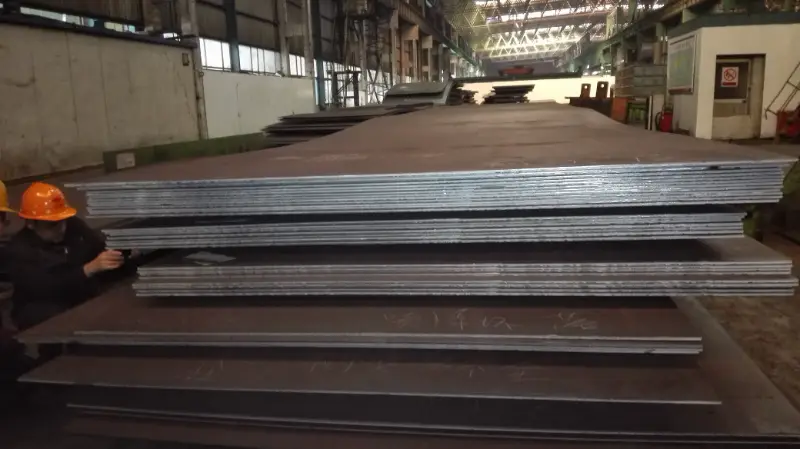
EN10083-3 39MnCrB6-2 Boron Alloy Steel
EN10083-3 39MnCrB6-2 Boron Alloy Steel Plate: High-Strength Quenched & Tempered Grade for Wear Parts
39MnCrB6-2 is a boron-alloyed quenched and tempered steel according to EN10083-3, offering excellent hardenability and high strength. Ideal for shafts, gears, and structural components requiring wear resistance.
Hot forming, forging, softening annealing, quenching and tempering, normalizing, surface hardening (induction/flame), welding with precautions
- Phone : +8618037372205
- Email : [email protected]
- WhatsApp: Contact via Whtsapp
- WeChat: +8618037372205
EN10083-3 39MnCrB6-2 Boron Alloy Steel Introduction
39MnCrB6-2 is a boron-containing alloy steel defined in EN 10083-3 for quenching and tempering. With a nominal carbon content of 0.39% and additions of manganese, chromium, and a micro-alloyed boron element, it achieves deep hardenability and uniform mechanical properties even in larger sections. After proper heat treatment (+QT), the material exhibits a typical tensile strength range of 900–1200 MPa, combined with good toughness and fatigue resistance.
This grade is characterized by:
- High strength after quenching and tempering, enabling lightweight designs
- Superior hardenability owing to controlled boron content
- Good machinability in the annealed or pre-hardened condition
- Reliable impact toughness at room and low temperatures
The steel is widely used for dynamically loaded parts in automotive and mechanical engineering. It is supplied as hot-rolled plate, round bars, or forgings in the soft-annealed or untreated condition, ready for final heat treatment by the manufacturer.
EN10083-3 39MnCrB6-2 Boron Alloy Steel Chemical Composition
The chemical composition according to EN 10083-3:2018 ensures consistent hardenability and mechanical strength. The key alloying elements are manganese and chromium for hardenability, while boron (in ppm range) significantly delays ferrite/pearlite transformation. Trace amounts of titanium or aluminium may be added to protect boron from nitrogen. Residual elements such as nickel, molybdenum, and copper are not required but may be present up to certain maxima (e.g., Ni ≤ 0.40%, Mo ≤ 0.10%, Cu ≤ 0.30%).
| Element | Standard Value (wt. %) | Remarks |
|---|---|---|
| Carbon (C) | 0.36 – 0.42 | Core for strength and hardness |
| Silicon (Si) | ≤ 0.40 | Deoxidizer, minor effect on strength |
| Manganese (Mn) | 1.10 – 1.40 | Increases hardenability and strength |
| Phosphorus (P) | ≤ 0.025 | Considered as impurity |
| Sulfur (S) | ≤ 0.035 | Controlled for machinability, low for toughness |
| Chromium (Cr) | 0.30 – 0.60 | Improves hardenability and wear resistance |
| Boron (B) | 0.0008 – 0.005 | Excellent hardenability booster; requires strict protection |
EN10083-3 39MnCrB6-2 Boron Alloy Steel Physical Properties – Typical Reference Values
The following physical properties are typical for a medium‑carbon alloy steel like 39MnCrB6‑2 in the heat‑treated condition and are not specified by the standard. They serve as engineering guidance. Slight variations may occur depending on exact heat treatment and microstructure. Electrical resistivity and thermal conductivity are measured at room temperature unless noted.
| Property | Typical Value | Unit | Test Condition / Remarks |
|---|---|---|---|
| Density (ρ) | 7.85 | g/cm³ | At 20°C |
| Elastic Modulus (E) | 210 | GPa | At 20°C |
| Shear Modulus (G) | 81 | GPa | At 20°C |
| Poisson Ratio (ν) | 0.30 | – | Elastic range |
| Thermal Expansion (α) | 12.3 | 10⁻⁶/K | Mean coefficient 20–100°C |
| Thermal Expansion (α) | 13.5 | 10⁻⁶/K | Mean coefficient 20–300°C |
| Thermal Conductivity (λ) | 41.5 | W/(m·K) | At 20°C |
| Specific Heat Capacity (c) | 460 | J/(kg·K) | At 20°C |
| Electrical Resistivity (ρ_e) | 0.23 | μΩ·m | At 20°C |
EN10083-3 39MnCrB6-2 Boron Alloy Steel Mechanical Properties in Quenched & Tempered Condition – Typical Guaranteed Values
The following values apply to test specimens taken from quenched and tempered round bars (40 mm thickness and below) or plates and correspond to minimum requirements. Properties depend on the ruling section: thicker sections may show lower strength. Impact energy is measured on ISO-V notch specimens, usually at +20°C. Yield strength is for the upper yield point (ReH) or 0.2% proof stress (Rp0.2) when no yield phenomenon occurs.
| Property | Standard Requirement (min.) | Unit | Test Condition / Ruling Section |
|---|---|---|---|
| Yield Strength (ReH / Rp0.2) | 700 | MPa | Ruling section ≤ 16 mm |
| Tensile Strength (Rm) | 900 – 1100 | MPa | Ruling section ≤ 16 mm |
| Elongation (A) | 12 | % | Gauge length L0 = 5.65√S0, ≤ 16 mm |
| Reduction of Area (Z) | 40 | % | At fracture, ≤ 16 mm |
| Impact Energy (KV, ISO-V) | 25 | J | +20°C, ≤ 16 mm |
| Yield Strength (ReH / Rp0.2) | 620 | MPa | 16 < t ≤ 40 mm |
| Tensile Strength (Rm) | 850 – 1050 | MPa | 16 < t ≤ 40 mm |
| Elongation (A) | 14 | % | 16 < t ≤ 40 mm |
| Reduction of Area (Z) | 45 | % | 16 < t ≤ 40 mm |
| Impact Energy (KV, ISO-V) | 30 | J | +20°C, 16 < t ≤ 40 mm |
| Yield Strength (ReH / Rp0.2) | 540 | MPa | 40 < t ≤ 100 mm |
| Tensile Strength (Rm) | 800 – 1000 | MPa | 40 < t ≤ 100 mm |
| Elongation (A) | 15 | % | 40 < t ≤ 100 mm |
| Impact Energy (KV, ISO-V) | 30 | J | +20°C, 40 < t ≤ 100 mm |
EN10083-3 39MnCrB6-2 Boron Alloy Steel Fully Equivalent Standards and Replacement Grades
| Country / Region | Standard | Designation | Remarks |
|---|---|---|---|
| European Union | EN 10083-3 | 39MnCrB6-2 | Material number 1.7189; identical chemical and mechanical requirements |
| Germany | DIN EN 10083-3 | 39MnCrB6-2 | Direct adoption of EN standard |
| France | NF EN 10083-3 | 39MnCrB6-2 | Direct adoption of EN standard |
| United Kingdom | BS EN 10083-3 | 39MnCrB6-2 | Direct adoption of EN standard |
| Italy | UNI EN 10083-3 | 39MnCrB6-2 | Direct adoption of EN standard |
| Spain | UNE EN 10083-3 | 39MnCrB6-2 | Direct adoption of EN standard |
| Sweden | SS-EN 10083-3 | 39MnCrB6-2 | Commercial designation may include 2239 or 1.7189 |
EN10083-3 39MnCrB6-2 Boron Alloy Steel Application Introduction
39MnCrB6-2 is engineered for components that must withstand high dynamic loads and wear after quenching and tempering. Its controllably fine-grained microstructure and through‑hardening capability make it suitable for a wide range of medium‑to‑large‑sized parts. Typical industries and applications are listed below.
Product Applications: Heavy-duty shafts and axles, Gears and pinions (case‑hardened or induction‑hardened), Connecting rods for engines, Crankshafts for reciprocating pumps/compressors, High-strength bolts and studs (≥ class 10.9), Wear plates and shear knives, Hydraulic cylinder rods and pistons
Processed into products: Transmission shafts and splined shafts, Differential gear blanks, Press columns and tie rods, Heavy machinery track pins and bushings, Forged steering knuckles, Pre‑hardened wear strips for excavator buckets
Application industries: Automotive and transportation, Agricultural machinery, Construction and earth-moving equipment, General mechanical engineering, Hydraulic and pneumatic systems, Mining and oil & gas
EN10083-3 39MnCrB6-2 Boron Alloy Steel Similar or Alternative Alloy Grades for Comparable Applications
| Country / Region | Standard | Designation | Remarks |
|---|---|---|---|
| Europe | EN 10083-3 | 27MnCrB5-2 | Lower carbon (~0.25–0.31%), less strength but better impact toughness; used for similar parts when higher toughness is needed |
| Europe | EN 10083-3 | 38MnB5 | Similar boron steel, no chromium; slightly lower hardenability but suitable for less demanding sections |
| Europe | EN 10083-3 | 42CrMo4 | Classic Cr-Mo steel without boron; comparable strength but requires higher alloy content and careful quenching; widely available |
| China | GB/T 3077 | 40MnB | Similar carbon-manganese-boron steel; chromium not required; composition and hardenability close to 39MnCrB6-2 for small sections |
| USA | ASTM A304 | 15B30 | Boron steel with 0.28–0.33% C; lower carbon but after carburizing/carbonitriding can replace 39MnCrB6-2 in wear applications |
Notes:
- Heat treatment recommendation: Austenitize at 850–880°C, quench in oil or water depending on section size, temper immediately at 200–550°C to achieve desired strength and toughness. Careful temperature control is necessary to avoid boron nitride precipitation (protect with sufficient Al or Ti).
- Welding: Welding in the quenched and tempered condition is generally not recommended due to the risk of cracking and distortion. If welding is unavoidable, preheating to 200–300°C and post-weld stress relieving at ~20°C below tempering temperature are mandatory. Filler metal matching the base metal strength should be used.
- Surface hardening: The steel is suitable for induction or flame hardening, producing a hard wear-resistant case (≥ 58 HRC) with a tough core. Case depth can be precisely controlled by frequency and time.
- Availability: Plate is commonly supplied in thicknesses from 6 mm up to 150 mm, widths up to 2500 mm, and lengths up to 12000 mm. Conditions: untreated (+U), annealed (+A), or quenched and tempered (+QT) by special arrangement.
- Share



