
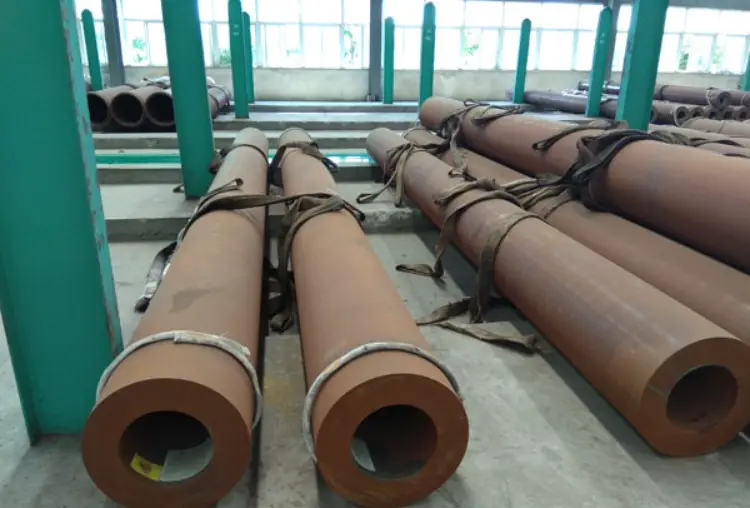
DIN 17175 13CrMo44 Alloy Steel Boiler Tube
DIN 17175 13CrMo44 Alloy Steel Boiler Tube: Composition, Properties and Equivalents
Complete material guide for 13CrMo44 boiler steel pipe under DIN 17175. Includes chemical composition, mechanical properties at room and elevated temperatures, physical data, equivalent grades worldwide, and application recommendations.
Hot rolling, cold drawing, normalizing, tempering, welding (with preheat and PWHT), bending
- Phone : +8618037372205
- Email : [email protected]
- WhatsApp: Contact via Whtsapp
- WeChat: +8618037372205
DIN 17175 13CrMo44 Alloy Steel Boiler Tube Introduction
13CrMo44 is a creep-resistant, low-alloy chromium-molybdenum steel designated in the withdrawn German standard DIN 17175 for seamless boiler and heat exchanger tubes. With approximately 1% Cr and 0.5% Mo, it provides a balanced combination of high-temperature strength, oxidation resistance and good weldability. This grade is capable of sustained operation up to about 550 °C and is widely encountered in power generation and petrochemical plants. In modern specifications it corresponds to 13CrMo4-5 (1.7335) of EN 10216-2.
- Excellent long-term creep strength
- Good resistance to hydrogen attack at elevated temperatures
- Suitable for bending and forming in the normalized or normalized-and-tempered condition
DIN 17175 13CrMo44 Alloy Steel Boiler Tube Chemical Composition according to DIN 17175
The chemical composition of 13CrMo44 is precisely defined to ensure high-temperature strength and corrosion resistance. The chromium and molybdenum contents are the primary alloying elements that enhance creep resistance. Residual elements such as phosphorus and sulfur are strictly controlled to maintain ductility and weldability. Values are taken from the historical DIN 17175 specification (cast analysis).
| Chemical Element | Standard Value | Remarks |
|---|---|---|
| Carbon (C) | 0.10–0.18 | Key for strength and hardenability |
| Silicon (Si) | 0.10–0.35 | Deoxidizer, improves oxidation resistance |
| Manganese (Mn) | 0.40–0.70 | Contributes to strength and toughness |
| Phosphorus (P) | ≤ 0.035 | Controlled to avoid embrittlement |
| Sulfur (S) | ≤ 0.035 | Controlled for cleanliness |
| Chromium (Cr) | 0.70–1.10 | Essential for creep and oxidation resistance |
| Molybdenum (Mo) | 0.40–0.60 | Increases hot strength and resistance to hydrogen attack |
| Iron (Fe) | Balance | Remainder |
DIN 17175 13CrMo44 Alloy Steel Boiler Tube Thermal and Electrical Physical Properties
Physical property data are representative for low-alloy Cr-Mo steel 13CrMo44 (1.7335) in the normalized condition. These values are useful for thermal and structural analysis but are not mandatory in the material standard. They are measured at room temperature unless otherwise noted.
| Property | Typical Value | Unit | Condition / Temperature |
|---|---|---|---|
| Density (ρ) | 7.85 | kg/dm³ | 20 °C |
| Modulus of elasticity (E) | 210 | GPa | 20 °C |
| Shear modulus (G) | 81 | GPa | 20 °C |
| Poisson's ratio (ν) | 0.30 | - | 20 °C |
| Thermal expansion coefficient (α) | 11.1 | 10⁻⁶/K | 20–100 °C |
| Thermal expansion coefficient (α) | 12.5 | 10⁻⁶/K | 20–300 °C |
| Thermal expansion coefficient (α) | 13.9 | 10⁻⁶/K | 20–500 °C |
| Thermal conductivity (λ) | 44 | W/(m·K) | 20 °C |
| Thermal conductivity (λ) | 42 | W/(m·K) | 200 °C |
| Thermal conductivity (λ) | 38 | W/(m·K) | 400 °C |
| Specific heat capacity (cp) | 460 | J/(kg·K) | 20 °C |
| Specific heat capacity (cp) | 540 | J/(kg·K) | 500 °C |
| Electrical resistivity (ρe) | 0.20 | Ω·mm²/m | 20 °C |
DIN 17175 13CrMo44 Alloy Steel Boiler Tube Mechanical Properties
The mechanical properties of 13CrMo44 are specified at room temperature for quality verification and at elevated temperatures for design. Tensile testing is performed on base pipe material in the delivery condition. Values depend on wall thickness; the table gives minimum requirements for typical sizes. Elevated temperature proof strength (Rp0.2) is crucial for high-temperature service.
- Room temperature values are according to DIN 17175 for wall thickness ≤ 16 mm.
- Hot yield strengths are comparable to those of EN 10216-2 Grade 13CrMo4-5.
| Property | Required Value | Unit | Test Conditions |
|---|---|---|---|
| Tensile strength (Rm) | 440–590 | MPa | Room temperature, longitudinal, wall thickness ≤ 16 mm |
| Yield strength (ReH) | ≥ 290 | MPa | Room temperature, longitudinal, wall thickness ≤ 16 mm |
| Elongation (A) | ≥ 22 (≥ 20) | % | Longitudinal (transverse), gauge length 5.65√S₀ |
| Bend test | No cracks | - | Bend angle 180°, former diameter 3× wall thickness (for tubes ≤ 50 mm OD) |
| 0.2% proof strength at 200 °C | ≥ 255 | MPa | Elevated temperature tensile test |
| 0.2% proof strength at 300 °C | ≥ 215 | MPa | Elevated temperature tensile test |
| 0.2% proof strength at 400 °C | ≥ 190 | MPa | Elevated temperature tensile test |
| 0.2% proof strength at 500 °C | ≥ 160 | MPa | Elevated temperature tensile test |
| Impact energy (KV) – not mandatory | ≥ 34 (typical) | J | Charpy-V, room temperature, if specified |
DIN 17175 13CrMo44 Alloy Steel Boiler Tube Completely Equivalent Material Standards and Replaceable Grades
| Country/Region | Standard | Grade | Remarks |
|---|---|---|---|
| Europe | EN 10216-2 | 13CrMo4-5 (1.7335) | Direct successor; identical chemistry and properties |
| Germany (historical) | DIN 17175 | 13CrMo44 | Original designation, now superseded |
| Germany (historical) | DIN 2448/17179 | 13CrMo44 | Seamless tubes, same grade |
| United Kingdom | BS 3059-2 | 620-440 | 1Cr–0.5Mo steel for boiler tubes |
| USA/Canada | ASTM A213 / A213M | T12 | Similar 1Cr-0.5Mo alloy, but minor compositional differences exist; often interchangeable with verification |
| Japan | JIS G3462 | STBA 22 | Equivalent Cr-Mo steel for boiler and heat exchanger tubes |
| China | GB/T 5310 | 15CrMoG (approximately) | Chinese grade with slight variations; requires case-by-case comparison |
DIN 17175 13CrMo44 Alloy Steel Boiler Tube Application Introduction
13CrMo44 (1.7335) is a well-established material for pressure parts exposed to high temperatures and moderate pressures. It is typically used in the water-wall, superheater and reheater sections of conventional boilers, as well as in reformer furnaces where hydrogen partial pressure is present. Thanks to its good weldability, it is also employed for field-fabricated piping.
- Maximum recommended service temperature: approximately 550 °C for continuous operation.
- Resistant to steam oxidation and high-temperature hydrogen attack under MPC (Nelson curve) limits.
- Commonly post-weld heat treated to reduce residual stresses.
Product Applications: Seamless boiler tubes (straight or U-bent), Superheater and reheater tube bundles, Steam headers and main steam piping, Heat exchanger tube sheets and bundles, Hydrogen reformer tubes
Processed into products: Boiler wall tubes and downcomers, Superheater pendant and platen sections, Hot reheat outlet headers, Tube-to-tube butt welds in boiler assemblies, Forged fittings and flanges (when specified)
Application industries: Fossil fuel power plants (boilers, steam lines), Combined cycle and cogeneration plants, Petrochemical and refinery (reformer tubes, heat exchangers), Chemical process industry (high-temperature reactors), Industrial boiler manufacturing
DIN 17175 13CrMo44 Alloy Steel Boiler Tube Similar or Alternative Materials with Close Properties
| Country/Region | Standard | Grade | Remarks |
|---|---|---|---|
| Europe | EN 10216-2 | 10CrMo9-10 (1.7380) | Higher creep strength (2.25Cr–1Mo); suitable for higher temperatures, but more alloying cost |
| Europe | EN 10216-2 | 16Mo3 (1.5415) | Mo-only alloy; lower creep strength, used up to ~480 °C |
| USA | ASTM A213 | T11 | 1.25Cr–0.5Mo–Si; slightly higher Cr, often used where 13CrMo44 is minimally adequate |
| USA | ASTM A213 | T22 | 2.25Cr–1Mo; for more demanding high-temperature service |
| Germany | DIN 17175 (historical) | 15Mo3 | 0.3% Mo steel; predecessor for lower temperature applications |
Notes:
DIN 17175 has been officially withdrawn and replaced by EN 10216-2 for new designs. However, 13CrMo44 remains a common designation in Asia and for replacement tube procurement. Welding consumables should match the base metal, typically using ER80S-B2 (AWS) or equivalent for GTAW, and E8018-B2 electrodes for SMAW, with a preheat of 200–300 °C and PWHT at 620–680 °C. Always refer to the latest edition of the applicable standard (e.g., EN 10216-2) for the current specification of 13CrMo4-5 (1.7335). For high-temperature hydrogen service, consult API RP 941 (Nelson curves) to verify resistance against hydrogen attack.
- Share



