
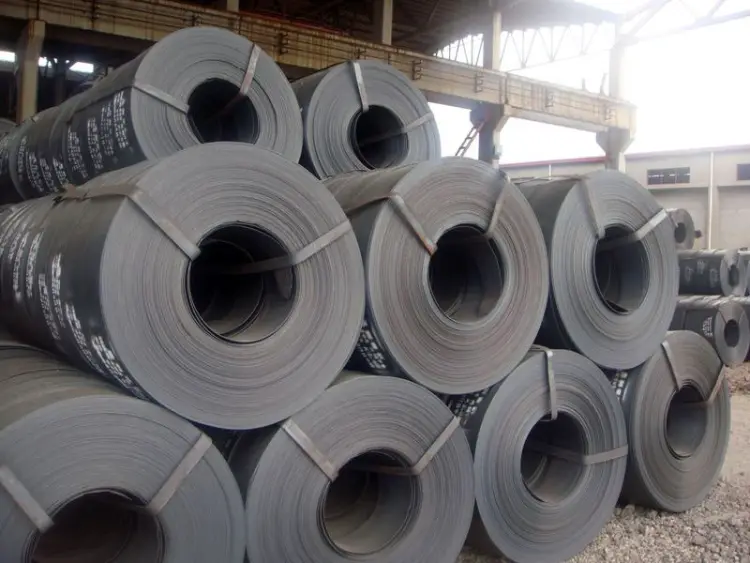
ASTM A514 Grade M High-Strength Quenched and Tempered Steel Coil
ASTM A514 Grade M High-Strength Quenched and Tempered Steel Coil
ASTM A514 Grade M is a low-carbon, nickel-molybdenum-boron alloyed quenched and tempered steel plate/coil offering minimum yield strength of 100 ksi (690 MPa) with excellent weldability and toughness. Used in structural, bridge, and pressure vessel applications.
hot rolling, quenching and tempering, flame cutting, welding, cold forming (limited radius)
- Phone : +8618037372205
- Email : [email protected]
- WhatsApp: Contact via Whtsapp
- WeChat: +8618037372205
ASTM A514 Grade M High-Strength Quenched and Tempered Steel Coil Introduction
ASTM A514 Grade M is a high-strength, low-carbon alloy steel supplied in the quenched and tempered condition, conforming to ASTM A514/A514M specifications. It is characterized by a carefully balanced chemistry containing nickel, molybdenum, and boron to achieve deep hardenability and excellent mechanical properties across thicknesses up to 2 inches (50 mm). The steel delivers a minimum yield strength of 100 ksi (690 MPa) and tensile strength in the range of 110–130 ksi (760–895 MPa), combined with good ductility, notch toughness, and weldability.
- Used for welded bridges, buildings, and heavy structural components
- Offers high strength-to-weight ratio, reducing structural dead load
- Performs well at low temperatures when supplementary toughness requirements are applied
- Available in coil, plate, and cut-to-length forms
ASTM A514 Grade M High-Strength Quenched and Tempered Steel Coil Chemical Composition
The chemical composition conforms to ASTM A514/A514M for Grade M. Typical heat analysis limits are listed. Residual elements such as Cu, V, Ti, Nb are controlled to maintain weldability and toughness. Boron addition enhances hardenability.
| Element | Composition (max or range) | Remarks |
|---|---|---|
| Carbon (C) | 0.12 max | For improved weldability |
| Manganese (Mn) | 0.45 – 0.70 | Strength and hardenability |
| Phosphorus (P) | 0.025 max | Residual element |
| Sulfur (S) | 0.010 max | For cleanliness and toughness |
| Silicon (Si) | 0.20 – 0.35 | Deoxidizer |
| Nickel (Ni) | 1.20 – 1.50 | Toughness and hardenability |
| Chromium (Cr) | 0.12 max | Residual element |
| Molybdenum (Mo) | 0.45 – 0.60 | Hardenability and strength |
| Boron (B) | 0.001 – 0.005 | Microalloying for deep hardenability |
| Copper (Cu) | 0.50 max | Residual; atmospheric corrosion resistance may be specified |
| Vanadium (V) | 0.08 max | Residual grain refiner |
| Titanium (Ti) | 0.05 max | Residual |
| Niobium (Nb) | 0.05 max | Residual grain refiner |
ASTM A514 Grade M High-Strength Quenched and Tempered Steel Coil Physical Properties
Physical properties are not specified by ASTM A514/A514M but are provided as typical values for quenched and tempered low-alloy steels. Actual values may vary slightly with exact composition and heat treatment.
| Property | Typical value | Unit | Condition |
|---|---|---|---|
| Density (ρ) | 7.85 | g/cm³ | At room temperature |
| Elastic modulus (E) | 205 | GPa | At room temperature |
| Shear modulus (G) | 80 | GPa | Typical for steel |
| Poisson's ratio (ν) | 0.3 | – | Within elastic range |
| Thermal expansion coefficient (α), 20–100 °C | 11.7 | 10⁻⁶/K | Mean coefficient |
| Thermal expansion coefficient (α), 20–200 °C | 12.2 | 10⁻⁶/K | Mean coefficient |
| Thermal expansion coefficient (α), 20–300 °C | 12.7 | 10⁻⁶/K | Mean coefficient |
| Thermal conductivity (λ) | 42 | W/(m·K) | At 20 °C |
| Specific heat capacity (c) | 475 | J/(kg·K) | At 20 °C |
| Electrical resistivity (ρ_e) | 0.20 | 10⁻⁶ Ω·m | At 20 °C |
ASTM A514 Grade M High-Strength Quenched and Tempered Steel Coil Mechanical Properties
Tensile and bend properties are mandatory as per ASTM A514/A514M. Testing is performed on specimens in the quenched and tempered condition. Elongation varies with gauge length and thickness. Bend test requirements depend on plate thickness; all bend angles are 180°.
| Property | Value | Unit | Test condition |
|---|---|---|---|
| Yield strength (ReH) | ≥ 690 (≥ 100) | MPa (ksi) | 0.2% offset, all thicknesses ≤ 2 in. (50 mm) |
| Tensile strength (Rm) | 760 – 895 (110 – 130) | MPa (ksi) | All thicknesses ≤ 2 in. (50 mm) |
| Elongation (A) in 50 mm (2 in.) | ≥ 18 | % | Thickness ≤ 3/4 in. (20 mm) |
| Elongation (A) in 50 mm (2 in.) | ≥ 16 | % | Thickness > 3/4 in. to 2 in. (20–50 mm) |
| Elongation (A) in 200 mm (8 in.) | ≥ 14 | % | All thicknesses ≤ 2 in. (50 mm) |
| Bend test (180°) – ratio = bend diameter / thickness | 2t | – | Thickness ≤ 1/2 in. (12.5 mm) |
| Bend test (180°) – ratio = bend diameter / thickness | 2.5t | – | Thickness > 1/2 in. to 1 in. (12.5–25 mm) |
| Bend test (180°) – ratio = bend diameter / thickness | 3t | – | Thickness > 1 in. to 2 in. (25–50 mm) |
ASTM A514 Grade M High-Strength Quenched and Tempered Steel Coil Completely Equivalent Material Standards and Replaceable Grades
| Country/Region | Standard | Grade | Remarks |
|---|---|---|---|
| Europe | EN 10025-6 | S690Q (1.8931) | Quenched and tempered fine grain structural steel; similar strength, Ni+Mo content may differ; verify weldability. |
| Europe | EN 10025-6 | S690QL (1.8928) | With specified minimum toughness at -40 °C; suitable for low-temperature applications. |
| Japan | JIS G 3128 | SHY685NS | High yield strength quenched and tempered steel; often used in bridges; similar Ni-Mo-B system. |
| China | GB/T 16270 | Q690D | High strength structural steel; D-quality with impact test at -20 °C; may need verification of Ni equivalent. |
ASTM A514 Grade M High-Strength Quenched and Tempered Steel Coil Application Introduction
ASTM A514 Grade M is used where high strength, weight reduction, and good weldability are essential. It is typically selected for welded structures subjected to heavy static or dynamic loads. The material can be flame-cut, welded with low-hydrogen electrodes, and cold-formed to generous radii. Preheating and controlled interpass temperatures are required during welding to avoid hydrogen cracking. Post-weld heat treatment is generally not needed for thicknesses up to 2 inches, but may be applied where stress relief is specified.
Product Applications: Welded plate girders and columns, Crane booms and outrigger beams, Skyscraper structural cores, Offshore platform legs and deck components, Heavy-duty vehicle chassis, Piling and retaining walls
Processed into products: Lifting lugs and attachment plates, Flame-cut structural shapes, Welded box sections, Machined end connections, Bearing plates and stiffeners, Telescopic boom sections
Application industries: Bridge construction (trusses, girders), Building and stadium structures, Heavy machinery and earthmoving equipment, Offshore platforms and marine structures, Pressure vessels (when supplied per ASTM A517 Grade M), Transportation equipment (trailers, rail cars, crane booms), Mining and material handling equipment
ASTM A514 Grade M High-Strength Quenched and Tempered Steel Coil Similar or Alternative Materials Recommendation
| Country/Region | Standard | Grade | Remarks |
|---|---|---|---|
| USA | ASTM A514/A514M | Grade B, H, F, Q | Other A514 grades with comparable strength; chemistry and hardenability differ; selection based on thickness and service temperature. |
| USA | ASTM A517/A517M | Grade M | Quenched and tempered alloy steel plate for pressure vessels; identical chemistry; intended for boilers and pressure vessels – usually delivered with impact requirements. |
| Europe | EN 10025-6 | S890Q | Higher strength (890 MPa min yield); requires careful welding and forming; heavier structural applications. |
| Japan | JIS G 3128 | SHY685 | Without NS (low-temperature toughness); common in bridge construction where low-temp service not critical. |
| USA | ASTM A709/A709M | Grade HPS 690W | High-performance steel for bridges with weathering capability; similar strength level; enhanced corrosion resistance. |
Notes:
Welding considerations: Use low-hydrogen processes (SMAW, GMAW, SAW). Preheat typically 150–200 °F (65–95 °C) depending on thickness. Forming: Minimum bend radius 4t for transverse direction. Impact toughness: Can be specified as supplementary requirement (e.g., Charpy V-notch at -20 °F, -50 °F). Consult ASTM A514/A514M for supplementary requirements S1 to S18. Corrosion resistance: This grade is not a weathering steel; however, copper content can be limited to improve atmospheric corrosion when required. For bridge applications, consider ASTM A709 Grade HPS 690W.
- Share



