
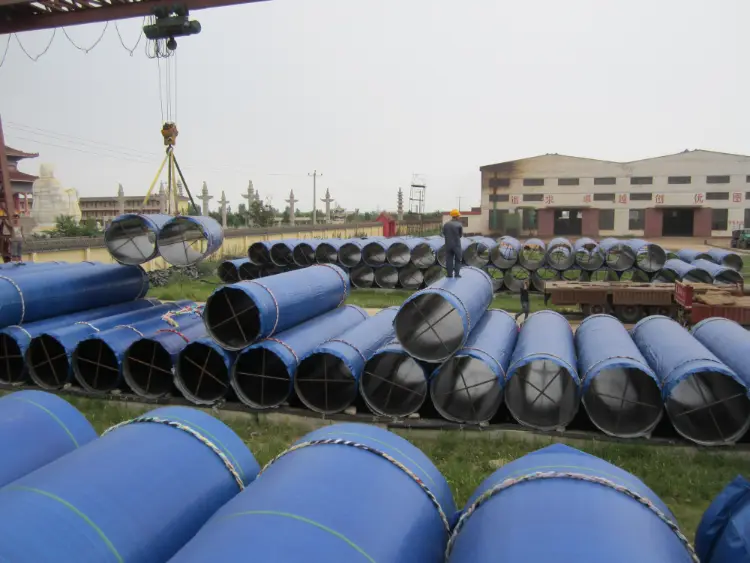
10CrMo910 Boiler Steel Pipe per DIN 17175
10CrMo910 Boiler Steel Pipe per DIN 17175 - High-Temperature Alloy Steel for Power Generation
10CrMo910 is a chromium-molybdenum alloy steel pipe grade specified in DIN 17175 for seamless boiler tubes. It offers excellent creep strength and oxidation resistance at elevated temperatures, making it ideal for power plant superheaters and reheaters.
Hot rolling, cold drawing, normalizing, tempering, welding (with preheat and PWHT), bending, flanging
- Phone : +8618037372205
- Email : [email protected]
- WhatsApp: Contact via Whtsapp
- WeChat: +8618037372205
10CrMo910 Boiler Steel Pipe per DIN 17175 Introduction
10CrMo910 is a 2.25% chromium – 1.0% molybdenum ferritic alloy steel designed for seamless boiler and heat exchanger tubes operating under high temperatures and pressures. Under the former German standard DIN 17175, this grade was widely used in power generation and petrochemical industries. The material provides a good combination of high-temperature strength, creep resistance, and resistance to oxidation and hydrogen attack. It is typically supplied in the normalized and tempered condition, with a uniform bainitic or ferritic-bainitic microstructure. The alloy is well-suited for welded construction and can be formed and machined using conventional methods, though preheating before welding and post-weld heat treatment are recommended to avoid stress corrosion cracking and ensure toughness.
10CrMo910 Boiler Steel Pipe per DIN 17175 Chemical Composition
The chemical composition according to DIN 17175 is tightly controlled to ensure the balance of high-temperature strength, weldability, and oxidation resistance. In particular, chromium and molybdenum contents define the creep-rupture properties, while phosphorus and sulfur are kept low for cleanliness.
| Element | Standard Value (%) | Remarks |
|---|---|---|
| Carbon (C) | 0.08 – 0.15 | Core hardenability and strength |
| Silicon (Si) | 0.15 – 0.50 | Deoxidation; higher Si aids oxidation resistance |
| Manganese (Mn) | 0.40 – 0.70 | Deoxidation and strength |
| Phosphorus (P) | ≤ 0.035 | Maximum limit for cleanliness |
| Sulfur (S) | ≤ 0.035 | Maximum limit for cleanliness |
| Chromium (Cr) | 2.00 – 2.50 | Provides oxidation/corrosion resistance and creep strength |
| Molybdenum (Mo) | 0.90 – 1.10 | Improves high-temperature strength and creep resistance |
| Others (Al, etc.) | Aluminum: 0.020 – 0.060 (if used for grain refinement) | Usually fine grain practice |
10CrMo910 Boiler Steel Pipe per DIN 17175 Physical and Thermal Properties
The data below are typical values for 2.25Cr-1Mo steel in the normalized and tempered condition. They are not mandated by DIN 17175 but are widely accepted for engineering design. Properties vary with temperature; selected temperatures are shown where significant. For precise design in high-temperature service, reference should be made to the applicable pressure vessel code (e.g., EN 13445) material data.
| Property | Standard Value | Unit | Test Condition / Temperature |
|---|---|---|---|
| Density (ρ) | 7.85 | g/cm³ | 20 °C |
| Elastic Modulus (E) | 210 | GPa | 20 °C |
| Elastic Modulus (E) | 198 | GPa | 200 °C |
| Elastic Modulus (E) | 185 | GPa | 400 °C |
| Shear Modulus (G) | 81 | GPa | 20 °C (calculated from E and ν) |
| Poisson's Ratio (ν) | 0.30 | – | 20 °C (typical for steel) |
| Thermal Expansion Coeff. (α) | 10.5 | 10⁻⁶/K | 20 – 100 °C |
| Thermal Expansion Coeff. (α) | 11.5 | 10⁻⁶/K | 20 – 200 °C |
| Thermal Expansion Coeff. (α) | 12.8 | 10⁻⁶/K | 20 – 400 °C |
| Thermal Expansion Coeff. (α) | 13.5 | 10⁻⁶/K | 20 – 600 °C |
| Thermal Conductivity (λ) | 35 | W/(m·K) | 20 °C |
| Thermal Conductivity (λ) | 36 | W/(m·K) | 200 °C |
| Thermal Conductivity (λ) | 34 | W/(m·K) | 400 °C |
| Specific Heat Capacity (cp) | 460 | J/(kg·K) | 20 °C |
| Specific Heat Capacity (cp) | 540 | J/(kg·K) | 400 °C |
| Electrical Resistivity (ρₑ) | 0.25 | µΩ·m | 20 °C (typical) |
10CrMo910 Boiler Steel Pipe per DIN 17175 Mechanical Properties
The following values represent minimum requirements for seamless tubes at room temperature according to DIN 17175. Properties are measured on specimens taken in the longitudinal direction. Values depend on wall thickness; the table shows data for thickness ≤ 16 mm. For thicker sections, reductions in strength and elongation may apply per the standard. Notched bar impact energy (KV) is not mandated by the base standard but can be agreed upon for low-temperature toughness requirements.
| Property | Standard Required Value | Unit | Test Condition / Remarks |
|---|---|---|---|
| Yield Strength (ReH, minimum) | 280 | MPa | Room temperature, longitudinal, t ≤ 16 mm |
| Yield Strength (ReH, minimum) | 260 | MPa | Room temperature, longitudinal, 16 < t ≤ 40 mm |
| Tensile Strength (Rm) | 450 – 600 | MPa | Room temperature, longitudinal, t ≤ 16 mm |
| Tensile Strength (Rm) | 440 – 590 | MPa | Room temperature, longitudinal, 16 < t ≤ 40 mm |
| Elongation (A, minimum) | 22 | % | Longitudinal, proportional test piece (L₀ = 5.65√S₀), t ≤ 16 mm |
| Elongation (A, minimum) | 20 | % | Transverse, proportional test piece, t ≤ 16 mm |
| Elongation (A, minimum) | 20 | % | Longitudinal, t > 16 mm (typical reduction) |
| Bend Test (Mandrel Diameter) | 3 × t | - | 180° bend, t = wall thickness, no cracks |
10CrMo910 Boiler Steel Pipe per DIN 17175 Direct Equivalent Standards and Substitute Grades
| Country/Region | Standard | Grade | Remarks |
|---|---|---|---|
| Germany | DIN 17175 | 10CrMo910 | Original specification (withdrawn, replaced by EN) |
| European Union | EN 10216-2 | 10CrMo9-10 (1.7380) | Current seamless boiler tube standard; identical chemistry |
| USA | ASTM A213 / A335 | T22 (tube) / P22 (pipe) | Seamless ferritic alloy steel for boilers and piping; same Cr-Mo base |
| USA | ASME SA-213 / SA-335 | T22 / P22 | ASME Boiler and Pressure Vessel Code equivalent |
| Japan | JIS G3458 | STPA 24 | Alloy steel pipes for high temperature service |
| China | GB/T 5310 | 12Cr2MoG | Seamless steel tubes for high-pressure boiler; minor difference in Mn, Si |
10CrMo910 Boiler Steel Pipe per DIN 17175 Application Introduction
10CrMo910 is specifically designed for components exposed to elevated temperatures where creep and oxidation resistance are essential. Its typical service temperature range is 450°C to 600°C. Proper heat treatment after forming and welding is critical to achieve the required mechanical properties and to minimize residual stresses. This material can be processed into a wide variety of shapes and components used in high-pressure and high-temperature industrial environments.
Product Applications: Superheater and reheater tube bundles, Main steam and hot reheat piping, Headers and manifolds in power boilers, Shell-and-tube heat exchangers for high-temperature service, Indirectly heated reformer tubes
Processed into products: Seamless boiler tubes (OD 20–610 mm), Steam piping elbows, tees, reducers, Welded stub connections and branches, Heat exchanger tube sheets and baffles, Finned tubes for enhanced heat transfer
Application industries: Conventional and nuclear power generation (fossil-fuel boilers, HRSGs), Petrochemical and refining (cracking furnaces, transfer lines), Chemical process industry (reactors, heat exchangers), Industrial heating (furnace tubes, radiant coils), Steam engineering (piping systems for high-pressure steam)
10CrMo910 Boiler Steel Pipe per DIN 17175 Similar Alternative Materials for Consideration
| Country/Region | Standard | Grade | Remarks |
|---|---|---|---|
| EU | EN 10216-2 | 13CrMo4-5 (1.7335) | 1Cr-0.5Mo steel; lower creep strength, suitable for moderate temperatures up to ~550°C |
| EU | EN 10216-2 | 11CrMo9-10 (1.7383) | Similar 2.25Cr-1Mo but with lower carbon limits; used in pressure vessels |
| USA | ASTM A213 | T11 | 1.25Cr-0.5Mo; lower alloy content, reduced high-temperature capabilities |
| USA | ASTM A213 | T23 | 2.25Cr-1.6W-V-Nb; improved creep strength, drop-in upgrade for some 2.25Cr-1Mo applications |
| Germany | VdTÜV | 24CrMoV5-5 | Higher Cr addition for increased creep rupture strength, used in high-temperature bolting |
Notes:
Welding considerations: Preheating to 200–300 °C is strongly recommended. Post-weld heat treatment (PWHT) at 680–750 °C according to applicable codes (e.g., EN 12952) is mandatory to restore toughness and relieve stress. Long-term service: Under prolonged exposure above 550 °C, the tempering response can lead to carbide coarsening; design codes incorporate creep data to ensure safe life. Hydrogen service: The 2.25Cr-1Mo composition offers good resistance to high-temperature hydrogen attack per API RP 941 (Nelson chart).
- Share



