
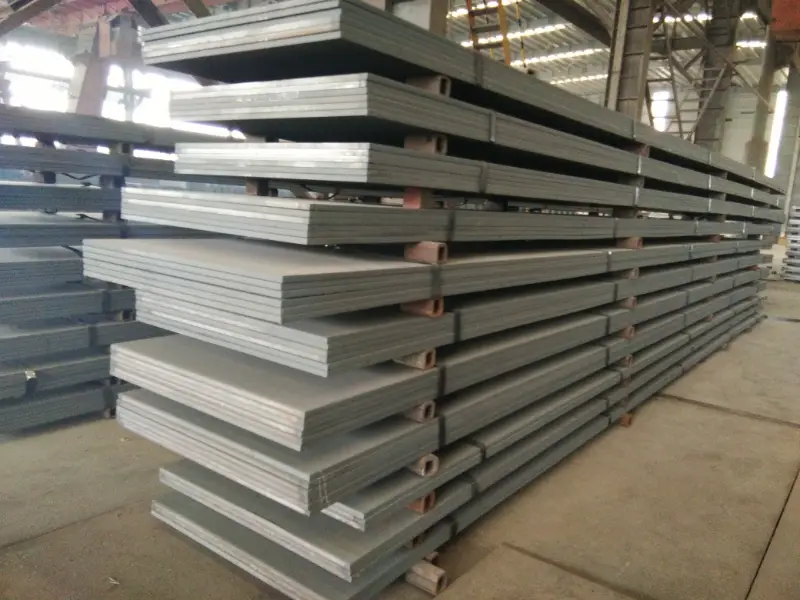
ASTM A514 Grade P Steel
ASTM A514 Grade P Steel: High-Strength Quenched & Tempered Alloy for Structural & Heavy Machinery
Explore ASTM A514 Grade P carbon and low-alloy high-strength steel coil. View chemical composition, mechanical and thermal properties, equivalent standards, and industrial applications.
Hot rolling, quenching and tempering, cold forming, welding (with proper preheat and procedures), machining (in annealed or tempered condition), cutting
- Phone : +8618037372205
- Email : [email protected]
- WhatsApp: Contact via Whtsapp
- WeChat: +8618037372205
ASTM A514 Grade P Steel Introduction
ASTM A514/A514M Grade P is a quenched and tempered low-alloy high-strength steel designed for structural applications demanding high yield strength (minimum 690 MPa / 100 ksi) with good toughness and weldability. It belongs to the family of A514 grades, each tailored with specific alloying elements. Grade P is characterized by a Cr-Mo-Ni-V-B chemistry that enhances hardenability and strength. Typically supplied in plate or coil form, this material is widely used in mobile equipment, crane booms, heavy-duty frames, and pressure vessels where weight savings and high load-bearing capacity are critical. The steel combines elevated mechanical properties with adequate ductility, and its heat-treated condition ensures uniform strength through the cross-section. Key features:
- High strength (yield ≥ 690 MPa, tensile 760–895 MPa)
- Excellent hardenability and through-thickness properties
- Good fabrication characteristics when correct procedures are followed
ASTM A514 Grade P Steel Chemical Composition
The chemical composition of ASTM A514 Grade P is carefully balanced to achieve high strength and good toughness after quenching and tempering. The additions of chromium, molybdenum, nickel, vanadium, and boron synergistically increase hardenability. Carbon is kept at a moderate level to maintain weldability. Maximum limits on phosphorus and sulfur ensure cleanliness and ductility. Note: Values are based on heat analysis per ASTM A514/A514M.
| Element | Standard Value (min - max, %) | Remarks |
|---|---|---|
| Carbon (C) | 0.12 – 0.21 | Key strength and hardenability element |
| Manganese (Mn) | 0.45 – 0.70 | Deoxidizer, improves hardenability |
| Phosphorus (P) | ≤ 0.035 | Residual element; limit for toughness |
| Sulfur (S) | ≤ 0.035 | Residual element; limit for toughness |
| Silicon (Si) | 0.20 – 0.35 | Deoxidizer |
| Nickel (Ni) | 1.00 – 1.50 | Enhances toughness and hardenability |
| Chromium (Cr) | 0.85 – 1.20 | Increases hardenability and corrosion resistance |
| Molybdenum (Mo) | 0.45 – 0.60 | Prevents temper embrittlement, adds hardenability |
| Vanadium (V) | 0.03 – 0.08 | Grain refiner, precipitation strengthener |
| Boron (B) | 0.001 – 0.005 | Significantly improves hardenability |
ASTM A514 Grade P Steel Thermal and Electrical Physical Properties
The following physical properties are typical for low-alloy quenched and tempered steels at room temperature unless otherwise noted. These values are not specified in ASTM A514/A514M but are derived from reliable engineering handbooks for similar low-alloy Cr-Mo-Ni steels. They serve as a guide for design calculations.
| Property | Typical Value | Unit | Test Condition / Remarks |
|---|---|---|---|
| Density (ρ) | 7.85 | g/cm³ (kg/m³) | Room temperature |
| Elastic Modulus (E) | 205 | GPa | Tension, room temperature |
| Shear Modulus (G) | 80 | GPa | Calculated |
| Poisson's Ratio (ν) | 0.28 – 0.30 | — | Room temperature |
| Thermal Expansion Coefficient (α) | 11.7 × 10⁻⁶ | /°C | Average 20–100°C; typical for alloy steel |
| Thermal Conductivity (λ) | 42 | W/(m·K) | At 100°C, decreasing with temperature |
| Specific Heat Capacity | 460 | J/(kg·K) | Room temperature |
| Electrical Resistivity (ρ_e) | 0.25 × 10⁻⁶ | Ω·m | At 20°C, approximate |
ASTM A514 Grade P Steel Mechanical Properties
Mechanical properties are determined on quenched and tempered test specimens. Requirements vary with plate thickness. The following values are based on ASTM A514/A514M Grade P for plates up to 2.5 in. (65 mm) in thickness. Note: For products supplied as coil, properties may be verified after flattening and heat treatment. All values are minimum unless specified as a range.
| Property | Standard Value | Unit | Test Condition / Remarks |
|---|---|---|---|
| Yield Strength (ReH) | ≥ 100 ksi (690 MPa) – for t ≤ 2.5 in. (65 mm) | ksi (MPa) | 0.2% offset, transverse specimen |
| Tensile Strength (Rm) | 110 – 130 ksi (760 – 895 MPa) | ksi (MPa) | Transverse, for t ≤ 2.5 in. |
| Elongation (A) | ≥ 18% (2 in. gauge length) – typical; actual varies by thickness | % | 2 in. (50 mm) gauge length; for t ≤ 2.5 in. |
| Bend Test | Bend 180° around diameter = 2t (t = specimen thickness) for t ≤ 1.5 in.; larger diameter for thicker | — | No cracks on the outside of the bent portion |
| Impact Toughness (KV) – optional | Typically 20 ft-lb (27 J) at -50°F (-46°C) when supplementary requirement S5 specified | ft-lb (J) | Charpy V-notch; not mandatory unless agreed |
ASTM A514 Grade P Steel Fully Equivalent Materials – Direct Replacements
| Country/Region | Standard | Grade/Designation | Remarks |
|---|---|---|---|
| USA / International | ASTM A514/A514M | Grade P | Original specification; fully compliant. |
| No direct identical international equivalent exists. | — | — | Most international grades cover the same strength level but differ in chemistry, hence substitution requires engineering assessment. |
ASTM A514 Grade P Steel Application Introduction
ASTM A514 Grade P steel is primarily used where high strength-to-weight ratios are critical. Its 690 MPa minimum yield strength allows designers to reduce section thickness and overall weight without sacrificing structural integrity. Typical applications fall into heavy equipment, transportation, and infrastructure. The material can be cold formed (with caution due to its high strength) and welded using low-hydrogen processes with appropriate preheat and interpass temperature controls. Post-weld heat treatment is generally not required for thicknesses below 50 mm. The coil form is ideal for continuous production of long members or roll-formed profiles.
Product Applications: Loader and excavator booms, dipper sticks, Dump truck frames and bodies, Crane telescopic boom sections, Heavy-duty off-road vehicle chassis, Bridge girder stiffeners and structural plates, Mining wear plates (in combination with overlay), Coil-fed roll-formed sections for trailers
Processed into products: Welded structural tubular assemblies, Cut, bent, and welded brackets and gussets, Machined pins and wear pads (after tempering), Flanges and web plates for built-up beams, Formed chassis rails and cross members, Reinforcement plates for fatigue-critical joints
Application industries: Construction and heavy civil engineering (bridges, high-rise buildings, stadiums), Mining and earthmoving equipment (dump truck bodies, excavator arms, bulldozer blades), Mobile crane and lifting equipment (telescoping booms, outrigger boxes, crawler frames), Transportation (heavy trailers, railcar components, ship hulls and decks), Offshore and marine structures (jack-up legs, platform components), Pressure vessel and storage tank manufacturing
ASTM A514 Grade P Steel Similar / Alternative Materials
| Country/Region | Standard | Grade/Designation | Remarks |
|---|---|---|---|
| Europe | EN 10025-6 | S690Q / S690QL | Quenched and tempered; similar min. yield strength 690 MPa, but chemistry broadly comparable (Cr, Mo, Ni, etc.) – check precise composition limits. |
| Japan | JIS G 3128 | SHY685 / SHY685N | High yield strength steel for welded structures, comparable strength level, often used in similar machinery applications. |
| China | GB/T 16270 | Q690D / Q690E | Quenched and tempered high-strength structural steel; yield strength ≥ 690 MPa, Charpy requirements at -20°C/-40°C. Composition may differ; verify process compatibility. |
| USA | ASTM A514/A514M | Other grades (E, H, F, Q, etc.) | Same strength class, adjusted chemical elements for improved toughness or weldability in specific thicknesses. Grade Q, for example, has a different alloy balance but comparable mechanicals. |
Notes:
Fabrication considerations:
- Heating for forming or welding must not exceed the original tempering temperature to avoid strength loss.
- Cold forming radii should be at least 4 times the thickness (4t) for bend angles up to 90°; consult the manufacturer for tighter radii.
- Welding requires low-hydrogen electrodes (AWS A5.5 E11018M or equivalent) and preheat of 150–200°C to prevent cold cracking.
- Stress relief heat treatment, if needed, should be performed at temperatures below 600°C and followed by controlled cooling.
Surface condition: The steel may be ordered with a slight oil coating to prevent atmospheric corrosion during transport. When supplied as coil, ensure it is adequately flattened and stress-relieved after uncoiling if required for structural flatness. Supplementary requirements (e.g., ultrasonic examination, restricted sulfur for improved Z-direction properties) can be specified per ASTM A514/A514M.
- Share



