
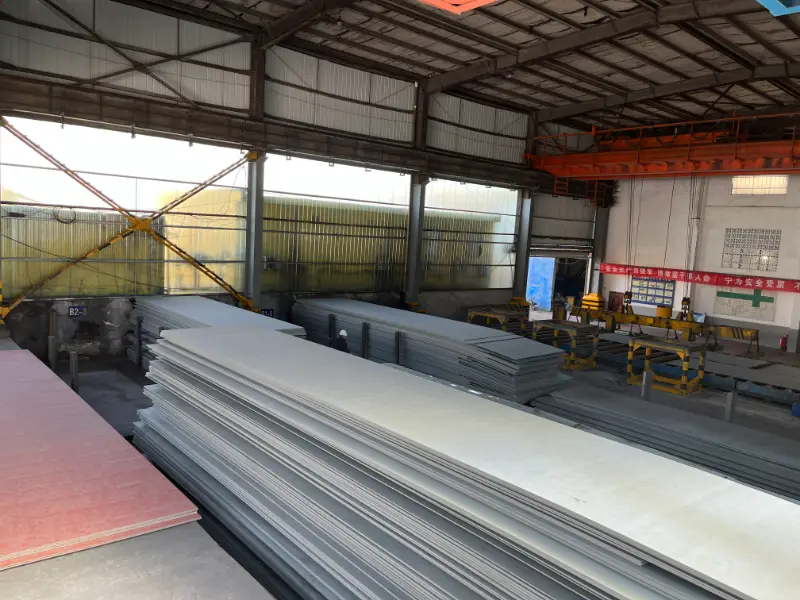
ASTM A514 Grade Q
ASTM A514 Grade Q High-Strength Quenched & Tempered Steel - Properties & Equivalents
Comprehensive technical data for ASTM A514 Grade Q steel: chemical composition, mechanical properties, thermal and electrical physical properties, international equivalents, and practical application guidance for heavy equipment and structural engineering.
Welding, thermal cutting, cold forming, hot forming (after reheat treatment), machining
- Phone : +8618037372205
- Email : [email protected]
- WhatsApp: Contact via Whtsapp
- WeChat: +8618037372205
ASTM A514 Grade Q Introduction
ASTM A514/A514M Grade Q is a high-yield, quenched and tempered alloy steel plate intended for structural applications where high strength and good weldability are essential. It provides a minimum yield strength of 690 MPa (100 ksi) in thicknesses up to 63.5 mm (2.5 in.), combined with excellent notch toughness and formability. The steel is characterized by its Ni-Cr-Mo-V alloy system, which contributes to deep hardenability and uniform mechanical properties. Typical applications include heavy-duty machinery, crane booms, bridges, pressure vessels, and offshore structures. The material is supplied in the quenched and tempered condition, ensuring optimum strength and toughness for demanding welded fabrications.
ASTM A514 Grade Q Chemical Composition
The chemical requirements for ASTM A514 Grade Q as specified in ASTM A514/A514M. The steel is alloyed with nickel, chromium, molybdenum, and vanadium to achieve deep hardenability and high strength after quenching and tempering. Elements shown are from the standard ladle analysis; product analysis tolerances apply.
| Element | Standard Value (wt.%) | Remarks |
|---|---|---|
| Carbon (C) | 0.14 - 0.21 | |
| Manganese (Mn) | 0.95 - 1.30 | |
| Phosphorus (P) | 0.035 max | |
| Sulfur (S) | 0.040 max | |
| Silicon (Si) | 0.15 - 0.35 | |
| Nickel (Ni) | 1.20 - 1.50 | |
| Chromium (Cr) | 1.00 - 1.50 | |
| Molybdenum (Mo) | 0.40 - 0.60 | |
| Vanadium (V) | 0.03 - 0.08 |
ASTM A514 Grade Q Thermal and Electrical Physical Properties
Physical properties for ASTM A514 Grade Q based on typical quenched and tempered low-alloy Cr-Ni-Mo-V steels. These values are not mandated by the product standard but serve as engineering reference data. Properties are influenced by tempering temperature and exact chemical composition.
| Property | Typical Value | Unit | Test Condition / Temperature |
|---|---|---|---|
| Density (ρ) | 7.85 | g/cm³ | 20 °C |
| Elastic Modulus (E) | 205 | GPa | 20 °C |
| Shear Modulus (G) | 80 | GPa | 20 °C |
| Poisson's Ratio (ν) | 0.29 | 20 °C | |
| Thermal Expansion (α) | 11.7 | 10⁻⁶/K | 20 – 100 °C |
| Thermal Expansion (α) | 12.2 | 10⁻⁶/K | 20 – 200 °C |
| Thermal Expansion (α) | 12.8 | 10⁻⁶/K | 20 – 300 °C |
| Thermal Conductivity (λ) | 35 | W/(m·K) | 100 °C |
| Thermal Conductivity (λ) | 34 | W/(m·K) | 200 °C |
| Specific Heat Capacity (c) | 460 | J/(kg·K) | 20 °C |
| Electrical Resistivity (ρ_e) | 0.25 | ×10⁻⁶ Ω·m | 20 °C |
ASTM A514 Grade Q Mechanical Properties
Mechanical properties for ASTM A514 Grade Q plate in the quenched and tempered condition, tested at room temperature in accordance with ASTM A370. Minimum yield strength and elongation depend on plate thickness; bend test requirements are also thickness-dependent. Impact toughness is not mandatory but may be specified by supplementary requirement.
| Property | Standard Requirement | Unit | Test Condition / Thickness Range |
|---|---|---|---|
| Yield Strength (ReH, 0.2% offset) | 690 min | MPa | t ≤ 63.5 mm (2.5 in.) |
| Tensile Strength (Rm) | 760 - 895 | MPa | t ≤ 63.5 mm (2.5 in.) |
| Elongation (A, 50 mm gauge) | 18 min | % | t ≤ 19 mm (0.75 in.) |
| Elongation (A, 50 mm gauge) | 16 min | % | 19 mm < t ≤ 63.5 mm (0.75 in. < t ≤ 2.5 in.) |
| Bend Test (bend angle 180°) | D = 2t | – | t ≤ 19 mm (0.75 in.), transverse specimen |
| Bend Test (bend angle 180°) | D = 3t | – | 19 mm < t ≤ 63.5 mm (2.5 in.), transverse specimen |
ASTM A514 Grade Q Directly Equivalent Standards and Substitutable Grades
| Country / Region | Standard | Grade | Remarks |
|---|---|---|---|
| USA | ASTM A514/A514M | Grade Q | Original specification |
| USA | ASME SA514/SA514M | Grade Q | Identical requirements for pressure vessel and structural applications |
| USA (UNS) | UNS K11630 | Unified Numbering System designation for Grade Q |
ASTM A514 Grade Q Application Introduction
ASTM A514 Grade Q is designed for welded structures requiring high yield strength, good ductility, and reliable toughness. It is typically used in heavy machinery and structural applications where weight savings and high load-bearing capacity are critical. The steel can be welded with low-hydrogen processes and requires careful preheat and interpass temperature control to avoid cracking.
Product Applications: Mobile crane booms and outriggers, Excavator arms and buckets, Dump truck bodies and frames, Bridge girders and box sections, Jack-up rig legs and platform components, High-pressure pipe and fittings
Processed into products: Structural plates and web stiffeners, Welded box sections and tubular joints, Lifting lugs and pin plates, Wear-resistant liners (with overlay), Chassis and frame rails, Flanges and brackets for heavy-duty connections
Application industries: Mining and earthmoving equipment, Construction and infrastructure (bridges, buildings), Heavy transport vehicles and trailers, Offshore and marine structures, Pressure vessels and storage tanks, Crane and lifting equipment
ASTM A514 Grade Q Similar / Near-Equivalent Alternative Materials
| Country / Region | Standard | Grade | Remarks |
|---|---|---|---|
| Europe | EN 10025-6 | S690Q, S690QL | Close in strength; Ni and Mo contents differ; additional impact requirements available; not identical composition. |
| Japan | JIS G 3128 | SHY685 | High-strength quenched and tempered steel; similar yield strength; Ni-Cr-Mo based, but exact chemistry differs. |
| China | GB/T 16270 | Q690E | High-strength structural steel Q&T; comparable strength; requires composition comparison for substitution. |
| USA | ASTM A514/A514M | Grade B, H, P | Other grades within the same standard with slightly different chemistries but similar mechanical properties; may substitute after evaluation. |
Notes:
Welding Considerations: Use low-hydrogen electrodes or processes (SAW, GMAW, FCAW). Preheating (typically 100–150°C) and strict interpass temperature control are necessary to prevent cold cracking. Post-weld heat treatment is generally not required but may be performed for stress relief if the tempering temperature is not exceeded. Forming: Cold forming is possible for moderate deformation; hot forming requires re-quenching and tempering to restore properties. Availability: Supplied as plate and cut-to-length coil in compliance with ASTM A514/A514M. Special testing (ultrasonic, Charpy impact) can be added via supplementary requirements.
- Share



