
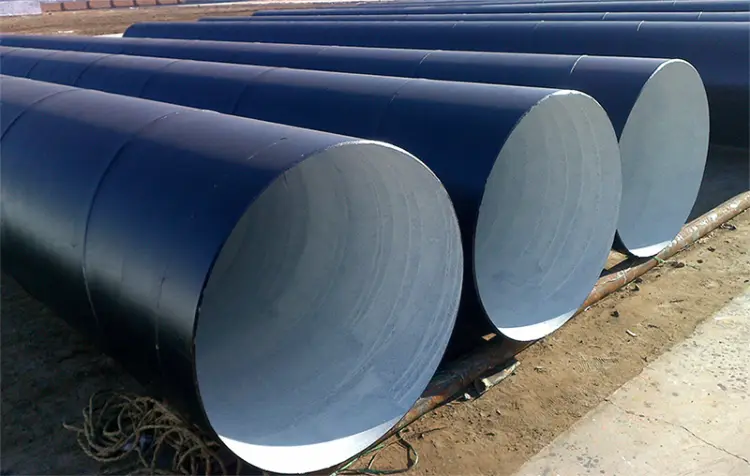
DIN 17175 14MoV6-3 Boiler Steel Pipe
DIN 17175 14MoV6-3 Boiler Steel Pipe - Properties, Composition & Equivalents
Complete material data for 14MoV6-3 steel according to DIN 17175: chemical composition, mechanical properties, thermal and electrical properties, international equivalents, and application guide for boiler pipes and pressure parts.
Hot finished or cold finished, weldable with preheating and PWHT, suitable for bending and forming
- Phone : +8618037372205
- Email : [email protected]
- WhatsApp: Contact via Whtsapp
- WeChat: +8618037372205
DIN 17175 14MoV6-3 Boiler Steel Pipe Introduction
14MoV6-3 is a low-alloy Cr-Mo-V ferritic steel designed for seamless tubes and pipes used in power generation and boiler applications under elevated temperatures. This grade is standardized in DIN 17175 (Seamless tubes of heat-resistant steels). It offers a good combination of high-temperature strength, creep resistance, and oxidation resistance up to approximately 550°C. The addition of molybdenum and vanadium provides solid solution strengthening and precipitation hardening, ensuring reliable performance in superheater and reheater sections. Typical delivery condition is normalized and tempered. The material is weldable using appropriate preheating and post-weld heat treatment procedures.
DIN 17175 14MoV6-3 Boiler Steel Pipe Chemical Composition
The chemical composition conforms to DIN 17175 for grade 14MoV6-3. Small amounts of molybdenum and vanadium improve high-temperature strength. All values are ladle analysis.
| Element | Standard Value (wt%) | Remarks |
|---|---|---|
| Carbon, C | 0.10 – 0.18 | Ladle analysis |
| Silicon, Si | 0.10 – 0.35 | |
| Manganese, Mn | 0.40 – 0.70 | |
| Phosphorus, P | ≤ 0.030 | |
| Sulfur, S | ≤ 0.030 | |
| Chromium, Cr | 0.30 – 0.60 | |
| Molybdenum, Mo | 0.50 – 0.65 | |
| Vanadium, V | 0.22 – 0.28 |
DIN 17175 14MoV6-3 Boiler Steel Pipe Thermal and Electrical Physical Properties
Physical properties are typical for 14MoV6-3 steel at room temperature unless indicated otherwise. These values are for general guidance and may vary with processing.
| Property | Typical Value | Unit | Test Condition / Temperature |
|---|---|---|---|
| Density, ρ | 7.85 | g/cm3 | 20°C |
| Elastic Modulus, E | 215 | GPa | 20°C |
| Shear Modulus, G | 84 | GPa | 20°C |
| Poisson's Ratio, ν | 0.29 | – | 20°C |
| Thermal Expansion Coefficient, α | 11.1 | 10^-6·K^-1 | 20 – 200°C |
| Thermal Expansion Coefficient, α | 12.1 | 10^-6·K^-1 | 20 – 400°C |
| Thermal Expansion Coefficient, α | 12.9 | 10^-6·K^-1 | 20 – 600°C |
| Thermal Conductivity, λ | 45 | W/(m·K) | 20°C |
| Specific Heat Capacity, c | 460 | J/(kg·K) | 20°C |
| Electrical Resistivity, ρe | 0.25 | μΩ·m | 20°C |
DIN 17175 14MoV6-3 Boiler Steel Pipe Mechanical Properties
Mechanical properties as per DIN 17175 for 14MoV6-3 in the normalized and tempered condition. Values are valid for wall thickness ≤ 16 mm at room temperature, unless otherwise stated. Longitudinal test pieces.
| Property | Standard Requirement | Unit | Test Condition |
|---|---|---|---|
| Yield Strength, ReH | ≥ 265 | MPa | Room temperature, t ≤ 16 mm |
| Tensile Strength, Rm | 460 – 610 | MPa | Room temperature, t ≤ 16 mm |
| Elongation, A (longitudinal) | ≥ 20 | % | Gauge length 5.65√So |
| Impact Energy, KV (V-notch, longitudinal) | ≥ 34 | J | at 20°C, 10x10 mm specimen |
| Yield Strength at 450°C | ≥ 176 | MPa | Elevated temperature (typical minimum) |
| Yield Strength at 500°C | ≥ 147 | MPa | Elevated temperature (typical minimum) |
DIN 17175 14MoV6-3 Boiler Steel Pipe Fully Equivalent Material Standards and Replaceable Grades
| Country/Region | Standard | Grade | Remarks |
|---|---|---|---|
| Europe | EN 10216-2 | 13CrMoV6-9 (1.7703) | Direct successor to DIN 17175 14MoV6-3, seamless tubes for pressure purposes |
| Germany | DIN 17175 (withdrawn) | 14MoV6-3 | Original standard, now replaced by EN 10216-2 |
DIN 17175 14MoV6-3 Boiler Steel Pipe Application Introduction
14MoV6-3 is intended for use in elevated-temperature service up to about 550°C, particularly in power generation and industrial boiler systems. Its balanced combination of chromium, molybdenum, and vanadium provides excellent scaling resistance and adequate long-term creep strength. This material is routinely selected for superheater and reheater sections. Proper heat treatment (normalizing and tempering) must be observed to achieve the required microstructure and mechanical properties. The steel is weldable, but preheating (200–300°C) and post-weld heat treatment (650–700°C) are recommended to avoid cold cracking and restore toughness.
Product Applications: Waterwall panels and headers, Superheater and reheater tube bundles, Main steam and hot reheat piping, Boiler drums and pressure vessels (as tubular components), Desuperheater and attemperator tubes
Processed into products: Seamless boiler tubes and pipes, Formed tube bends and elbows, Welded tube-to-tube sheet joints, Tube supports and hangers, Steam traps and valve bodies (as wrought material)
Application industries: Power generation (thermal and nuclear power plants), Petrochemical and refining, Industrial boiler manufacturing, Heat exchanger fabrication, Steam and gas turbine auxiliary piping
DIN 17175 14MoV6-3 Boiler Steel Pipe Similar or Alternative Material Recommendations
| Country/Region | Standard | Grade | Remarks |
|---|---|---|---|
| USA | ASTM A335 / A335M | Grade P22 | 2¼Cr-1Mo steel, higher Cr but comparable Mo; higher creep strength, suitable for higher temperatures |
| USA | ASTM A213 / A213M | Grade T22 | Seamless alloy-steel boiler and heat exchanger tubes |
| Europe | EN 10216-2 | 10CrMo9-10 (1.7380) | 2¼Cr-1Mo grade, higher temperature capability, sometimes used as alternative |
| Europe | EN 10216-2 | 13CrMo4-5 (1.7335) | 1Cr-½Mo grade, lower strength and temperature limits, used for less demanding service |
Notes:
DIN 17175 has been officially withdrawn and replaced by EN 10216-2. However, the material designation 14MoV6-3 is still used for maintenance of older power plants. For new construction, 13CrMoV6-9 (1.7703) should be specified. When replacing or modifying existing units, the chemical composition and mechanical property ranges should be compared to ensure compatibility. Data provided here are for general reference; actual values must be verified against the relevant edition of the standard and heat treatment applied. The elevated temperature properties are indicative and depend strongly on operating duration and stress levels.
- Share



