
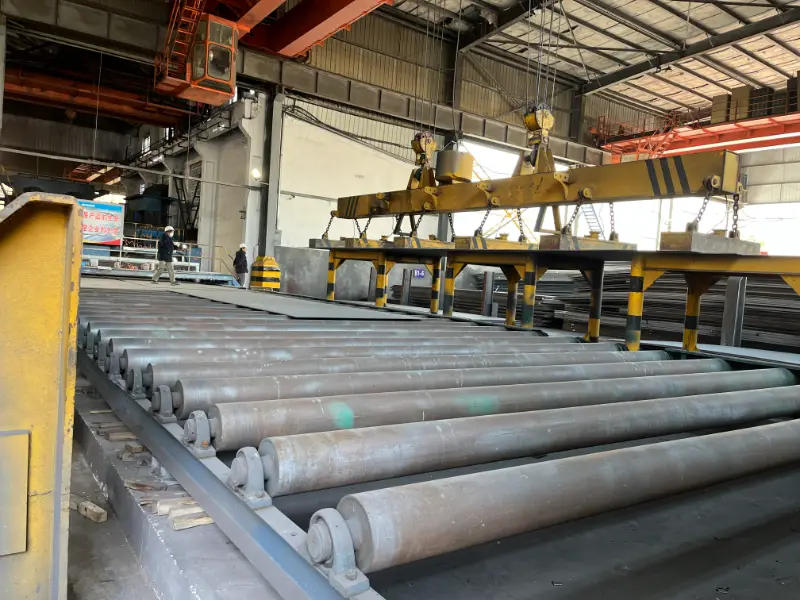
ASTM A514 Grade R High-Strength Quenched & Tempered Alloy Steel
ASTM A514 Grade R High-Strength Quenched & Tempered Alloy Steel for Heavy-Duty Structures
Detailed properties of ASTM A514/A514M Grade R, a boron-treated Cu-Ni-Cr-Mo-V alloy steel with minimum yield strength of 100 ksi (690 MPa), excellent weldability, and notch toughness for demanding structural applications.
Suitable for cutting, cold forming (limited), welding (preheat/postheat as necessary), machining, and drilling.
- Phone : +8618037372205
- Email : [email protected]
- WhatsApp: Contact via Whtsapp
- WeChat: +8618037372205
ASTM A514 Grade R High-Strength Quenched & Tempered Alloy Steel Introduction
ASTM A514/A514M Grade R is a quenched and tempered high-yield-strength alloy steel plate intended for welded structures. It offers a minimum yield strength of 100 ksi (690 MPa) in thicknesses up to 2.5 in. (63.5 mm) and 90 ksi (620 MPa) for greater thicknesses. The grade is characterized by a precisely controlled chemical composition including boron for hardenability, copper for atmospheric corrosion resistance, and microalloying elements (V, Ni, Cr, Mo) to achieve superior strength and toughness. It is supplied in the heat-treated condition and typically finds use in heavy construction, pressure vessels, lifting equipment, and offshore platforms where weight savings and high load-bearing capacity are critical.
ASTM A514 Grade R High-Strength Quenched & Tempered Alloy Steel Chemical Composition per ASTM A514/A514M Grade R
The chemistry of Grade R is carefully balanced to achieve high strength and good weldability. Elements like boron (0.0005-0.005%) significantly improve hardenability, copper (0.20-0.40%) enhances atmospheric corrosion resistance, and combinations of Cr-Ni-Mo-V provide deep hardening and tempered martensitic structure.
| Element | Standard Value (wt%) | Remarks |
|---|---|---|
| Carbon (C) | 0.15 - 0.20 | Controls hardness and hardenability |
| Manganese (Mn) | 0.85 - 1.15 | Deoxidizer, strength enhancer |
| Phosphorus (P) | 0.025 max | Residual element, controlled for toughness |
| Sulfur (S) | 0.025 max | Residual element, kept low for ductility |
| Silicon (Si) | 0.20 - 0.35 | Deoxidizer, strengthens ferrite |
| Chromium (Cr) | 0.90 - 1.20 | Enhances hardenability and corrosion resistance |
| Nickel (Ni) | 0.90 - 1.10 | Improves toughness and low-temperature properties |
| Molybdenum (Mo) | 0.15 - 0.25 | Prevents temper embrittlement, adds high-temperature strength |
| Vanadium (V) | 0.03 - 0.08 | Grain refinement and precipitation strengthening |
| Boron (B) | 0.0005 - 0.005 | Powerful hardenability agent, critical control |
| Copper (Cu) | 0.20 - 0.40 | Provides atmospheric corrosion resistance |
ASTM A514 Grade R High-Strength Quenched & Tempered Alloy Steel Thermal and Electrical Physical Properties
These values are indicative for fully hardened and tempered low-alloy steels similar to A514 Grade R. They are not mandatory in the material specification and may slightly vary with exact heat treatment and composition.
| Property | Typical Value | Unit | Test Condition |
|---|---|---|---|
| Density (ρ) | 7.85 | g/cm³ | Room temperature |
| Modulus of elasticity (E) | 205 | GPa | Room temperature |
| Shear modulus (G) | 80 | GPa | Estimated from E and ν |
| Poisson's ratio (ν) | 0.30 | - | Room temperature |
| Coefficient of thermal expansion (α) | 11.7 × 10⁻⁶ | /K | 20–100°C |
| Thermal conductivity (λ) | 42 | W/(m·K) | At 100°C |
| Specific heat capacity | 475 | J/(kg·K) | At 20°C |
| Electrical resistivity (ρ_e) | 0.22 × 10⁻⁶ | Ω·m | Ambient temperature |
ASTM A514 Grade R High-Strength Quenched & Tempered Alloy Steel Mechanical Properties
The tensile properties depend on plate thickness. For thickness ≤ 2.5 in. (63.5 mm), the minimum yield strength is 100 ksi (690 MPa); for thickness > 2.5 in. to 6 in. (152.4 mm) it is reduced to 90 ksi (620 MPa). Elongation requirements vary with thickness and gauge length. Note: bend test diameters are defined in the standard.
| Property | Standard Value | Unit | Test Condition / Thickness Range |
|---|---|---|---|
| Yield Strength (0.2% offset) | 690 min | MPa | ≤ 63.5 mm (≤ 2.5 in.) |
| Yield Strength (0.2% offset) | 620 min | MPa | > 63.5–152.4 mm (> 2.5–6 in.) |
| Tensile Strength | 760–895 | MPa | ≤ 63.5 mm |
| Tensile Strength | 690–895 | MPa | > 63.5–152.4 mm |
| Elongation in 8 in. (200 mm) | 18 min | % | ≤ 19.0 mm (≤ 0.75 in.) thickness |
| Elongation in 2 in. (50 mm) | 18 min | % | > 19.0–63.5 mm (> 0.75–2.5 in.) |
| Elongation in 2 in. (50 mm) | 17 min | % | > 63.5–152.4 mm (> 2.5–6 in.) |
| Bend Test (180°) | Diameter = 3T for thickness ≤ 1 in.; 4T for > 1 in. | Per ASTM A514/A514M, no cracks on outside of bent portion |
ASTM A514 Grade R High-Strength Quenched & Tempered Alloy Steel Materials with Closely Matching Requirements
| Country/Region | Standard | Grade/Designation | Remarks |
|---|---|---|---|
| Europe | EN 10025-6 | S690QL (1.8928) | Similar minimum YS 690 MPa, but chemical composition differs (no Cu/B requirement); must verify project specifications. |
| Japan | JIS G 3128 | SHY685N | High yield strength 685 MPa grade for welded structures; Ni-Cr-Mo-V based but without Cu/B; possible substitution with engineering approval. |
| China | GB/T 16270 | Q690E | Quenched and tempered high strength structural steel; 690 MPa yield class, chemistry not identical; suitable alternative for many applications. |
ASTM A514 Grade R High-Strength Quenched & Tempered Alloy Steel Application Introduction
ASTM A514 Grade R is designed for heavy structural service where high strength-to-weight ratio, good notch toughness at low temperatures, and resistance to atmospheric corrosion are necessary. It is commonly used in welded assemblies operating under static or dynamic loads. Preheating and strict hydrogen control are essential during welding to avoid cold cracking.
Product Applications: Welded box sections and telescopic booms, Bridge girders and trusses, Offshore platform node joints, Excavator arms and bucket components, Heavy-duty truck frames, Blast-resistant structural elements
Processed into products: Crane boom chords and lattice members, Load-bearing pins and shafts (plate cutting/machining), Transition pieces for welded H-beams, Gusset plates and stiffeners, Bottom plates of dump trucks, Wear plates in chutes and hoppers (hardfacing applied), Flanges for large diameter wind tower shells
Application industries: Construction & Infrastructure (bridges, building columns), Crane & Heavy Lifting Equipment, Shipbuilding & Offshore Platforms, Mining & Earthmoving Machinery, Pressure Vessel & Storage Tank (special design), Wind Tower & Renewable Energy Structures
ASTM A514 Grade R High-Strength Quenched & Tempered Alloy Steel Similar High-Strength Quenched & Tempered Steels
| Country/Region | Standard | Grade/Designation | Remarks |
|---|---|---|---|
| USA | ASTM A514/A514M | Grade Q | Similar mechanicals (100 ksi min YS), but different chemistry (Mn-V based, no Cu, lower Ni); interchangeable in many structural uses. |
| USA | ASTM A514/A514M | Grade S | 100 ksi min YS, Si-Ni-Cr-Mo-V chemistry, lower Cu; often used for same applications. |
| Europe | EN 10025-6 | S690Q (1.8931) | Non-modified version of S690QL; 690 MPa min YS, alloy design differs. |
| Japan | JIS G 3140 | SPV490 | High strength steel for pressure vessels, lower yield (490 MPa), but often compared for similar fabrication practices. |
Notes:
- All mechanical property values are mandatory minimums except tensile strength which is a range.
- Charpy V-notch impact tests are optional and must be specified at purchase; typical requirement is 20 ft·lbf (27 J) at -20°F (-29°C) or lower for structural applications.
- Bend test diameters: 3T up to 1 in. thickness; 4T over 1 in. to 2.5 in.; for thickness >2.5 in. testing may be on specimens with round edges.
- When welding Grade R, low-hydrogen electrodes (AWS E11018 or similar) and controlled heat input are recommended; post-weld heat treatment (PWHT) is generally not required but may be performed at temperatures below the tempering temperature.
- Share



